Female Pattern Hair Loss: Why the Workup Comes Before Any Talk of Surgery
Widening part, intact hairline, and a dozen possible causes behind it. Why women need blood work and a diagnosis before anyone discusses grafts, and who is not a candidate.
Written and medically reviewed by Dr. Nyra, MBBS, MD (Dermatology)

Female pattern hair loss is a gradual thinning over the top of the scalp, most visible as a widening centre part, with the frontal hairline usually preserved. It is common, progressive and treatable. It also shares its appearance with several other causes of hair loss in women, which is why a proper diagnosis, including blood tests and a scalp examination, has to come before any discussion of treatment, let alone surgery.
Many women arrive at a clinic already told, by a salon, a website or a product quiz, that they have "hormonal hair fall" or that they need a transplant. Neither is a diagnosis. The same widening part can come from iron deficiency, a thyroid disorder, polycystic ovary syndrome, a long-running shed, or a scarring condition that surgery would make worse. The order of events matters: diagnose, correct what is correctable, treat the pattern medically, and only then consider whether grafting has any role. The NHS advice on hair loss makes the same point from the other direction, recommending a doctor's assessment before paying a private hair clinic.
What female pattern hair loss looks like
The typical presentation is diffuse thinning concentrated over the crown and mid-scalp. When the hair is parted down the centre, the part looks wider towards the front than further back. Hair at the sides and back is usually fuller. The ponytail feels thinner, and more scalp shows under overhead lighting or when the hair is wet.
Unlike the male pattern, women rarely develop a receding hairline or complete baldness in any one area. DermNet's overview of female pattern hair loss describes it as diffuse thinning due to increased shedding, reduced hair volume, or both, and notes that a receding hairline is unusual unless androgen levels are raised. The American Academy of Dermatology describes a widening part as a typical sign and emphasises that the condition is progressive.
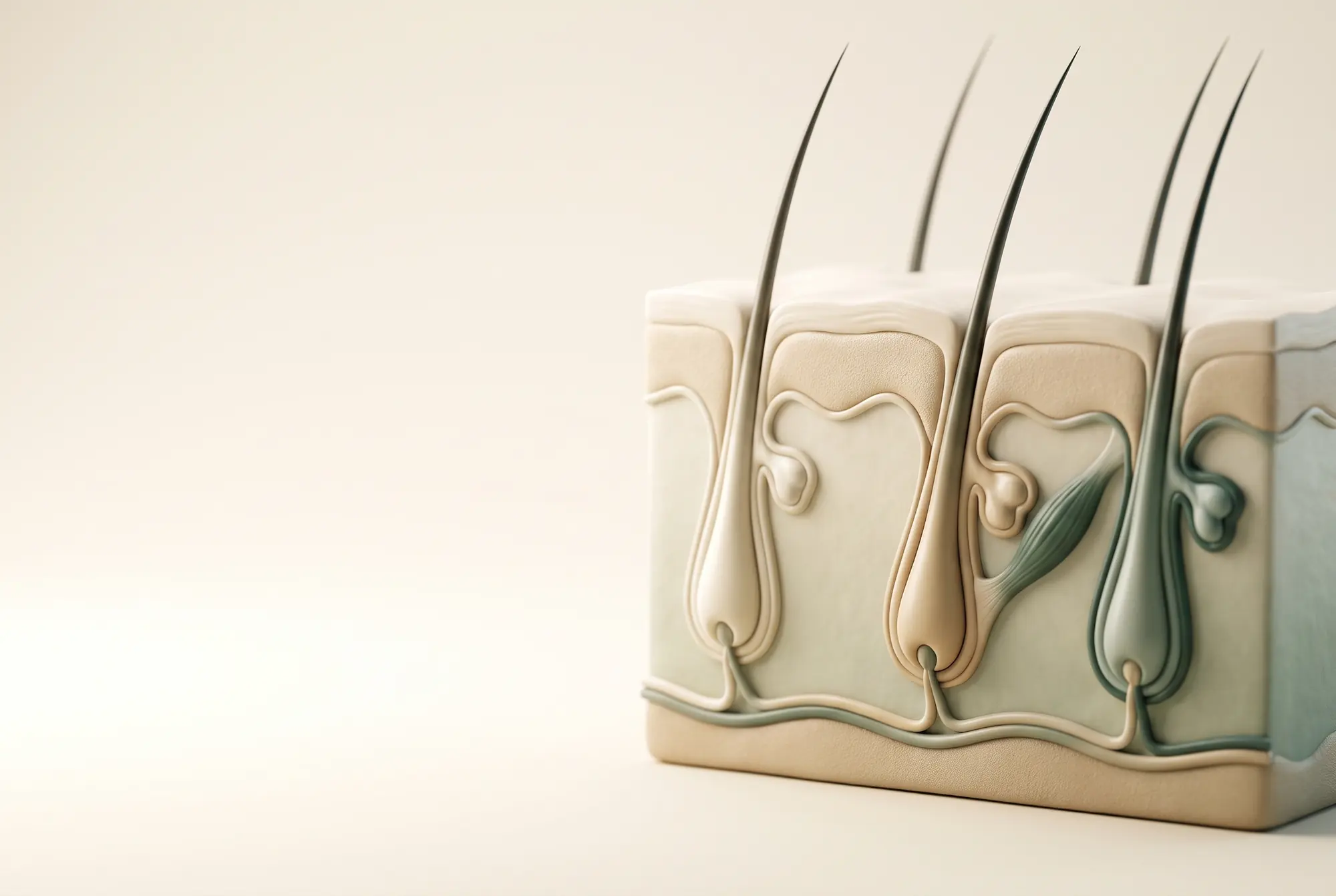
The underlying process is miniaturisation: follicles produce progressively finer, shorter hairs over successive growth cycles. Genetics plays a large part. The role of androgens is less straightforward than in men, because most women with this pattern have normal hormone levels when tested.
The conditions that look like it
This is the central reason the workup comes first. Several conditions produce thinning that looks similar at a glance and needs completely different management.
Telogen effluvium
A diffuse shed triggered by illness, childbirth, surgery, rapid weight loss, severe stress or a change of medication, usually appearing a few months after the event. It generally settles. A chronic form can persist for years and is easily mistaken for pattern loss. Telogen effluvium versus pattern hair loss explains how the two are separated.
Iron deficiency and thyroid disease
Both are common in women, both cause diffuse thinning, and both are correctable. Heavy periods, recent pregnancy and a diet low in iron all raise the likelihood of depleted iron stores. Thyroid disorders, whether underactive or overactive, affect hair alongside energy, weight, periods and tolerance of heat or cold. Where either is contributing, correcting it can make a real difference to the shedding.
Polycystic ovary syndrome and other androgen excess
Thinning that comes with acne, irregular periods or increased facial and body hair suggests excess androgens, and PCOS is the most common cause. DermNet lists these features as markers worth investigating. Here the hair is one part of a hormonal condition that deserves management in its own right, sometimes alongside a gynaecologist or endocrinologist. The acne and unwanted facial hair that often come with it can be treated at the same time, through skin treatment and laser hair removal.
Postpartum shedding
Heavy shedding a few months after delivery is common and usually temporary. It can, however, unmask pattern thinning that was already developing, and it frequently coexists with low iron.
Traction and styling damage
Tight buns, braids, extensions and heavy hairpieces pulling at the same points, repeated over years, cause traction alopecia, typically at the temples and along the hairline. Heat, bleaching and chemical straightening cause breakage that is easily mistaken for loss. Early traction alopecia can recover once the tension stops; long-standing traction can become permanent. Hard borewell water, a frequent complaint in Gurgaon, can leave hair rough and more prone to breakage, but it does not cause pattern thinning; what hard water and pollution actually do to hair separates the two.
Alopecia areata
Usually patchy, but a diffuse form exists that can resemble other kinds of thinning. It is an immune condition with its own treatment, covered under alopecia areata treatment.
Scarring alopecias
Conditions such as frontal fibrosing alopecia and lichen planopilaris destroy follicles permanently. They may present with a receding frontal hairline, thinning eyebrows, redness or scale around follicles, itching or tenderness. They are less common, but they are the most important not to miss, because hair lost to them does not return, and surgery into an active scarring process is generally avoided because grafts are unlikely to survive in inflamed tissue.
What a proper workup involves
A thorough assessment of hair loss in women is broader than it usually is for men, and it is not a formality.
- A detailed history. When the thinning began and whether it was sudden or gradual; the menstrual pattern; pregnancies, delivery dates and breastfeeding; contraception or hormone therapy; diet and weight changes; illnesses and operations; every medicine and supplement; styling habits; and family history.
- Examination. The part width, the hairline, the eyebrows, the sides and back, signs of androgen excess such as acne or facial hair, and any redness, scale or scarring on the scalp.
- Trichoscopy. Magnification shows variation in hair diameter, density in different zones, and signs of inflammation or scarring. It also provides a baseline for measuring change later.
- Blood tests where indicated. Commonly a full blood count, ferritin and thyroid function, often with vitamin D and B12, and hormone tests where the history suggests androgen excess. DermNet notes that sex hormone levels and thyroid function form part of the diagnostic workup. Which blood tests matter for hair fall explains what each result can and cannot show.
- Occasionally, a biopsy. If a scarring alopecia is suspected, or the diagnosis remains unclear, a small scalp biopsy settles it.
At the end of that process, the diagnosis might be female pattern hair loss alone, pattern loss with a contributing factor such as low iron, or something else entirely. Each leads somewhere different.
Medical treatment options
Female pattern hair loss is managed rather than cured. The aim is to slow progression, stabilise the hair and, in some women, improve density. Treatment is ongoing: the AAD notes that when treatment stops, the hair gained is gradually lost again within months.
- Topical minoxidil is the most established first-line treatment. It takes months to show an effect, can cause a temporary increase in shedding early on, and in some women causes scalp irritation or unwanted facial hair.
- Oral treatments prescribed off-label are used by dermatologists in selected cases. These include low-dose oral minoxidil and anti-androgen medicines such as spironolactone, particularly where there are features of androgen excess. They need a medical assessment, monitoring and a clear conversation about pregnancy, because anti-androgens must not be taken by a woman who is or may become pregnant.
- Finasteride is not indicated for female pattern hair loss, although it is occasionally used off-label after menopause. It must not be used by women who are or may become pregnant. Minoxidil and finasteride in India covers the prescription rules and side effects in full.
- Correcting contributing factors such as iron deficiency or thyroid disease, which on its own can improve shedding considerably.
- Adjuncts such as PRP, whose evidence is modest and which works as maintenance rather than a cure. Whether PRP works for hair loss sets out what the published reviews support.
The AAD also notes that treatments generally take six to twelve months to show whether they are working. Judging a treatment at six weeks, or switching products every month, makes it impossible to know what helped.
Your own case
Pattern thinning, a treatable cause, or both?
A consultation brings together your history, trichoscopy and targeted blood tests, which is how female pattern hair loss is confirmed or ruled out before any treatment, or any conversation about surgery, begins.
Where a hair transplant fits, and who is not a candidate
A transplant moves follicles from the back of the scalp to thinner areas. In men with pattern loss, the back of the scalp is usually resistant to thinning, which is what makes it a useful donor area. In many women, the thinning is diffuse and extends into that region too, so the hair taken may itself be miniaturising, and the donor supply may be both limited and unreliable.
That is why many women with female pattern hair loss are not good transplant candidates, and why an honest assessment says so. Surgery tends to be considered only when:
- The diagnosis is confirmed and a scarring alopecia has been ruled out.
- The loss has been stabilised on medical treatment over a sustained period.
- The donor area has adequate density on trichoscopy and is not itself thinning.
- The area to be treated is defined, such as the front of the part line, rather than the whole scalp.
- Expectations about density are realistic, and medical treatment will continue afterwards.
Women who are generally not candidates include those with active shedding, diffuse thinning throughout the scalp including the donor zone, an active or undiagnosed scarring alopecia, uncorrected medical causes such as iron deficiency or thyroid disease, or hair loss that has never been assessed. There are situations where surgery is more often suitable for women, such as traction alopecia that has become permanent, a naturally high hairline, or a stable scar, and hair transplant for women describes those. The wider list of reasons to decline is in who should not have a hair transplant.
A transplant also does not stop female pattern hair loss progressing in the hair around the grafts. Whether a hair transplant is permanent explains why the native hair stays on its own trajectory.
What to bring to the assessment
Much of the diagnosis rests on history, and history is easier to give accurately with a little preparation. It is worth bringing:
- A timeline. When you first noticed thinning or shedding, and anything that happened in the months before it: an illness, an operation, a delivery, a new medicine, a change in diet or weight, a stressful period.
- Your menstrual and hormonal history, including how regular your periods are, any contraception or hormone therapy, and changes around pregnancy or menopause.
- Every medicine and supplement, with doses. Mention biotin specifically, because it can distort some blood tests, including thyroid tests.
- Any recent blood reports, even if they were done for another reason.
- Older photographs showing your hair a few years ago, which help establish how quickly things have changed.
- Your styling routine, including tight styles, extensions, heat, colouring, and keratin or chemical straightening treatments.
- Family history of thinning on both sides of the family.
- Pregnancy plans over the next year or two, because they shape which treatments are appropriate at all.
None of this needs to be exact. A rough timeline is far more useful than none, and it often points towards the diagnosis before the examination has even begun.
What realistic progress looks like
Honest expectations protect against both disappointment and wasted money.
- Stabilisation is a result. For many women, the main achievement of treatment is that thinning stops getting worse. That is easy to overlook without photographs.
- Improvement is gradual. Any increase in density builds over many months and shows most clearly in standardised photographs, not in the daily mirror.
- Contributing causes change the outlook. Where iron deficiency or a thyroid disorder was driving part of the shedding, correcting it can change the picture considerably.
- Treatment is long term. Stopping generally means the benefit fades, so choosing a treatment you can realistically keep up matters more than choosing the most intensive one.
If you are noticing a widening part, the most useful next step is not a product or a procedure. It is a diagnosis. Women's hair loss treatment at our Gurgaon clinic starts with the workup described above, as part of a medical, cause-first approach to hair fall, and a consultation with a dermatologist is where the examination and the plan happen. Consultations are available at both our clinics, in Sector 39, Gurugram and in Rohini, Delhi.
Female pattern hair loss FAQs
At what age does female pattern hair loss start?
It can begin at any age after puberty, although it becomes more common with age, particularly around and after menopause. Thinning that starts young, or that comes with irregular periods, acne or increased facial hair, is a reason to look carefully for a hormonal contributor rather than assume it is simply genetic.
Is my hair loss caused by PCOS?
It may be part of it. Polycystic ovary syndrome can drive thinning in a pattern, usually alongside irregular periods, acne or increased facial and body hair. Many women with female pattern hair loss, though, have normal hormone levels on testing. The history, the examination and targeted blood tests answer the question, and PCOS is then managed as a condition in its own right. See women's hair loss treatment.
Can I use hair loss treatment while pregnant, breastfeeding or trying to conceive?
Several treatments are unsuitable. Anti-androgen medicines and finasteride must not be used by a woman who is or may become pregnant, and minoxidil should generally be avoided during pregnancy and breastfeeding. Tell the doctor about any pregnancy plans before treatment starts, because that shapes which options are appropriate at all.
Will female pattern hair loss make me go bald?
Complete baldness in a region is uncommon in women. The usual course is gradual, progressive thinning over the top of the scalp, with the frontal hairline preserved. Without treatment it tends to continue slowly, which is why stabilising it early is worthwhile.
Can a hair transplant fix female pattern hair loss?
Sometimes, for a small group of women: those with a confirmed diagnosis, stable loss on medical treatment, a dense donor area that is not itself thinning, and a defined area to treat. Many women with diffuse thinning are not good candidates, and saying so is part of an honest assessment. Hair transplant for women describes who tends to suit it.
Does postpartum hair loss turn into female pattern hair loss?
Postpartum shedding does not cause female pattern hair loss, and it usually settles over the months after delivery. It can, however, reveal pattern thinning that was already developing, and it often coexists with low iron. If shedding continues well beyond six to nine months, or the part stays wider than before, it is worth having the scalp examined.
Medical disclaimer. Information on this website is general patient education. It is not medical advice and does not create a doctor-patient relationship. Suitability, graft numbers and treatment plans are decided only after an in-person examination by a registered medical practitioner. Outcomes differ from person to person, and no particular outcome, density or timeline can be promised.
Related treatment
Considering hair fall treatment?
This article is patient education. What applies to your own case is decided after an examination — the treatment page sets out how that works, what it costs and what to expect.