Hard Water, Pollution and Monsoon Shedding: What Really Drives Hair Fall in Gurgaon
Borewell water damages hair shafts; it does not cause pattern baldness. What hard water, pollution and monsoon shedding really do, and when to stop blaming the tap.
Written and medically reviewed by Dr. Nyra, MBBS, MD (Dermatology)
Hard water does not cause baldness. The calcium and magnesium in Gurgaon's borewell water can leave hair drier, rougher and more likely to snap, which makes it look thinner at the ends and feel worse to handle. That damage happens along the hair shaft, outside the skin. It does not reach the follicle, and it does not produce the widening parting or receding hairline of pattern hair loss.
Pollution and monsoon humidity sit in a similar place: genuine irritants for the scalp and hair, with far weaker evidence as causes of hair loss than their reputation suggests. If your hair is genuinely thinning rather than breaking, the tap is rarely the explanation, and blaming it can delay finding the real cause.
What is actually in Gurgaon's water
There is no single answer, because there is no single supply. Depending on the sector and the building, water may come from the municipal supply, a borewell, a tanker, or a mixture that changes through the year, and many households then run it through a purifier. Two flats in the same society can wash with noticeably different water.
For groundwater, the most authoritative recent picture is the Central Ground Water Board's Annual Ground Water Quality Report 2024, based on samples taken before the 2023 monsoon. It lists Gurugram among the Haryana districts where groundwater at one or more monitoring locations exceeded the limits for salinity, fluoride and nitrate, and it names Gurugram among the districts nationally most affected by high electrical conductivity, which is a measure of dissolved salts.
What the report does not give is a hardness figure for the district, and we are not going to invent one. Hardness refers specifically to calcium and magnesium; total dissolved solids, the number a handheld TDS meter shows, covers every dissolved salt. The two often rise together in borewell water, but they are different measurements, so a high TDS reading tells you the water is mineral-heavy without telling you how hard it is. An inexpensive hardness test kit answers that for your own tap.
For hair, fluoride and nitrate are not the concern. They matter for drinking water, which is a question for purification rather than for your shampoo.
What hard water does to the hair shaft
Hard water leaves minerals behind. Calcium and magnesium react with soap to form an insoluble scum, reduce how well shampoo lathers, and leave a film on the hair surface. The result is hair that feels coated, looks dull, tangles easily and takes more force to comb, and friction repeated day after day is what breaks hair.
How much hard water weakens the hair itself is less settled than the internet suggests, and the published work is small. Two laboratory studies soaked cut hair in hard water and measured the force needed to break it:
- An Indian study published in 2013 used water with a hardness of about 212 ppm over thirty days and found no statistically significant difference in tensile strength or elasticity compared with distilled water, while noting that harder water or longer exposure might give a different result.
- A 2018 study used considerably harder water, around 487 mg/L, over three months, on hair from seventy young men, and did find a significant reduction in strength, which its authors linked to increased breakage.
Read together, they suggest that very hard water may weaken the shaft and moderately hard water may do little measurable harm. Neither study looked at shedding from a living scalp, because neither could: hair cut from a head has no follicle attached. That limitation is exactly where the next distinction starts.
Breakage is not hair loss, and you can usually tell them apart
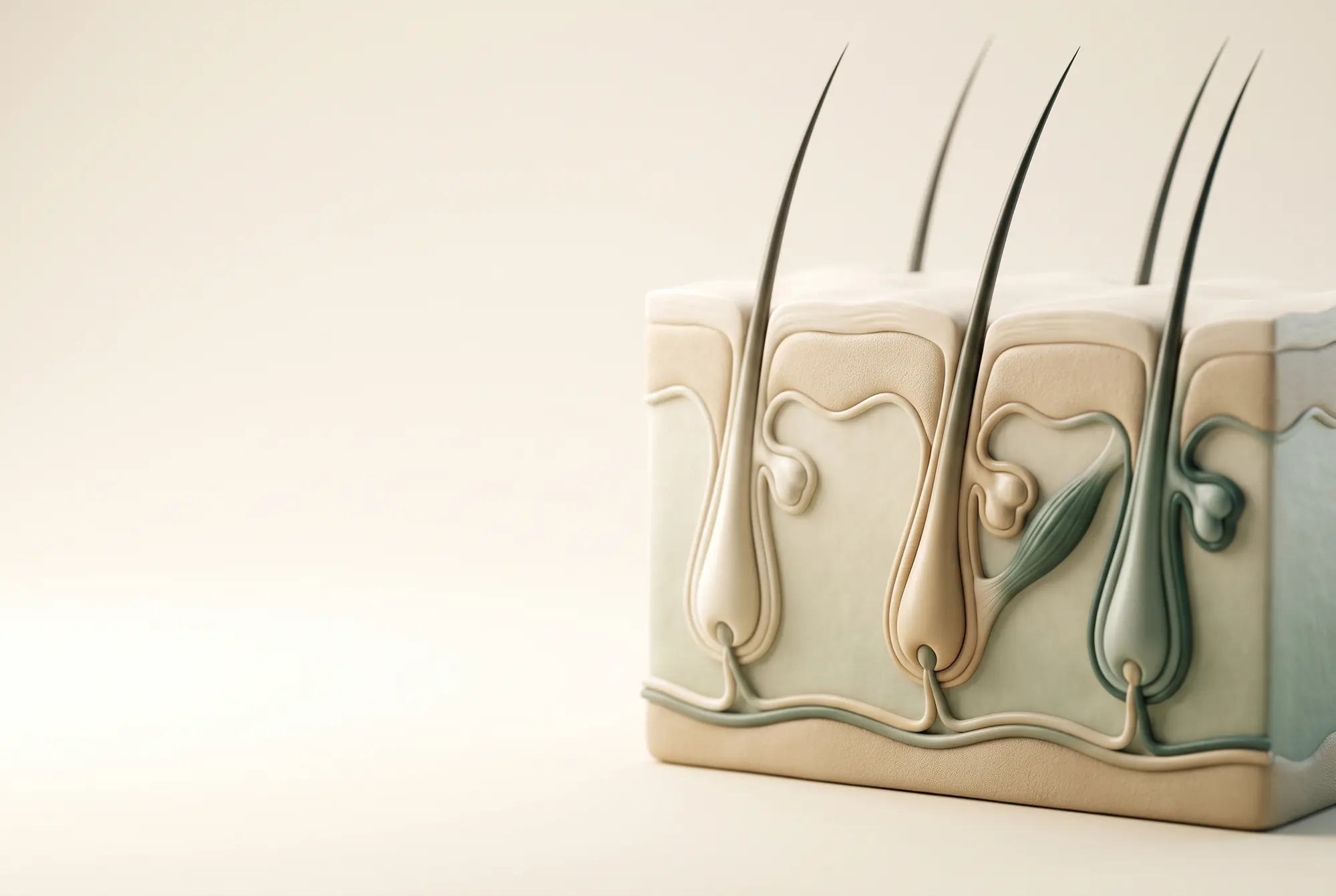
Breakage and hair loss happen in different places. Breakage is the shaft snapping somewhere along its length, which shortens and thins the ends while the follicle carries on producing hair as before. Hair loss happens at the follicle: either more hairs than usual enter the shedding phase at once, or follicles shrink over years and produce finer, shorter hairs until they stop.
You can check which you are collecting. Gather the hairs from your comb or the shower drain and look at the ends:
- A full-length hair with a tiny pale bulb at one end has been shed from the follicle. Some of this is normal every day; somewhere around 50 to 100 hairs is generally considered ordinary.
- Short pieces of varying length with no bulb have broken. That is the pattern hard water, heat styling, tight hairstyles and rough towelling produce.
Water chemistry does not make follicles miniaturise. Pattern hair loss is driven largely by genetics and, in men, by the follicle's sensitivity to androgens, and it shows as a receding hairline, a thinning crown or a widening parting rather than as frayed ends. Heavy, diffuse shedding of full-length hairs usually has a trigger inside the body rather than in the bathroom, and telogen effluvium compared with pattern hair loss explains how the two are told apart. In women, where diffuse thinning is especially easy to blame on water, the workup for female pattern hair loss is worth reading before changing shampoos again.
Pollution and the scalp: what is known, and what is not
The honest summary is that the evidence linking air pollution to hair loss in people is limited. Most of what gets quoted comes from laboratory work, in which particulate matter is applied to human hair follicles or follicle cells grown in culture. Those studies have reported more cell death and higher markers of inflammation and oxidative stress in the exposed tissue.
That is a plausible mechanism, not a demonstrated effect. A follicle in a dish receives a measured dose directly; a follicle in your scalp sits beneath skin, hair and sebum, and nobody has established how much airborne particulate actually reaches it in daily life, or whether that amount changes how much hair a person keeps. Anyone presenting NCR air quality as a proven cause of baldness is ahead of the evidence.
What pollution does do, without much argument, is make a scalp dirtier and more irritable. Dust, sweat and oil build up through a Gurgaon summer, and a scalp prone to seborrhoeic dermatitis can flare. An itchy, flaking, inflamed scalp may shed more while the inflammation lasts, and scratching adds breakage. That is treatable, and it is a scalp problem rather than a pollution problem; dandruff and seborrhoeic dermatitis treatment covers how it is distinguished from dry scalp, psoriasis and fungal infection. Regular washing helps rather than harms. The hairs that come out in the shower had already been shed.
Monsoon and seasonal shedding
Seasonal shedding is real, but it is modest and temporary. Follicles cycle through growth, rest and shedding, and the proportion resting at any one time shifts through the year. A Swiss study of more than 800 women, published in the journal Dermatology in 2009, found that the proportion of resting, telogen hairs peaked in summer, with a smaller rise in spring and the lowest levels in late winter.
Nobody has mapped that pattern onto an Indian monsoon, so it would be wrong to present a monsoon shed as an established phenomenon. What can be said is that the rainy months bring several things that affect hair in ordinary ways:
- Humidity. Hair absorbs moisture, swells and frizzes, and frizzy hair tangles and breaks more readily when combed.
- A damp, covered scalp. Helmets, sweat and hair that stays wet for hours suit the yeast involved in dandruff and can aggravate folliculitis.
- Fevers. Many fevers circulate during and after the rains. A significant illness with a high temperature can push a large share of follicles into the resting phase together, and the shedding typically begins two to four months later, placing hair fall from a September fever somewhere between November and January.
That last one catches people out. Shedding that begins in December gets blamed on winter, the water or a new shampoo, when the trigger was an illness in the autumn. It usually settles on its own over several months once the trigger has passed, but it is worth confirming rather than assuming, particularly if iron stores, thyroid function and the other relevant blood tests have never been checked.
Your own case
Breakage, seasonal shedding, or hair loss that needs treating?
Examining your scalp and the hairs you are losing tells breakage apart from shedding and shedding apart from pattern loss, and blood tests where indicated find the internal causes that no change of water will fix.
What is worth doing about water, chlorine and build-up
None of the following treats hair loss. All of it can make hair feel better and break less, which is worth having on its own terms.
Chlorine
Municipal water is disinfected with chlorine, at levels far lower than a swimming pool. Pool water is the bigger issue: with repeated exposure it can dry hair, roughen its surface and alter the tone of light or colour-treated hair. Wetting hair with tap water before swimming, rinsing promptly afterwards and using a conditioner does most of what is possible. At either strength, chlorine acts on the shaft rather than the follicle.
Shower filters
Be realistic about these. Most compact shower filters use media aimed mainly at reducing chlorine; removing calcium and magnesium in meaningful amounts generally needs a water softener that exchanges those minerals, which is a larger installation. Independent evidence that a shower filter improves hair is thin. If one makes your hair feel better, there is no harm in it, provided the cartridge is changed as directed, but it is not a hair fall treatment, whatever the packaging implies.
Clarifying and chelating shampoos
A clarifying shampoo removes product and mineral build-up; chelating formulations contain ingredients that bind metal ions so they rinse away. Used occasionally, when hair starts to feel coated rather than as an everyday wash, they can restore softness in hard-water areas. Used too often they dry hair out, which defeats the purpose.
Conditioner and gentle handling
Conditioner on the lengths reduces friction, and less friction means less breakage. Detangle wet hair gently with a wide-toothed comb, press water out with a towel rather than rubbing, and keep oils to the lengths rather than an itchy, flaking scalp, where heavy oiling often makes seborrhoeic dermatitis worse. Some people with very hard borewell water find that a final rinse with a jug of softer, stored or purified water helps. It is a cosmetic measure, and a reasonable one.
When to stop blaming the water and get assessed
Water is a reasonable explanation for dry, rough, breaking hair. It is not a reasonable explanation for any of the following, each of which deserves an examination rather than another filter:
- Shedding clearly heavier than your normal for more than six to eight weeks
- A parting that is widening, or scalp showing where it did not before
- Temples receding or the crown thinning
- Round, well-defined bare patches
- A scalp that stays itchy, red, scaly or sore
- Hair loss that carried on unchanged after you changed water, shampoo or city
There is also a simple household test. If everyone at home washes in the same water and only one of you is thinning at the parting or hairline, the difference lies in that person's follicles, not in the supply.
Genuine hair loss is easier to manage once its cause has been identified, so months spent switching shampoos can delay the step that matters. The online hair loss self-assessment is a quick first step that points you towards the likely kind of problem, without sending your answers anywhere. The examination itself, with a history, a magnified look at the scalp and blood tests where indicated, is set out under hair fall treatment in Gurgaon, with a separate route for women's hair loss. If pattern loss is confirmed, the prescription options and their side effects become the next conversation, and it is one to have with a dermatologist who has examined your scalp.
Medical disclaimer. The information on this page is general patient education and is not a substitute for a consultation. Results vary between patients; individual treatment plans differ, and suitability for any procedure is determined only after clinical assessment by a qualified doctor. No outcome, density or timeline is guaranteed.
Related treatment
Considering hair fall treatment?
This article is patient education. What applies to your own case is decided after an examination — the treatment page sets out how that works, what it costs and what to expect.