Dandruff Treatment, and Whether It Is Really Why Your Hair Is Falling
Most people who search this are worried about two things at once: the flaking, and the hair in the sink. They are usually connected less than you would expect. Dandruff does not cause baldness, and treating a scalp while pattern loss progresses underneath is a common and costly mistake.
- Scalp examined, not diagnosed from a description
- Hair loss assessed separately if present
- Treatment by active ingredient, not by brand
- Gurugram · Mon–Sat · 10:00 – 20:00
Assessed & treated by
Dr. Nyra
MBBS, MD (Dermatology) · Owner & Chief Consultant, DenceSpot Clinic
Properly distinguished
Psoriasis and fungal infection look similar.
Seen by a dermatologist
A scalp condition assessed by a skin doctor.
Two problems, two answers
Flaking and hair loss assessed separately.
Used correctly
Contact time explained, because it is the usual failure.
Maintenance planned
It recurs, so the plan expects that.
The question behind the question
Is My Dandruff Causing My Hair Loss?
Almost certainly not in the way you fear. Dandruff does not cause pattern baldness, and it does not destroy follicles. The link people notice is real but much smaller than it feels.
What can happen is this: an inflamed, itchy scalp is scratched, and inflammation itself can push more hairs into the shedding phase. So you shed more while the scalp is bad. Settle the scalp and that shedding usually settles with it, and the hair recovers.
The trap is what happens when the shedding does not settle. Very often two separate things are running at the same time — a flaking, itchy scalp, which is visible and annoying and gets all the attention, and genuine pattern hair loss, which is silent and progressive and gets none. Treating the first does nothing for the second, and months go by.
That is why an appointment about dandruff here includes looking at whether you are also losing hair, and if so, why. They are two questions, and they get two answers.
Worth checking
Signs there is more than dandruff
- A parting that has widened over time
- A hairline that has moved back
- Visible thinning at the crown
- Shedding that continues after the scalp settles
- Patches of complete hair loss
Any of these warrants assessing the hair loss in its own right. Start at hair fall treatment, or women's hair loss treatment.
The condition
What Dandruff Actually Is
Dandruff sits at the mild end of seborrhoeic dermatitis, an inflammatory condition of skin in oil-rich areas. Three things come together: Malassezia, a yeast that lives on everyone's skin, the oil the scalp produces, and an individual susceptibility to reacting to that combination.
It is not a hygiene problem
The yeast involved is on everyone. What differs is the individual response. Washing harder does not fix it and frequently irritates the scalp further.
It is not contagious
You cannot catch it or pass it on. That is why it can affect one person in a household and nobody else.
It recurs
It is controlled rather than cured. Flares with seasonal change and during stressful periods are typical, which is why a maintenance plan matters more than a one-off treatment.
A distinction that changes the treatment
Dandruff or a dry scalp?
More like dandruff
- Larger, oilier, yellowish flakes
- Scalp may be red and itchy
- Often worse when the scalp is oilier
- Sometimes affects eyebrows and nose creases
More like dry scalp
- Smaller, drier, whiter flakes
- Skin elsewhere is generally dry too
- Often worse in cold or dry weather
- Less redness of the scalp itself
This matters because the treatments pull in opposite directions. Treating oily seborrhoeic dermatitis as dryness, typically with heavy oil applications, is one of the most common self-treatments and one of the most reliable ways to make it worse.
What else it could be
Conditions That Look Like Dandruff
A flaking, itchy scalp is a symptom, not a diagnosis. Several conditions produce it and are managed quite differently, which is the reason a scalp is examined rather than a shampoo recommended over a chat.
Scalp psoriasis tends to produce thicker, well-defined, silvery plaques that can extend past the hairline. It is a different condition with different treatment.
Fungal infection of the scalp can cause scaling with patches of hair loss, and is more common in children. It needs specific treatment and does not respond to an ordinary anti-dandruff shampoo.
Contact dermatitis from a hair product, dye or treatment can produce itching and flaking that resolves once the culprit is identified and stopped.
Inflammatory scarring conditions of the scalp are less common but important, because they can permanently destroy follicles. Redness, soreness, or scaling combined with genuine loss of hair in an area needs proper assessment rather than another shampoo.
See someone if
- A properly used medicated shampoo is not working
- The scalp is very red, sore or bleeding
- There are thick, well-defined plaques
- There are patches of actual hair loss
- You are also losing hair generally
Bring with you
- Every shampoo and product you have tried
- Any hair dye or treatment used recently
- How long it has been going on
- Whether it varies by season
Treatment
What Actually Controls It
Medicated shampoos are the mainstay, and the useful thing to know is that the active ingredient matters far more than the brand on the bottle.
Antifungal preparations
Target the yeast involved in the process. A common first-line category, used at a frequency that suits your scalp and then reduced for maintenance.
Zinc and selenium preparations
Widely available categories that reduce yeast and scaling. Often rotated with others, because scalps sometimes respond better to a change than to more of the same.
Tar preparations
Reduce scaling and inflammation. Useful in more stubborn cases, with the practical drawbacks of smell and potential effect on light or coloured hair.
Keratolytics
Lift and loosen thick scale so that other treatments can actually reach the scalp underneath. Particularly relevant where build-up is heavy.
Anti-inflammatory treatment
Where inflammation is significant, a prescribed preparation may be used for a defined period to settle things, alongside rather than instead of the shampoo regimen.
A maintenance plan
Because it recurs, the plan includes what to do when it comes back and how to reduce frequency once it is controlled. Stopping abruptly the moment it clears is the usual reason it returns quickly.
The most common reason treatment fails
Contact time
A medicated shampoo works on the scalp, not the hair, and the active ingredient needs time in contact with the skin. Most people apply it, lather, and rinse immediately, exactly as they would an ordinary shampoo. That gives the ingredient a few seconds to work.
Worked into the scalp with the fingertips and left for the period the product specifies before rinsing, the same bottle often performs completely differently. A large share of "nothing works for me" is this and nothing else.

Who performs and reviews this treatment
Dr. Nyra, MBBS, MD (Dermatology)
Owner & Chief Consultant, DenceSpot Clinic
Qualified MBBS from Dr. D. Y. Patil Medical College, and holds an MD in Dermatology. Three years of clinical work in Germany followed — two at Bio Hair Clinic and one at St. Georg Klinikum Eisenach — before establishing DenceSpot in Gurugram.
Why a dandruff appointment here includes looking at your hair: the flaking is what brings people in, and it is usually the less important of the two problems they arrive with. Scalp inflammation can increase shedding temporarily, but it does not cause pattern baldness, and the pattern loss that is often running alongside it is silent, progressive and treatable early. Settling the scalp and never asking the second question is how someone spends a year on shampoos while the thing that actually needed treating gets worse.
Qualification
MBBS, MD (Dermatology)
Training
3 years, Germany
Specialization
Dermatology
Cost guidance
What Treatment Costs
This is one of the least expensive things treated here. For most people it is a consultation and a shampoo regimen, occasionally with a prescribed preparation for a period.
Consultation and examination
Where the diagnosis is established
Medicated preparations
Mostly widely available, chosen by active ingredient
Prescribed treatment
Only where inflammation warrants it
Review
To check response and set the maintenance plan
If a clinic responds to a flaking scalp by quoting for a course of scalp procedures, be sceptical. Dandruff is a condition to be diagnosed and controlled, not a sales opportunity.
Get the Scalp Looked At
Send photos of the scalp with the hair parted in a few places, in daylight, and tell us what you have already tried and for how long.
Send photos on WhatsApp Book an assessmentYour details are used only to arrange your consultation.
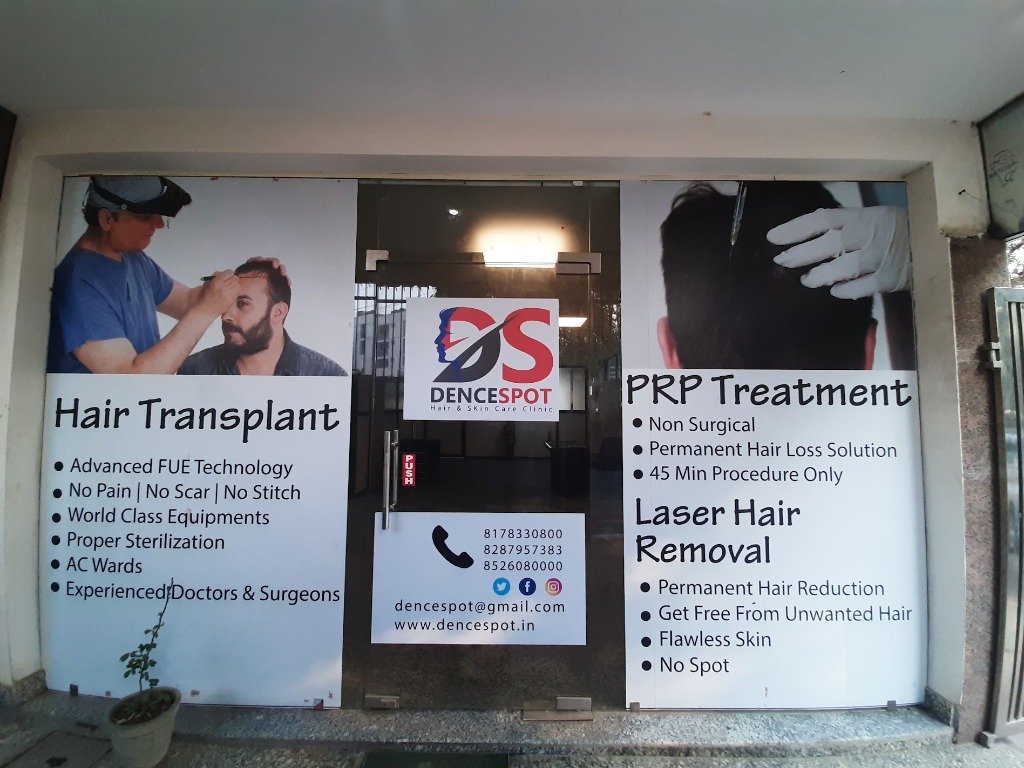
Visit the clinic
Scalp Condition Care at Our Gurgaon Clinic
Diagnosis, treatment and review happen at our Sector 39 clinic in Gurugram, with the same doctor throughout. Patients travel to us from across Gurugram and neighbouring parts of South Delhi.
- Address
- 1123, Sector 39 Road, Jharsa, C Block, Sector 39,
Gurugram, Haryana 122003 - Phone
- +91 81783 30800
- Message +91 81783 30800
- dencespot@gmail.com
- Hours
- Mon–Sat · 10:00 – 20:00Sunday · closed
Getting here
Next step
Find Out Whether It Is One Problem or Two
Come in and have the scalp examined properly. You will get a diagnosis rather than a shampoo recommendation, a treatment plan that expects recurrence, and a separate answer on your hair loss if there is one.
Suitability is determined after clinical assessment. This page is patient education and does not constitute medical advice.
Quick enquiry