DHI Hair Transplant in Rohini, Delhi
DHI — direct hair implantation — uses the same extraction as FUE, then sets each graft with a hollow implanter pen that makes the opening and places the hair in one movement. It is carried out at our Rohini clinic by registered medical practitioners. Its value is precision along the hairline and temples; across a large crown it usually adds cost without adding coverage.
- Carried out at the Rohini clinic
- Each graft set at a controlled angle and depth
- Suited to hairlines and temples
- Same recovery as FUE
Clinic 2 · Rohini
The instrument
What an Implanter Pen Does
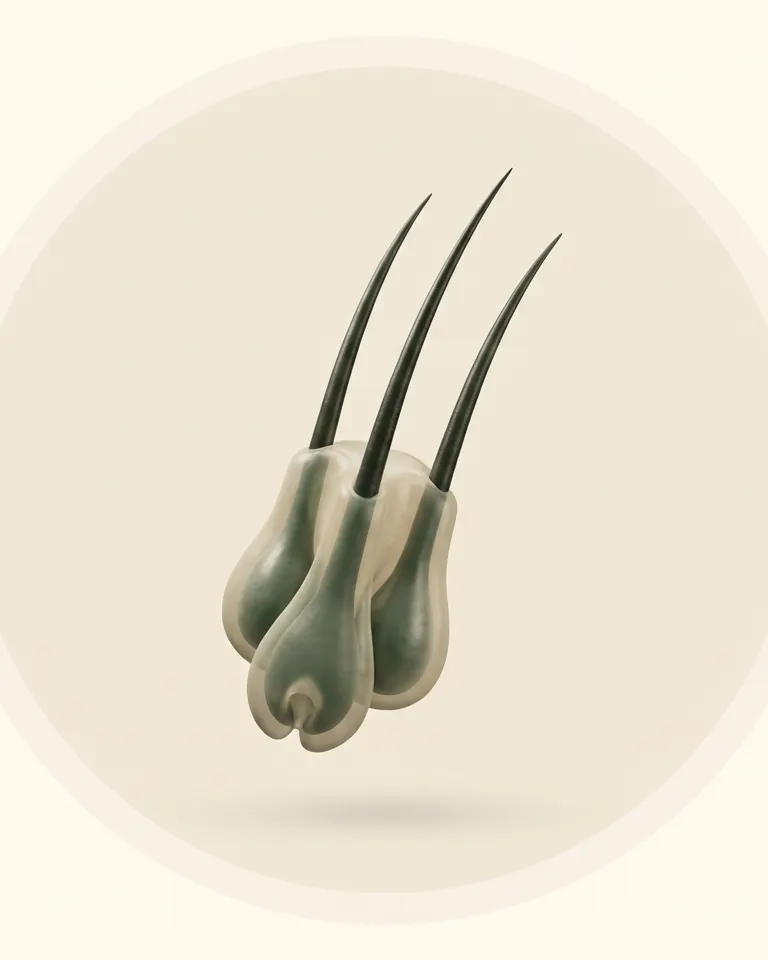
An implanter is a pen-shaped instrument with a hollow needle tip. After extraction, each graft is loaded into an implanter on its own, and the doctor makes the opening in the scalp and delivers the graft in the same movement. Depth, angle and direction are set for that one graft at that moment.
Needle sizes are matched to the graft — finer for single-hair units in the front rows, slightly larger for multi-hair units behind. With no separate step of making sites, grafts spend little time out of the body between extraction and placement.
Extraction itself is identical to FUE; how it works, and the dot scars it leaves, are covered on FUE hair transplant in Rohini.
In one line
DHI is a way of placing grafts, not a separate operation. The control it gives is what you pay for.
Three ways grafts are placed
Sharp implanters
Make the opening and place the graft in one movement. This is DHI in the classic sense.
Blunt implanters into pre-made sites
Openings are made first with a blade or needle, then grafts are pushed in with a blunt implanter — a hybrid sometimes sold as DHI.
Forceps placement
Conventional FUE: grafts held with fine forceps and set into pre-made sites. Efficient over large areas.
None of the three is wrong. The instrument matters less than the hands holding it, so ask which method is planned for each zone, and who will be holding it.
Hairlines and detail zones
Hairline Work: Where DHI Earns Its Place
In the first rows of a hairline, hairs emerge at very shallow angles and in no neat order. A ruled edge, or hairs all pointing the same way, reads as artificial. Setting angle and depth graft by graft is the real advantage of an implanter, and it shows most here.
Designed before you lie down
The line is drawn while you sit upright, checked in a mirror and agreed. Precision cannot rescue a badly designed line — see what makes a hairline look natural.
Temples
Very fine hair at acute angles, where a wrong direction is noticed at once. Small graft numbers, high precision.
Between existing hair
Adding grafts among hair that still grows, where pre-made sites risk damaging it. Women with frontal or parting loss often fit here, once medical causes have been investigated.
Correcting a hairline done elsewhere
Softening a line placed too straight or too low, working between earlier grafts. Sometimes grafts need removing too, assessed separately — see hair transplant repair.
Value, honestly
When DHI Is Worth It — and When It Is Not
DHI is slower than placing grafts into pre-made sites, because each implanter is loaded one graft at a time, and it usually costs more per graft for the extra chair time and single-use tips. Whether that premium buys anything depends on the zone.
Usually worth it
- Hairline and temple work
- Adding density between existing hair
- Frontal work with minimal trimming
- Small, defined sessions
- Softening an earlier hairline
Usually not
- A large crown, which needs coverage more than angle control
- Very large sessions across several zones
- Hoping for faster healing — it is the same as FUE
- Hoping for higher graft survival — not reliably shown
Often the answer is both. For many people with moderate loss, DHI at the front and FUE behind puts the precision where it shows and places the rest more quickly. Cost then follows graft count, zones, technique mix, shaving approach and sessions, set out in writing after your assessment — see how hair transplant cost is worked out.
On the day
A DHI Day at the Rohini Clinic
DHI sessions run long by nature. Your own timings are given beforehand; this is the usual shape of the day.
Marking
Consent, photographs, and the hairline marked and checked with you sitting upright.
Trim and anaesthetic
The donor is trimmed and numbed with local anaesthetic; the injections are the uncomfortable part.
Extraction
Follicular units removed one at a time and spread across the donor, exactly as in FUE.
Loading and placement
Grafts sorted by hair count, loaded into implanters and placed one by one — usually the longest stretch, after a break to eat.
Home
Dressing, medication where prescribed, washing explained, and your first review at Rohini booked.
Recovery is the same as FUE
Crusts in the first week or two, shedding within the first month, new growth from about three to four months, and the result judged at ten to twelve. DHI does not shorten any of these, and results vary between patients.
Candidacy and aftercare are covered on hair transplant in Rohini; for more depth, see the DHI page for our Gurugram clinic.
Who you will see
Doctors at DenceSpot Clinic
Treatment at the Rohini clinic is carried out by registered medical practitioners. Every doctor at DenceSpot is listed below with qualifications and registration details.
Dr. Nyra
MBBS, MD (Dermatology)
Our two clinics
Visit Our Rohini Clinic
DHI consultations, procedures and reviews take place at the Rohini clinic in North-West Delhi. DHI is also carried out at our Sector 39, Gurugram clinic.
-
Clinic 1
Gurugram Sector 39
- 1123, Sector 39 Road, Jharsa, C Block, Sector 39, Gurugram, Haryana 122003opposite Medanta – The Medicity
- Mon–Sat · 10:00 – 20:00Sunday · closed
- +91 81783 30800
-
Clinic 2
Delhi Rohini
- Rohini, Delhi [full street address to be added]North-West Delhi (Near Outer Ring Road / Rohini)
- Mon–Sat · 10:00 – 20:00Sunday · closed
- +91 95406 99152
DHI Hair Transplant is also carried out at our Sector 39, Gurugram clinic: DHI Hair Transplant in Gurugram.
Rohini, Delhi
Other Treatments at Our Rohini Clinic
Every treatment below is carried out at the Rohini clinic as well as in Sector 39, Gurugram. Each starts with an examination and a written plan.
Hair Transplant in Rohini
FUE and DHI, planned around your donor area.
FUE Hair Transplant in Rohini
Follicles extracted one by one from the donor area.
Beard Transplant in Rohini
Patchy cheeks, jawline, moustache and scars.
Eyebrow Transplant in Rohini
Thin, over-plucked or scarred brows.
Hair PRP & GFC in Rohini
For thinning where follicles are still present.
Hair Fall Treatment in Rohini
The cause is investigated before treatment.
Laser Hair Removal in Rohini
A course of sessions to reduce unwanted hair.
Skin Treatment in Rohini
Acne, pigmentation and other skin concerns.
Next step
Ask Whether DHI Is Worth It for Your Hairline
Bring your questions and a list of your medicines. The doctor examines your donor area, draws a hairline on your face and tells you plainly whether DHI, FUE or a mix suits your zones, and what each would mean for the cost.
Suitability is determined after clinical assessment. This page is patient education and does not constitute medical advice.
Quick enquiry