What Makes a Hairline Look Natural, and Why Placement Matters More Than Graft Count
Patients compare graft counts; surgeons argue about placement. Why hairline position, angle and irregularity decide whether a result reads as natural at 30 and at 50.
Written and medically reviewed by Dr. Nyra, MBBS, MD (Dermatology)
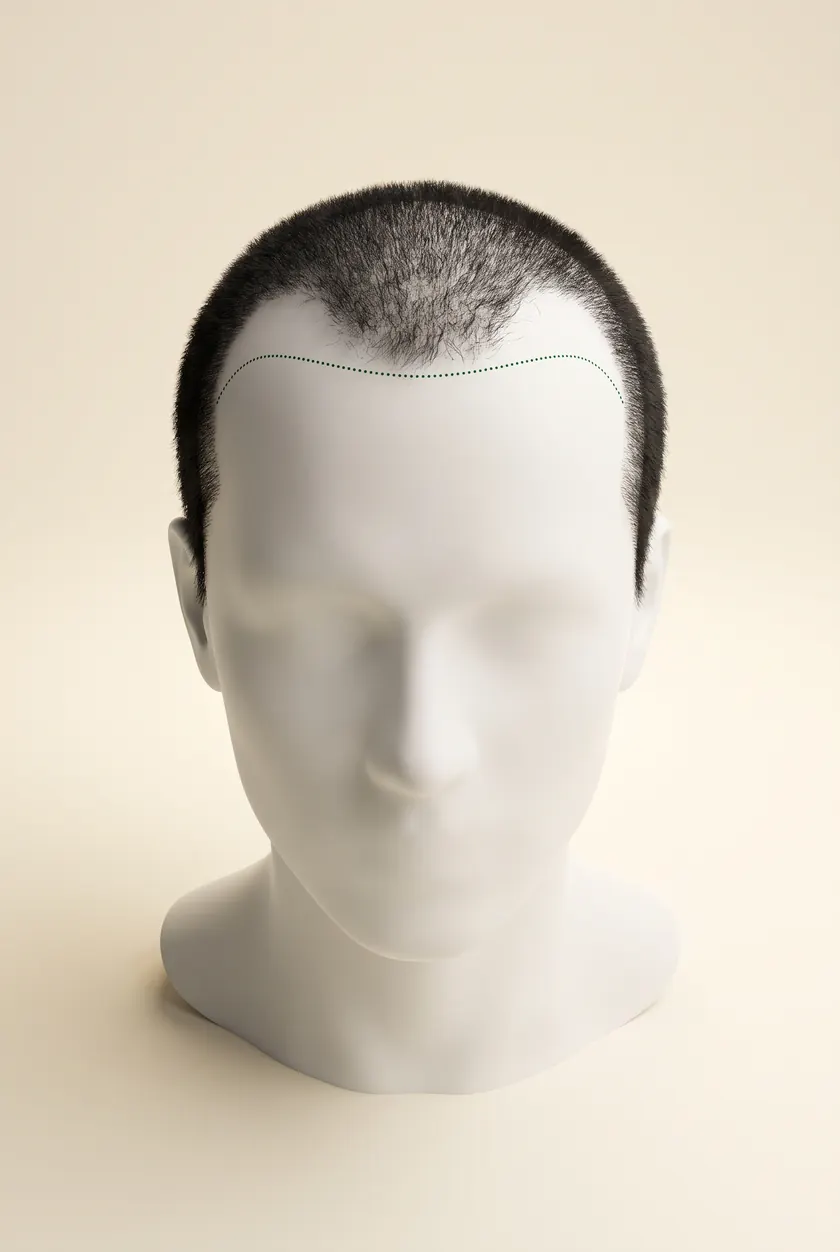
Two clinics can propose the same number of grafts for the same head and produce results that look nothing alike. Grafts are raw material. What decides whether a finished hairline reads as yours or as something applied to you is a set of judgements made with a marker pen before any incision: where the line sits, how it bends, how ragged its front edge is, and which direction each hair is asked to leave the skin in.
None of that appears on a quotation, and all of it is visible from a metre away for the rest of your life. What follows is an explanation of the craft, so you can look at a line drawn on your own forehead and ask better questions than how many grafts it takes.
The line has to work at fifty, not just at thirty
Almost every man's hairline moves back a little from its adolescent position during his twenties and then settles. That settled position is a mature hairline, a normal adult feature rather than the start of male pattern hair loss. Rebuilding the line a seventeen-year-old had is not a return to normal; it is the construction of something most adults do not have.
The problem with a low line at twenty-five is not how it looks at twenty-five, but what sits behind it at forty. Pattern loss carries on in the untransplanted scalp, so a low frontal line built early can end up as a dense strip with thinning scalp behind it, a shape no natural head produces. It also spends hair on territory a conservative design would have held in reserve, and your donor area is a one-time budget.
Why a surgeon argues for a higher line than you want
A slightly high, slightly recessed line looks unremarkable at every age. It also leaves the option of lowering it later, whereas a line placed too low can only be undone by extracting hairs one at a time. A clinic that agrees immediately to the lowest line you ask for is worth noticing rather than celebrating.
The line is planned against your face, not to a measurement
There are conventional reference points: the curve of the frontal bone where the scalp turns from horizontal to vertical, the vertical lines running up from the outer edge of each eye, the proportion of the forehead against the middle and lower thirds of the face. They are starting references, not a formula. A tall forehead on a long face carries a different line from a short forehead on a broad one, and a measurement quoted in centimetres above the eyebrows ignores both.
Almost no face is symmetrical, and a geometrically even line often looks subtly wrong on one that is not. So the drawing is checked in a mirror, with you sitting upright and your eyebrows relaxed. This is why a design cannot honestly be finalised over WhatsApp, and why the questions you ask at a consultation matter more than the photographs you send beforehand.
Irregularity is the whole trick
Nothing announces surgery faster than a straight, even line. Natural hairlines are irregular at two scales, and both have to be built deliberately.
Macro irregularity
Across the width of the forehead a natural line rises and falls: small mounds where hair sits lower, shallow bays between them, and two halves that rarely mirror each other exactly. A design running as a smooth symmetrical arc from temple to temple has none of this, and the eye picks it up even when the observer cannot say why.
Micro irregularity
At the front edge itself a natural hairline is not a border at all. It is a scattered transition zone: isolated sentinel hairs standing ahead of the line, gaps between them, density building over a centimetre or so rather than starting abruptly. A transplanted edge that begins at full density in a single row is the classic artificial look, and no amount of volume behind it rescues that front row.
Single hairs at the front, larger units behind
Follicular units come out of the donor area naturally containing one, two, three or occasionally four hairs. Sorting them under magnification and deciding where each type goes is a large part of the work, and none of it appears on a quotation.
The front edge takes single-hair grafts only, placed irregularly. Two-hair units build the density behind them, and three-hair units go further back where they add bulk without being individually visible. A two-hair graft in the front row costs nothing on the day and shows for as long as the hair grows, because two hairs emerging from one point read as a tuft. This grading applies whether placement uses pre-made channels or an implanter pen, which is one reason the FUE and DHI comparison matters less than patients expect.
Angle and direction of exit
Every hair leaves the scalp at an angle to the skin and points in a particular direction, and both vary across the head. At the frontal hairline the angle is acute, so hairs lie forward almost flat against the skin, while further back they lift. Direction fans outward towards the temples and turns into a spiral at the crown.
Getting this wrong is one of the few errors in hair restoration that is genuinely permanent. Hairs set at too steep an angle stand up instead of lying down, so the line will not sit flat or comb into the rest of the hair, and grafts angled inconsistently beside each other never look like one sheet. Patients describe the result as grass or as doll's hair, and the remedy is extraction and replacement, which is why it recurs throughout what corrective surgery can and cannot fix. Holding one angle across several thousand incisions is a stamina problem as much as a skill problem, worth asking about when you discuss how an FUE procedure is run or how implanter placement is supervised.
Coarse dark hair on brown skin shows every mistake
Design errors are not equally visible on everybody. The higher the contrast between hair and scalp colour, and the coarser the shaft, the more each hair reads as a separate object. Fine, light hair on fair skin is forgiving. Thick black hair on medium or deep brown skin is not, and that is the combination most patients in Gurgaon have.
Coarse hair is an advantage in coverage and a liability at the front edge, where one thick shaft at the wrong angle is conspicuous. That argues for a wider transition zone, more single-hair grafts spent on it, and sometimes finer hairs from the lower nape in the very front row. It is also why any photograph you are shown is only relevant if it shows hair like yours, photographed properly, a skill set out in how to read a before-and-after photograph.
Your own case
Where would a sensible hairline actually sit on your face?
An examination settles the position your face and your age support, what your donor area can fund, and whether the design should stay conservative now so that it still holds up in twenty years.
Temple points, and the case for leaving them alone
The triangular points of hair in front of the ears frame the face, and their loss is part of what makes a hairline look older. Rebuilding them is among the most demanding work in hair restoration: the hairs are fine, the angles extremely acute, and the direction runs backwards and downwards. A point built with the wrong calibre of hair, or a few degrees off in angle, looks odd, and it sits in the line of sight in profile.
Then there is the budget. Temple points consume donor hair that could buy density in the frontal third, where it does more work for how you look face on. For many patients with progressive loss the mature decision is to leave the temples recessed, a judgement resting on the same donor assessment behind the graft number your plan is built on and on where you sit on the Norwood scale. Aggressively rebuilt temples on a man whose loss is still moving tend to age badly.
How to evaluate a proposed hairline before you consent
The design should exist as a drawing on your skin before you agree to anything. If nobody draws it, you have not been shown the plan.
- Sit upright in front of a mirror with your eyebrows relaxed. A line drawn while you are reclined and raising your brows sits differently once you stand up.
- Photograph it yourself — front on, both forty-five degree angles, and the top of your head — in daylight, then review those images away from the clinic.
- Check that the line is not a smooth arc and not exactly symmetrical. Ask where the transition zone begins and how deep it is.
- Ask where this line sits at fifty if your loss continues. The answer should acknowledge that loss continues around transplanted hair.
- Ask which grafts go in the front row and how they are sorted. Anyone who designs hairlines answers that quickly and specifically.
- If you are shown photographs of other people, check that they have your hair calibre and skin tone and were taken at ten to twelve months, not at three.
Then take a week. A line you still find acceptable in your own photographs seven days later is a reasonable line; one that only looked right in the consultation room is worth revisiting. If the honest answer is that surgery is premature or unsuitable, that conversation is a better outcome than a well-drawn line on the wrong candidate.
Design judgement is the part of hair restoration surgery in Gurgaon that no price comparison captures, and it is the part you live with longest. If you want a line drawn and discussed before committing to anything, arrange a consultation.
Hairline design FAQs
If I start with a conservative hairline, can it be brought forward later?
Adding to a line is far easier than unpicking one. A conservative first line leaves the option of lowering it in a later session if your loss stays settled and the donor area still has supply. Removing hairs placed too low means extracting them one at a time, which is slow work, and the skin does not always return to how it looked before.
Does my hairline have to be shaved for the procedure?
The recipient area at the front is usually trimmed short so the surgeon can see the angle of the existing hairs and place grafts between them. Some plans keep the frontal hair longer so it covers the area while it heals. It depends on how many grafts are going in and how much native hair is still there, so ask specifically at your consultation.
How long do the marks in the hairline stay visible after surgery?
Small crusts sit at each graft site for roughly the first one to two weeks, and the skin underneath is usually pink for some weeks after that. The pinkness settles gradually. Read the first fortnight day by day for what the front of the scalp actually looks like during that period.
Should I ask for a widow's peak to be recreated?
A slight central point can be built in, and it suits some faces because it breaks up the symmetry of the line. Be cautious with a pronounced one: it is a strong feature, it draws the eye to the exact spot where design errors show, and it is not easy to soften afterwards. Raise it while the line is still a drawing.
Who should actually draw the hairline, the doctor or a technician?
The design is a surgical decision and should be made by the doctor who will perform your procedure, with you sitting up and looking in a mirror. If the line is drawn by someone you will not see again on the day, ask who is accountable for it.
Does the hairline need redesigning if I have a second session later?
Not usually redesigned, but it is reviewed. A second session normally works behind the existing line, adding density or following loss that has moved further back. If the original line was placed sensibly for your age, it should still suit you. If it was placed too low, the second session is where that becomes a repair problem rather than a top-up.
Medical disclaimer. Information on this website is general patient education. It is not medical advice and does not create a doctor-patient relationship. Suitability, graft numbers and treatment plans are decided only after an in-person examination by a registered medical practitioner. Outcomes differ from person to person, and no particular outcome, density or timeline can be promised.
Related treatment
Considering hair transplant treatment?
This article is patient education. What applies to your own case is decided after an examination — the treatment page sets out how that works, what it costs and what to expect.