How to Choose a Hair Transplant Clinic
A stage-by-stage guide to a decision you cannot undo. What to establish before you enquire, exactly what to ask in the consultation room, how to read the quote afterwards, and when to walk away. Written to be useful even if you choose someone else.
- The questions, stage by stage
- How to compare two different graft numbers
- The warning signs worth leaving over
- Applies to any clinic, including this one
Written & reviewed by
Dr. Nyra
MBBS, MD (Dermatology) · Owner & Chief Consultant, DenceSpot Clinic
Why this decision is different
Three Things That Make It Unusually High-Stakes
It is irreversible. Grafts are living hair placed in permanent positions. A hairline set too low cannot be raised. Angle cannot be corrected after the site is made. Correction is possible in a limited sense and it is slow, partial and expensive.
It spends a finite resource. Your donor area has to last a lifetime, and grafts taken out cannot be put back. A clinic that inflates the graft number to raise the bill is not merely overcharging you — it is spending something you cannot buy more of.
The verdict takes a year. You will not know whether the decision was good for roughly twelve months. By the time a poor result is unmistakable, every option has narrowed. That is precisely why the checking has to happen before, not after.
Those three facts are the reason this guide exists and the reason it is worth spending a fortnight on the choice rather than an afternoon.
The shortest possible version
If you read nothing else
- See at least two clinics
- Ask who will actually perform the surgery
- Ask how the graft number was calculated
- Get it in writing and leave without booking
- Ask what would make them refuse to operate
Five questions. They will separate clinics more reliably than any amount of website reading.
Stage one
Before You Enquire Anywhere
A small amount of preparation changes what you get out of every consultation that follows.
Know what is bothering you
The hairline, the crown, or general thinning? They are different problems with different priorities and costs. Arriving with a clear answer stops the agenda being set for you.
Establish whether it is still moving
Hair loss that is actively progressing changes the advice completely. Compare photographs from a few years ago. If it is moving quickly, expect to be told to stabilise it first.
Rule out a treatable cause
Especially important for women. Iron, thyroid and hormonal causes are common and treatable, and they need investigating before surgery is even a sensible conversation.
Gather your medical history
Every medicine and supplement, any conditions, any previous scalp problems. Bring the list rather than trying to recall it in the room.
Set a realistic budget
Including the possibility of a second session and ongoing medical treatment. A plan you cannot complete is worse than a smaller plan you can.
Decide what you will not accept
Being pressured, an unexplained graft number, or an outcome guarantee. Deciding your limits beforehand is far easier than deciding them under persuasion.
Stage two
In the Consultation Room
Treat the consultation as your assessment of them, running alongside their assessment of you. These are the questions, grouped by what they actually reveal.
About the people
Who does what
- Who will make the recipient sites?
- Who performs the extraction?
- Who places the grafts?
- What is your qualification and registration number?
- Will I see the same person at follow-up?
What you are listening for is specificity and speed. Hesitation or generality here is itself the answer.
About the plan
How the number was reached
- How did you calculate my graft number?
- Was my donor density measured, and what was it?
- How much can my donor safely give in total?
- What are you leaving in reserve for future loss?
- Is a second session likely, and when?
A clinic that examined you properly will enjoy these questions. One that did not will get vague.
About the design
The part you cannot undo
- Will you draw the hairline on me before I consent?
- Why have you placed it there?
- How will it look as I lose more hair?
- How is the transition zone being built?
If one clinic offers a markedly lower hairline than the others, that is not generosity. See hairline design.
About what goes wrong
The conversation that reveals most
- What happens if growth is poor?
- When exactly can I judge the result?
- What will the donor area look like?
- What would make you refuse to operate on me?
The last one is the most informative question in this entire guide. A clinic with no answer declines nobody.
Stage three
Reading the Quote, Away From the Clinic
Leave without booking. Read the estimate the next day somewhere neutral. Anything persuasive in the room that does not survive that is persuasion, not information.
Check what is excluded
Quotes diverge far more in exclusions than in headline rate. Anaesthesia, medication, dressings, follow-up reviews and any second session all belong in the comparison.
Compare plans, not rates
Per-graft rates are only comparable when the graft numbers were derived the same way. If the counts differ substantially, compare how each was justified instead.
Watch for expiry
A discount that lapses if you do not book today exists to stop you doing exactly what you are doing now. Treat it as information about the clinic.
Look for the risks in writing
Shedding, the twelve-month timeline, the possibility of a further session. If none of it appears in your paperwork, note what that says about the consultation.
Add the ongoing costs
Medical treatment usually continues after surgery to protect native hair. It is a real recurring cost and it belongs in your budget.
Check the graft number twice
It is the number every rupee rests on. If you cannot explain to a friend how it was reached, you do not yet have enough to decide.
Warning signs
When to Walk Away
Any single one of these is reason to slow down. Two together is reason to leave.
A graft number without an examination
Donor density cannot be assessed from a photograph. A number produced that way has no clinical basis, and it is the foundation of everything else you are being told.
A guaranteed result
No clinic can guarantee density, coverage or a permanent outcome. Biology does not allow it. An offered guarantee is a statement about the business, not the surgery.
Pressure to decide today
Expiring discounts and same-day booking incentives on irreversible surgery exist for one reason. A clinic confident in its work does not need you to decide before you have thought.
Evasion about who operates
You are entitled to know who will hold the instruments and what they are qualified as. Difficulty getting a direct answer is itself a direct answer.
Surgery offered despite active disease
Being offered a transplant with active alopecia areata, an inflamed scalp or rapidly progressing loss is a serious warning about clinical judgement.
Only good news
A consultation that never mentioned shedding, the year-long timeline, the donor area or the chance of a second session was a sales meeting with medical decor.

Who performs and reviews this treatment
Dr. Nyra, MBBS, MD (Dermatology)
Owner & Chief Consultant, DenceSpot Clinic
Qualified MBBS from Dr. D. Y. Patil Medical College, and holds an MD in Dermatology. Three years of clinical work in Germany followed — two at Bio Hair Clinic and one at St. Georg Klinikum Eisenach — before establishing DenceSpot in Gurugram.
Why a clinic publishes a guide that might send you elsewhere: the most common regret in this field is not choosing the wrong clinic, it is choosing quickly. Patients arrive at repair consultations having booked on the day of a first consultation, under a discount that expired that evening, with a graft number nobody could explain. A checklist is only worth something if it can be used against the clinic that wrote it, so apply every question here to us as well, and treat vagueness from anyone as the finding it is.
Qualification
MBBS, MD (Dermatology)
Training
3 years, Germany
Specialization
Dermatology
Stage four
Comparing Two Clinics Properly
Once you have two written plans, the comparison that matters is not price. It is the two graft numbers and the two hairlines.
If the graft counts differ substantially for the same head, one clinic has read your donor differently or is planning to take more from it. Ask each to explain their number against the other. The explanations will not be equally convincing.
If the proposed hairlines differ, look at which is lower and ask why. Lower is easy to sell and permanent to live with, and a clinic proposing a conservative line is usually thinking about your face at fifty rather than your photographs at thirty.
Then look at what each has left in reserve. A plan that spends nearly all your donor supply on the front leaves nothing for the crown when the loss arrives there. Ask both clinics that question directly.
Side by side, compare
- The graft number and its stated basis
- The hairline position each proposed
- What each leaves in donor reserve
- What each excludes from the price
- Whether each mentioned a second session
- Who each says will perform the surgery
Related reading
Judging clinics in Gurgaon — the criteria, applied to us too.
Hair transplant cost — how pricing works.
Why quotes vary — the mechanics behind the differences.
Consultation questions — a longer list to take with you.
Visit the clinic
If You Would Like to Apply This to Us
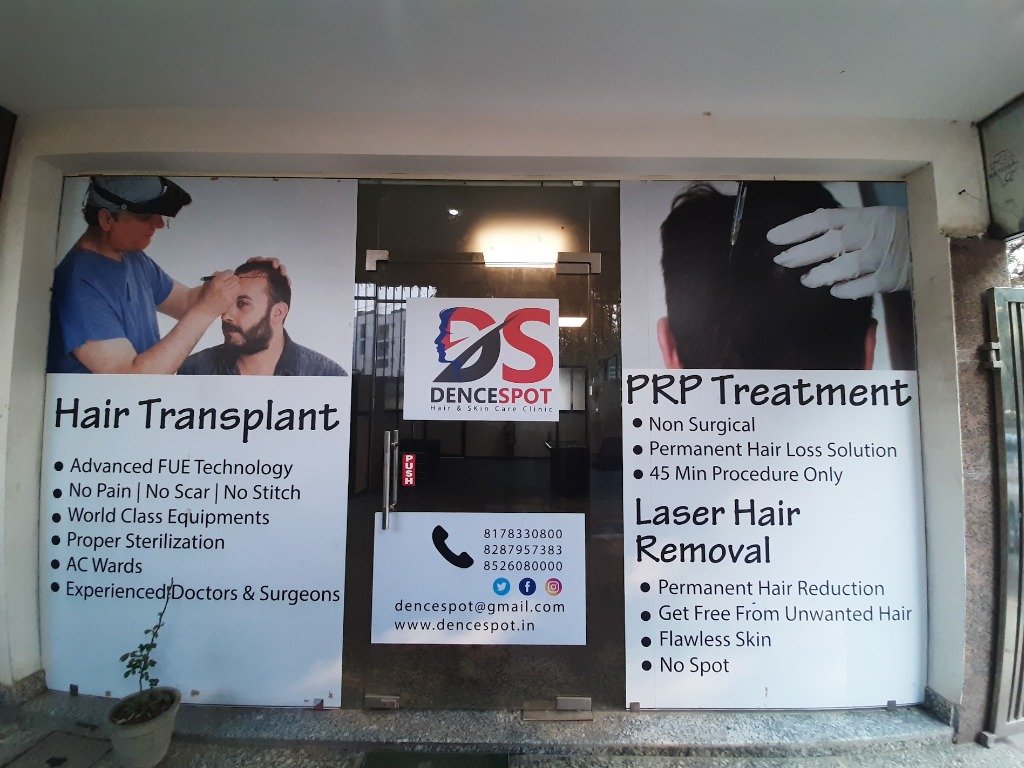
Consultation, surgery and every follow-up happen at our Sector 39 clinic in Gurugram, with the same doctor throughout. Bring the questions on this page. Patients travel to us from across Gurugram and neighbouring parts of South Delhi.
- Address
- 1123, Sector 39 Road, Jharsa, C Block, Sector 39,
Gurugram, Haryana 122003 - Phone
- +91 81783 30800
- Message +91 81783 30800
- dencespot@gmail.com
- Hours
- Mon–Sat · 10:00 – 20:00Sunday · closed
Getting here
Next step
Bring This List to Your Consultation
Ask us who operates, how the graft number was reached, and what would make us decline. You will get an examination, a hairline drawn on you before consent, and an itemised written estimate to take away and think about.
Suitability is determined after clinical assessment. This page is patient education and does not constitute medical advice.
Quick enquiry