FUE vs DHI: What Actually Differs, and Whether the Difference Matters for You
Extraction is the same in both. What changes is how grafts are placed, and how much that difference is worth. A plain comparison of implanter pens against pre-made channels.
Written and medically reviewed by Dr. Nyra, MBBS, MD (Dermatology)
Hair transplants are commonly offered as FUE, DHI, or a version with a brand name attached. The impression can be of a ladder, with DHI a rung above FUE and the branded version above both. That is a pricing structure, not a clinical one.
DHI stands for direct hair implantation. It describes how grafts go into the scalp, not how they came out, and every DHI procedure is a follicular unit extraction procedure. That one fact removes most of the confusion here.
Both methods begin with FUE extraction
Follicular unit extraction describes how grafts leave the donor area. A punch under a millimetre across scores a circle around each follicular unit at the back and sides of the head. Grafts are lifted out, sorted under magnification, and held in chilled solution until placement. That sequence runs identically whether the day's work is called FUE or DHI.
Nothing about the punch changes, and nothing about donor selection changes. Permanence still rests on the donor zone being genuinely resistant to the hormonal process that caused the loss (DermNet: male pattern hair loss) — a property of the hair you harvest, not of the instrument that places it. Your donor area as a one-time budget sets out that constraint at length.
So when a clinic says it performs DHI rather than FUE, translate it: we place grafts with an implanter pen rather than into pre-made channels. That is a real difference, and a much narrower one than the naming implies. Both the FUE procedure and placement using implanter pens are described on their own pages.
Where the two methods actually diverge
Implantation is the point of separation, and the two sequences are genuinely different craft.
Pre-made channels, then forceps
The surgeon first creates the recipient sites: small incisions, called channels or slits, each cut at a chosen angle, depth and direction. Most of the area is prepared before any graft goes in. Trained technicians then place grafts into those waiting sites with fine forceps.
Loaded implanter pens
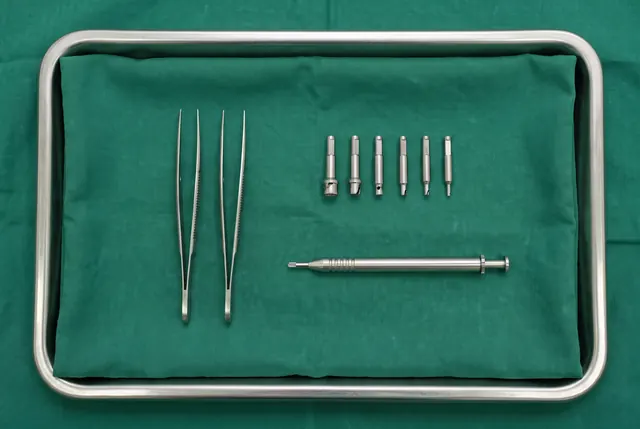
An implanter is a hollow needle in a handle. A graft is loaded into it before anything touches the scalp. The tip then pierces the skin and the graft is delivered as the pen withdraws. Incision and placement become one movement instead of two, and the recipient area is never opened beforehand.
Control of angle, depth and direction
A transplanted hair reads as natural or as planted largely because of the angle it emerges at, the direction it points, and whether its neighbours agree with it. That decides how the result looks in a mirror, and counts for more than any graft number. What makes a transplanted hairline look natural goes further into the design side.
With pre-made channels the surgeon makes every incision personally and reads the whole field before a graft goes in. Direction is committed early, and depth is largely fixed by the incision, which limits how much a tiring technician can vary it later. The risk is obvious: a channel cut at the wrong angle is difficult to un-cut.
With implanter pens, angle and depth are set graft by graft, by the hand holding the pen. In a practised hand that is very precise, and placement can be adjusted as an area fills. The trade-off is that control is distributed across everyone holding a pen, so consistency depends on how that team is trained and supervised. Neither arrangement is inherently safer, and both fail the same way: inattention.
Time out of the body, and how grafts are handled
A graft is living tissue out of circulation from extraction until placement. Less time outside the body and less handling are sensible goals, and both workflows claim them.
Implanter advocates note that a graft is gripped once, when loaded, and not taken up again by forceps. Channel advocates note that with sites already open, placement runs without pausing to load.
Both are plausible, and neither settles it. What governs time out of the body is how many trained hands are working, how the day is sequenced, and whether the team is being pushed towards a graft target. A clinic answering this with a percentage is overreaching — what claimed survival rates really mean explains why no such figure can be verified on your own head.
Shaving, and the real limits of unshaven work
The donor area is clipped or shaved in both methods, because the punch has to see what it is cutting. What differs is the recipient area, and this is where DHI gets marketed as the no-shave option.
There is something in it. Because an implanter makes its own incision as it goes, grafts can be threaded between existing hairs without first cutting hundreds of slits into a surface you cannot see clearly. That makes unshaven work more practical with pens, and it matters if being seen at work next week is the constraint.
It is not unlimited. Existing hair obscures the scalp, so work is slower, fewer grafts can be placed well in a session, and native hairs you want to keep are at risk. Unshaven work suits a hairline refinement or a modest patch of thinning far better than a large session. If discretion is the reason you are asking, how the scalp actually looks in the first fortnight is the more useful read, and the month-by-month growth timeline covers the year that follows either route.
Density in a single pass, and why the workflow matters
How closely grafts can be packed is limited by blood supply, not by instruments. Beyond a certain density the skin cannot support what is put into it, and pushing past that risks poor growth in the very area you cared most about.
Within that ceiling the methods behave differently. Pre-made channels let a surgeon lay out spacing across the whole area before committing a graft, which makes even coverage easier to judge. Implanter placement is decided one graft at a time into skin that has not been mapped, so evenness depends on the team holding a consistent picture for hours.
Implanter workflows also change the logistics. Pens must be reloaded, occupying hands that would otherwise be placing, so clinics often run these sessions with a different team structure, sometimes across two days. That is not a defect, and it is one reason the honest answer to how many grafts you can have depends on the plan rather than the acronym, as who decides your graft number sets out.
Which situations genuinely favour one over the other
There are cases where the choice is not arbitrary. There are rather more where it barely matters.
| Situation | What tends to suit it | Why |
|---|---|---|
| Small hairline refinement | Implanter pens | Each graft is angled individually, and unshaven work is practical at this size. |
| Dense frontal rebuild | Either, often channels | Whole-field planning makes even, high density easier to control. |
| Large session, extensive loss | Channels, commonly | Placement throughput matters, and the day is already long. |
| Placing among existing thinning hair | Implanter pens | Fewer blind incisions around native follicles you are trying to keep. |
| Beard and moustache work | Implanter pens, usually | Very flat exit angles, where an error is visible immediately. |
Read those as tendencies, not rules. A surgeon who has spent years placing into pre-made channels will build a better hairline that way than with a tool they use occasionally.
If a clinic cannot explain why it would use one method for your particular case, the choice is being made by its equipment cupboard rather than by your scalp.
Your own case
Would the placement method actually change anything in your case?
For most patients it does not, and the plan turns instead on donor supply, whether the loss has stabilised, and hairline design. An examination is what tells you which category you fall into, and what the sensible sequence is for your own scalp.
What the marketing overstates
Branded names. Direct hair implantation is associated with a commercial brand, and clinics with no affiliation to it use the term generically anyway. Sapphire, bio, ultra and micro prefixes describe blades, solutions or punch sizes, not new operations.
Claimed survival advantages. You will see figures asserting that one placement method yields better graft survival. You cannot verify that on your own head, because there is no parallel version of you who had the other method the same day. Numbers offered without that context are advertising, and reading a before-and-after photograph properly is the nearest check you can run yourself.
The upgrade framing. Being told DHI is the upgrade and FUE the basic option collapses a technical choice into a price tier. It is the same move that reduces a real comparison of extraction against the older strip technique to two brochure lines. Ask instead which method the surgeon uses most, and why they would choose it for you.
How to decide without relying on the brand names
The questions that separate clinics have little to do with the acronym. Who makes the incisions or holds the pens, and under whose supervision. How many patients are booked that day. What happens if growth disappoints at twelve months. The questions worth asking at a consultation covers the full set, including which answers should worry you.
Ask also who is operating. In India that is a regulated question with a specific answer, worth settling before you compare techniques. At DenceSpot, consultations and procedures are carried out by registered medical practitioners, and Dr. Nyra's qualifications are published for that reason.
Take the dull version away: extraction is the same, placement differs, and the difference is real but smaller than the pricing implies. What changes your result far more is whether the loss has stabilised, what your donor area can supply, and how carefully the hairline is designed. Those are examination findings, not menu choices, and settling them is what a hair transplant assessment in Gurgaon is for.
FUE and DHI FAQs
Is DHI more painful than FUE?
Both are done under local anaesthetic, and the anaesthetic is the same either way. The uncomfortable part of either day is the injection at the start, not the placement itself. Some people find a long implanter session more tiring simply because it runs longer. If pain is the thing worrying you, raise it at the consultation — it is a reasonable thing to plan around rather than endure.
Can both placement methods be used in the same session?
Yes, and it is fairly common. A surgeon may use implanter pens along the frontal hairline where every graft is angled individually, then switch to pre-made channels for bulk work behind it where even spacing and throughput matter more. Nothing prevents mixing them, and a clinic that presents them as mutually exclusive is describing its own workflow, not a rule.
Does the recovery differ between the two?
Not meaningfully. Crusting, swelling and the shedding phase follow the same course, because the donor wounds are identical and the recipient wounds are small in both cases. Washing instructions, sleeping position and the return to normal activity are the same. See hair transplant aftercare for what the first fortnight actually asks of you.
What is sapphire FUE, and is it a third method?
No. Sapphire refers to the blade material used to make recipient channels, in place of steel. It is a variation within the channel method and has nothing to do with extraction at all. Treat it as you would any material claim: ask what it changes for your scalp specifically, and whether the surgeon would use it either way.
Does DHI cost more than FUE?
Clinics often price it higher, usually citing implanter consumables and longer chair time. Whether that difference is justified depends on what the quote actually includes. Compare whole plans rather than labels — how a hair transplant quote is built and the payment options set out what belongs in that comparison.
Does the placement method matter for a beard transplant?
Angle control matters more on the face than almost anywhere else, because facial hair emerges at a much flatter angle than scalp hair and errors are visible immediately. Many surgeons prefer implanters there for that reason. It is a preference rather than a requirement — see beard transplant in Gurgaon.
Medical disclaimer. Information on this website is general patient education. It is not medical advice and does not create a doctor-patient relationship. Suitability, graft numbers and treatment plans are decided only after an in-person examination by a registered medical practitioner. Outcomes differ from person to person, and no particular outcome, density or timeline can be promised.
Related treatment
Considering hair transplant treatment?
This article is patient education. What applies to your own case is decided after an examination — the treatment page sets out how that works, what it costs and what to expect.