Your Donor Area Is a One-Time Budget: What It Can and Cannot Cover
Donor hair is spent once and does not grow back where it came from. How supply is measured, why coverage and density compete, and what extensive loss can realistically get.
Written and medically reviewed by Dr. Nyra, MBBS, MD (Dermatology)
Most consultations open with a number. How many grafts, how many sessions, how soon. It is the wrong end of the conversation, because the figure that actually constrains everything sits on the back of your head and was fixed before you were born.
Treat it as an account you can only withdraw from. Every graft moved to the front has left the back permanently, and the lifetime total is capped by anatomy you did not choose.
Why donor hair resists pattern loss, and where the safe zone sits
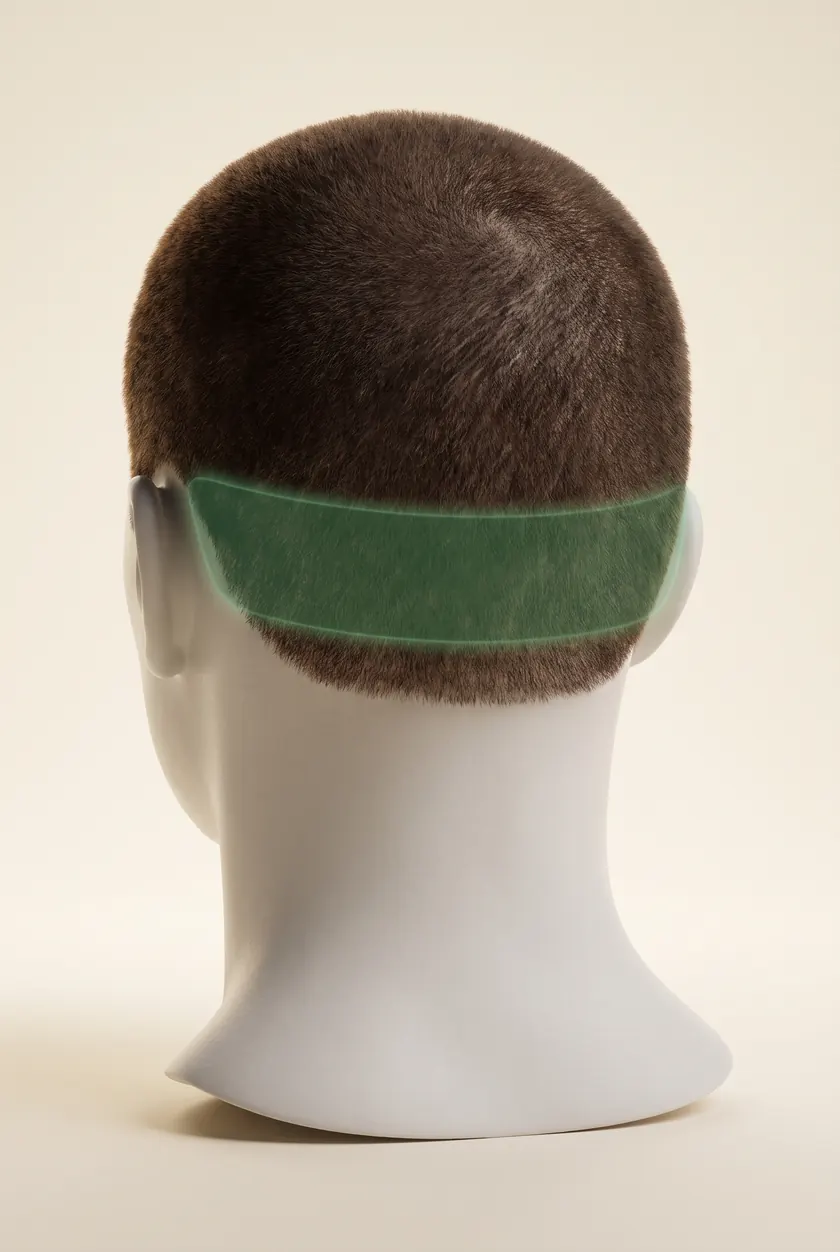
Pattern hair loss is not a disease of the skin; it is a sensitivity carried by individual follicles. Follicles on the top and front of the head respond to dihydrotestosterone by miniaturising over successive growth cycles until they produce nothing visible. Follicles in a band around the sides and lower back are largely insensitive to the same hormone, which is why that band survives while everything above it goes (DermNet: male pattern hair loss). Move an insensitive follicle into a bald area and it keeps behaving as it always did. That is donor dominance, and it is the entire biological basis of the operation.
The working phrase is safe donor zone, and it is narrower than the hair you can see. Its boundaries are judged on your own head rather than from a diagram: broadly a band above the ears and across the occiput, kept below the point where the crown is thinning and above the nape, where hair thins with age in almost everyone. Take from outside that band and the transplanted hair may look good at thirty-five and thin at fifty, because you moved hair that was always going to go. The zone also narrows as loss progresses, which is one reason where you sit on the Norwood scale changes the plan rather than merely the quote.
How donor supply is assessed
Three separate readings, taken under magnification, on your scalp. None can be estimated from a photograph, which is why a graft number quoted before any examination is a marketing figure rather than a plan.
Density
Follicular units per square centimetre across the donor band, and the average number of hairs inside each unit. Two scalps with identical unit density can differ substantially in total hair count if one runs mostly two- and three-hair units and the other runs mostly singles. It is measured, not assumed.
Calibre
How thick each hair shaft is. Calibre does more visual work than almost anything else, because coverage depends on the total cross-sectional area of hair standing on the skin, not on the count alone. Coarse hair covers scalp with far fewer grafts than fine hair does. A patient with modest density but thick shafts can comfortably outperform one with high density and fine hair.
Laxity
How mobile the scalp is over the skull. Laxity matters most where a strip is closed, since a tight scalp limits how much can be taken without tension, but it also affects extraction spacing and healing. A comparison of FUE and strip donor yield is usually where this reading changes the recommendation.
A low reading on any of the three is not a refusal. It is a smaller budget, and the honest response is to redraw the plan. Sometimes the correct answer after measurement is that the goal you arrived with cannot be funded at all, and the cases where surgery is the wrong answer include several that only become clear at this point.
Overharvesting, and why it cannot be undone
The donor tolerates being thinned. It does not tolerate being emptied. Take too many units from one region, or space extractions too closely, and the result is a moth-eaten donor: patchy, low-density skin that looks acceptable at four inches of hair and obviously damaged at four millimetres. Most patients discover it the first time they use clippers.
Nothing reverses it. There is no follicle to put back, and grafting into the donor to disguise the damage spends more of the same shrinking supply. It belongs firmly among the risks that are permanent rather than temporary, and it is usually the consequence of a single oversized session planned around graft count rather than donor capacity.
A conservative extraction plan is not caution for its own sake. It is the difference between having options at fifty and having none.
Coverage versus density, when the arithmetic does not work
Here is the trade-off that matters most in extensive loss. Grafts can be spread thinly over a large area, or packed densely into a small one. They cannot do both once the bald area is larger than the donor can fill, and at Norwood 5, 6 and 7 it usually is.
Native scalp carries far more hair per square centimetre than any transplant achieves. Surgery does not restore original density; it restores the impression of hair, and that impression rests on contrast between hair and skin, on shaft calibre, on hair colour against skin tone, and on how you wear it. A dark-haired man with pale skin needs more hair for the same visual effect than someone whose hair and skin sit closer in tone.
So for an extensive pattern the real choice is between a strong, dense frontal area with an unrestored crown, and a uniform thin wash across the whole scalp that reads as thinning hair rather than as hair. Put in those terms, most surgeons and most patients choose the first. Either way, coverage can only be judged once the grafts have grown, which the month-by-month growth timeline places at around ten to twelve months.
Why the frontal third gets funded before the crown
The frontal third frames the face: it is what people see across a table and what a photograph records. The crown is seen by others more than by you, and it sits on a curve that consumes grafts quickly, because the hair whorls outward from a central point instead of lying in one direction.
The crown also keeps expanding. A crown filled at thirty-two with a large share of the supply frequently needs a second ring of grafts at forty-two, by which time the hairline has moved back too and there is nothing left to defend it. That is the ten-year picture: an island of crown hair, a receded front, and a donor that cannot fund a rescue. Funding the frontal third first is what keeps a hairline reading naturally as you age rather than ageing into an obvious repair case.
Your own case
What can your own donor area actually fund over a lifetime?
Measuring density, calibre and laxity against the area you want covered is what turns this from a general principle into a number for your head, including the honest answer if the arithmetic does not reach your goal.
Staging, instead of one maximal session
The alternative to a maximal first procedure is a plan with reserves in it. Restore the frontal third properly. Keep medical treatment running on the hair you still have, because slowing ongoing hair fall reduces what the donor is later asked to replace. Reassess at ten to twelve months, when the first result can honestly be judged, then decide whether a second session goes to the mid-scalp, the crown, or nowhere.
This is slower, and it is a less satisfying thing to be told. It is also the only approach that accounts for the fact that your loss is still moving, which a transplant does not halt. Two staged procedures do add up to more than one session, and how hair transplant cost is worked out covers that.
Beard and body hair as supplementary donor
Where the scalp donor is exhausted or was never large, beard hair is the most useful supplement. It is often thicker than scalp hair, it is plentiful under the chin and along the neck, and in careful hands it adds genuine bulk. Chest hair contributes in some patients.
The limits are real. Beard hair has a coarser texture and a growth cycle unlike scalp hair, so it lengthens and behaves differently once placed. It is generally unsuitable for a hairline, where a mismatched shaft is immediately visible, and is used instead through the mid-scalp and crown, or underneath scalp hair to add density beneath a natural front. Body hair yields less reliably again. None of it replaces scalp donor, and drawing heavily on the beard has its own cost if you wear one, which is the trade-off a beard transplant runs in reverse.
Reading a plan that promises 4,000 to 6,000 grafts
Large numbers are not automatically wrong; some donor areas genuinely support them. What should concern you is a large number offered without any of the following in the same conversation:
- A measured donor density and calibre reading, taken on your scalp, that you were actually shown.
- An explicit statement of what will not be covered, and why.
- What remains in reserve for the loss expected over the next fifteen years.
- Whether the number is one session or two, and where the second one comes from.
- What the plan does if your loss progresses faster than assumed.
Ask what the lifetime extraction ceiling on your donor is, and how much of it this plan spends. A clinic that cannot answer has not measured. Several of the questions worth putting to any clinic exist precisely to surface this, and skipping it is a large part of why two quotes for the same head differ so much.
The technique matters less here than the budget does. Follicular unit extraction and its variants change how grafts are harvested and placed, not how many exist. If a plan does not begin from what the donor can safely give, the method it names is decoration on an arithmetic problem, and a doctor-led assessment should be willing to show you the working.
Donor area FAQs
Does hair grow back in the donor area after FUE?
Not in the punched sites. Each extraction removes a whole follicular unit, and that unit then grows only where it was moved to. What changes is how the surrounding area looks: the remaining follicles are spread more thinly across the same skin, so the donor reads as slightly less dense rather than as visible holes.
Will medication or PRP increase how many grafts I have available?
No. Nothing adds follicles to the donor zone. Medication and injectables act on hair that already exists, mostly by keeping miniaturising hair in the game for longer. That is worth having, because protecting native hair reduces what the donor is later asked to replace, but it does not raise the ceiling itself.
Can I shave my head short after a transplant?
It depends on how much was taken and how evenly. Many people can wear a number two or three without the extraction sites being obvious. Very short clipper work, or a wet shave, exposes the donor to inspection and is where earlier overharvesting becomes obvious. If you expect to wear your hair short, say so before the plan is drawn.
How long should I wait between transplant sessions?
Usually at least ten to twelve months, because that is when the first session can be honestly judged and when the donor has settled. Operating sooner means planning against an unfinished result and a scalp that has not recovered its laxity. The interval is a clinical one, not a commercial one.
Can a donor area damaged by a previous clinic be repaired?
Partly, and rarely to how it was. Scar tissue can sometimes be softened, small patches camouflaged with grafts or pigment, and a linear scar improved. Density that has been removed cannot be put back. See what hair transplant repair can address before assuming a second procedure fixes it.
Medical disclaimer. Information on this website is general patient education. It is not medical advice and does not create a doctor-patient relationship. Suitability, graft numbers and treatment plans are decided only after an in-person examination by a registered medical practitioner. Outcomes differ from person to person, and no particular outcome, density or timeline can be promised.
Related treatment
Considering hair transplant treatment?
This article is patient education. What applies to your own case is decided after an examination — the treatment page sets out how that works, what it costs and what to expect.