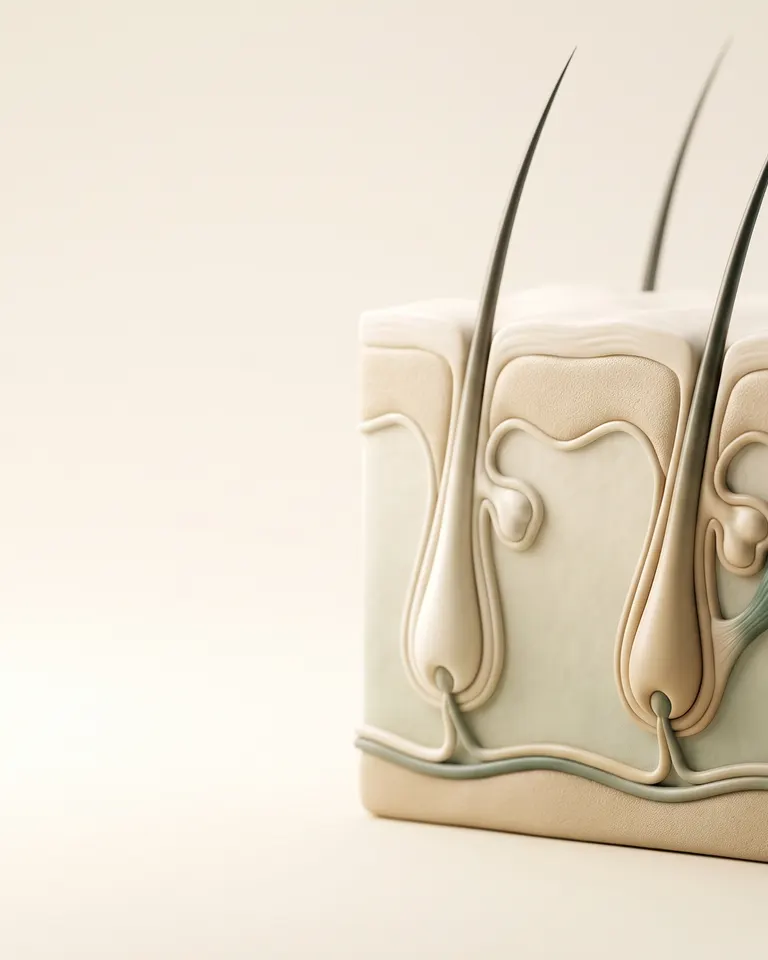
Beard Transplant: What Scalp Hair Does and Does Not Do on Your Face
Scalp hair on a face behaves like scalp hair: it keeps growing and needs shaving. What transfers well, what looks wrong if angles are careless, and what it costs your scalp.
Written and medically reviewed by Dr. Nyra, MBBS, MD (Dermatology)
A beard transplant moves hair follicles from the back and sides of your scalp into the parts of your face where a beard grows thinly or not at all. It generally works, in the sense that the follicles take and grow. What surprises people is that the hair which grows is still scalp hair: it keeps the character of the place it came from, it keeps growing past the length a beard would stop at, and it needs trimming like the rest of your beard.
So the realistic expectation is not a beard as such, but scalp hair placed carefully enough that it reads as a beard at conversational distance. Whether it does depends far less on the graft number than on three things: the angle each hair is set at, how densely each zone is filled, and whether your donor area can spare the grafts without compromising a scalp you may want treated later. Those three things are what this article is about.
What a beard transplant actually moves
The procedure is a relocation, not a creation. Follicular units, the natural groups of one to a few hairs that hair grows in, are removed individually from the scalp, usually by FUE extraction from the back and sides of the head, and placed into very small sites made in the beard area. No new follicles are generated anywhere. The number of hairs you own stays the same; some of them move from a place where they are plentiful to a place where they are wanted.
The back and sides of the scalp are used because hair there is generally resistant to the hormonal process behind pattern hair loss, and it tends to keep that resistance after it moves. In selected cases hair from under the chin or on the neck can be used instead, which is closer to beard texture but a far smaller and less predictable supply.
Grafts are placed either into pre-made sites or with an implanter pen, and on a face the choice often varies from one zone to the next. The beard transplant procedure at our Sector 39 clinic sets out what happens on the day. What follows is about what the result can and cannot be.
Scalp hair and beard hair are not the same hair
Transplanted scalp hair keeps its scalp characteristics. It is usually finer and straighter than beard hair, it may be a slightly different shade, and it has a longer growth phase, so left alone it grows longer than your native beard would. Most people find it blends once trimmed to beard length, but the difference does not disappear entirely.
Beard hair is a different kind of hair. It is typically coarser, often curlier, and its growth phase is shorter, which is why many beards seem to stop at a certain length however long they are left. Scalp hair placed in the cheek does not turn into beard hair. The skin around it does not instruct it to change, and nothing reliably makes it do so.
In practice this matters in two situations:
- Mixed zones. Where grafts sit among plenty of native beard hair, a finer, straighter hair can stand out if both are grown long. Kept at stubble or short-beard length, the difference is rarely obvious.
- Colour. Beards often carry red or lighter tones that scalp hair lacks, and grey tends to arrive in the beard at a different pace from the scalp. A good match today is not a promise of the same match at fifty.
Some change in texture over the first year is normal. New hairs often emerge fine and coarsen as they mature. That is change within the range of scalp hair, not a transformation into beard hair.
Angle, direction and density: where the result is won or lost
Facial hair lies almost flat against the skin, and its direction changes across the face. A graft set at a scalp angle stands up and bristles, and no amount of trimming hides it. The angle and direction of each recipient site, far more than the graft count, decide whether a transplanted beard reads as natural or as work done.
On the cheek, hair sweeps downward. Along the jaw it fans outward. Under the chin it turns inward towards the neck, and across the upper lip it points down and away from the midline. Each change has to be reproduced site by site. The logic is the same one behind why placement matters more than graft count in a hairline, only with flatter angles and less forgiveness.
Density: a beard is not a scalp
A natural beard carries far fewer hairs over a given area than a full scalp, and its visible edges are made of single hairs rather than clusters. Two errors follow from ignoring that. Packing grafts too densely produces a tufted, artificial look. Placing multi-hair grafts along the cheek line or the moustache border produces an edge that looks planted. The principle is single-hair grafts along every border and larger units kept to the interior, which is why beard grafts are sorted under magnification rather than used as they come out.
Irregularity is deliberate. A ruled cheek line looks drawn on. Real beards thin out gradually at their edges, and a design that copies that looks unremarkable, which is exactly the aim.
Zone by zone: moustache, cheeks, jawline and sideburns
Most requests are not for a whole beard but for one or two zones that never filled in. Each behaves differently.
Moustache and goatee
Upper-lip hair points sharply downward, the skin is thin and mobile, and the area moves every time you eat or talk. Swelling there is noticeable for the first few days. Grafts here tend to be single hairs placed with particular care, and closing the gap between moustache and chin is often a small graft count with a large visual effect.
Cheeks
Patchy upper cheeks are the commonest reason men ask about a beard transplant. The cheeks are also the largest area, and the most graft-hungry where little native hair grows. The upper border is the most visible edge of any beard, so its height is drawn on your face with you sitting upright, and agreed before anything is placed.
Jawline
Carrying density along the jaw is what defines the face in profile. Where there is some growth to build on, this is modest work. Where there is none, it becomes a larger job that competes with the cheeks for the same grafts.
Sideburns
Sideburns are usually a smaller part of a plan, often requested for symmetry, to connect scalp and beard, or after a previous scalp procedure left them out of proportion. They are also where scalp hair and beard hair meet naturally, so a texture difference is least noticeable here.
Mature scars within the beard area, whether surgical, accidental, from a burn or from cleft-lip repair, can also be grafted, with the caveat that scar tissue has a poorer blood supply and graft survival is less predictable. Eyebrows follow the same design principles in an even less forgiving zone, and eyebrow transplantation is covered on its own page.
The donor trade-off with your scalp
Beard grafts come out of the same finite donor area a scalp transplant would use. Hair extracted from the back of the head does not grow back there. Every graft placed in your cheek is one that cannot later cover a receding hairline or a thinning crown, so a sensible beard plan has to account for the scalp you may have in ten or twenty years.
This is the part of the conversation most often skipped. A man in his late twenties with a patchy beard and early recession at the temples is not choosing between a beard now and nothing. He is spending from a budget whose future demands are not yet known. A family history of pattern hair loss is a reason to plan conservatively, not necessarily a reason to refuse. How donor supply is measured, and why it is a one-time budget, explains the arithmetic.
A careful plan does three things. It measures donor density rather than guessing it. It asks directly how much scalp loss there is now and what the family pattern suggests. And it tells you, before the beard is designed, if the numbers would compromise a future scalp hair transplant. The graft count that comes out of that process is also what drives what a beard transplant costs in Gurgaon, which is one more reason it should be derived from a mapped design rather than chosen from a package.
Who should wait, and who should not proceed yet
A beard transplant suits someone whose facial hair has stopped changing, whose donor area can spare the grafts, and whose beard-area skin is healthy. If the beard is still filling in, if the patches might be alopecia areata, or if the skin is inflamed, the right answer is time or treatment first, and surgery only afterwards.
- A beard still developing. Facial hair often keeps filling in through the late teens and into the twenties. Grafting before it settles can leave transplanted zones out of step with native growth that arrives later. Whether a patchy beard is worth waiting on covers how to tell.
- Patches that may be alopecia areata. Smooth, well-defined patches that appeared where hair used to grow are a different problem from a beard that never filled in. The condition can affect the beard, DermNet describes its course as unpredictable, with frequent relapses, and grafts placed into an active patch can be lost. It needs diagnosing and treating as a medical condition first.
- Skin problems in the beard area. Active acne, recurrent folliculitis, keloid-prone skin or a scar that is still red and maturing all change the plan or the timing.
- Medication and general health. Isotretinoin, blood thinners, diabetes, thyroid disease and bleeding disorders need to be disclosed. Some alter the timing; some alter the plan.
Facial hair as part of gender-affirming care is a reasonable indication. It is usually considered once masculinising hormone therapy has had enough time to show what grows on its own, and planned alongside the doctors already managing that treatment.
Suitability is decided on examination, and it should be decided by someone qualified to operate. Who may perform this surgery in India is regulated, and who is legally allowed to perform a hair transplant sets out the rule and how to check a registration.
Your own case
Will scalp hair actually read as a beard on your face?
A consultation maps your existing growth zone by zone, measures what your donor area can spare against any future scalp needs, and rules out alopecia areata before a single border is drawn.
What the first year looks like
Recovery has its own article, the beard transplant recovery timeline, so only the outline belongs here. Small crusts form around each graft and sit on the face for roughly the first week, with redness and some swelling. The transplanted hairs commonly shed somewhere between the second and fourth weeks while the follicles stay in the skin. New growth usually begins around three to four months, unevenly and finer than it will end up, and the result is fairly judged at around ten to twelve months.
Two practical points are specific to the face. It cannot be hidden under a cap, so most people plan the first week or two around anything client-facing. And beard skin is more prone than the scalp to inflamed follicles and ingrown hairs as new hairs break through; DermNet notes that in the beard area irritant folliculitis is known as pseudofolliculitis barbae. It is usually minor and treatable, but it should be looked at rather than squeezed.
When trimming and razor shaving are allowed is decided by your doctor at a review, according to how the grafts have healed, not by a date printed on a website. Trimming is usually cleared first.
What a beard transplant cannot do
- It cannot create more hair than your donor area holds. A full, dense beard for someone with almost no native growth may not be affordable in grafts, or may need to be staged across sessions.
- It cannot turn scalp hair into beard hair. Texture and growth length stay those of the donor site.
- It cannot promise a density or a survival figure. Not every graft survives, native hair around the grafts can shed temporarily, and some zones need a planned second session.
- It cannot quickly fix a poor angle. Grafts set to bristle keep bristling, and correcting them means further surgery.
- It does not stop change. The native beard around the grafts still ages, greys and shifts over the decades.
Photographs are the other place expectations get set. A beard photographed freshly trimmed, oiled and lit from the side can look very different under overhead office lighting, and reading before-and-after photos critically applies to faces just as much as scalps.
If you are weighing it up, bring the question you actually have. It is not whether beard transplants work in general, but whether your face, your donor area and your scalp's likely future make it a good trade for you. That is what an examination by a registered medical practitioner is for, and it is a question an honest consultation will sometimes answer with not yet.
Beard transplant expectations FAQs
Will transplanted beard hair grow as long as scalp hair?
It can, because it keeps the longer growth phase of the scalp hair it came from. Left untrimmed, transplanted hairs usually outgrow the native beard around them. In practice that means trimming them to the same length as the rest of the beard, which most men with a beard do anyway. It is a maintenance point rather than a problem, but it is worth knowing before surgery.
Can I shave my beard off completely after a transplant?
Yes, once your doctor has cleared razor shaving. The follicle sits below the skin, so a razor removes the hair shaft rather than the graft, and the hair grows back as stubble. The risk is shaving too early, while grafts are not yet secure and the skin is still healing. Trimming is normally cleared before a razor is.
Is FUE or DHI better for a beard transplant?
Neither is better for every beard. Extraction is the same in both; what differs is placement. An implanter pen sets depth and angle at the moment each graft goes in, which is useful along visible edges, while pre-made sites let the whole pattern be reviewed before placement, which is efficient across larger areas. Many beard cases use both. See how DHI placement works.
Can hair from my beard be used for my scalp instead?
In selected cases, yes. Beard hair is coarser than scalp hair, so it is generally used as a supplementary source for density in the crown or in repair work rather than for a hairline. It means accepting small extraction marks in the beard. It is assessed individually and is not a way around the limits of the scalp donor area.
Will a beard transplant leave scars on my face?
The recipient sites on the face are very small and usually become hard to see once healed, although pinkness can last for some weeks. The scalp donor area is left with small dot-like marks after FUE, usually hidden by the surrounding hair but visible if the back and sides are clipped very short. Anyone with keloid-prone skin should say so at the consultation, because it changes the risk.
How do I know whether my patchy beard is alopecia areata?
A mirror will not reliably tell you. Alopecia areata patches tend to be smooth, well defined, and appear where hair used to grow, sometimes over a few weeks, whereas a genetically patchy beard has simply never filled in. Examination of the patch and its edges under magnification settles it. A transplant is not considered while the condition is active.
Medical disclaimer. Information on this website is general patient education. It is not medical advice and does not create a doctor-patient relationship. Suitability, graft numbers and treatment plans are decided only after an in-person examination by a registered medical practitioner. Outcomes differ from person to person, and no particular outcome, density or timeline can be promised.
Related treatment
Considering beard transplant treatment?
This article is patient education. What applies to your own case is decided after an examination — the treatment page sets out how that works, what it costs and what to expect.