When Does a Beard Fully Grow In? Age, Genes and Hormones
Why many men's beards keep filling in until their late twenties, the role of genes and hormones, and when a patchy beard is worth assessing.
Written by the DenceSpot Clinic team
For most men a beard keeps changing for years after it first appears. Facial hair usually starts in the mid-teens, and Cleveland Clinic notes that most beards keep developing in thickness and coarseness from about 18 to 30. How full a beard finally becomes is decided mainly by genes, through how strongly the facial follicles respond to DHT, rather than by how much testosterone is in the blood.
That is why two brothers with similar hormone levels can end up with very different beards, and why a sparse beard at 20 tells you little about the beard you will have at 28. This article explains the timeline and the biology behind it. If you already know your beard is patchy and want a practical plan for tracking it and deciding what to do, whether a patchy beard is worth waiting on covers that step by step.
The usual timeline, from puberty to the late twenties
Facial hair is one of the later changes of puberty. It usually begins as a few darker hairs at the corners of the upper lip and spreads across the moustache area. Hair then appears below the lower lip and on the upper cheeks, and finally spreads over the chin, the sides of the face and the jaw. The order is broadly similar between men, though not identical. The timing varies far more.
| Stage | Where hair appears | Broad timing |
|---|---|---|
| First signs | Corners of the upper lip | Early to mid teens |
| Moustache | Across the upper lip | Mid to late teens |
| Lower lip and upper cheeks | Below the lower lip and high on the cheeks | Mid to late teens |
| Chin, sides and jaw | The chin, the sides of the face and the jawline, joining into a beard | Late teens into the twenties |
| Filling in | Existing areas become denser, darker and coarser | Through the twenties, for many men towards 30 |
The last stage is the one people underestimate. Even after hair has appeared in every zone, individual follicles keep converting from fine, light hairs into thicker, pigmented beard hairs over several years. A beard that looks thin at 21 is often a beard partway through that process, not a finished one.
Hair appearing in a zone is not the same as that zone filling in. The upper cheeks and the strip connecting moustache to chin are commonly the last areas to become dense, and in some men they never do. Both outcomes are normal variation.
Hormones: why DHT matters more than testosterone level
Beard growth is driven by androgens, the group of hormones that includes testosterone. During and after puberty, androgens gradually convert small follicles producing fine, almost invisible hair into larger follicles producing thick, pigmented hair. How far that conversion goes in any one area depends on the follicles there.
Testosterone is converted to DHT in the follicle
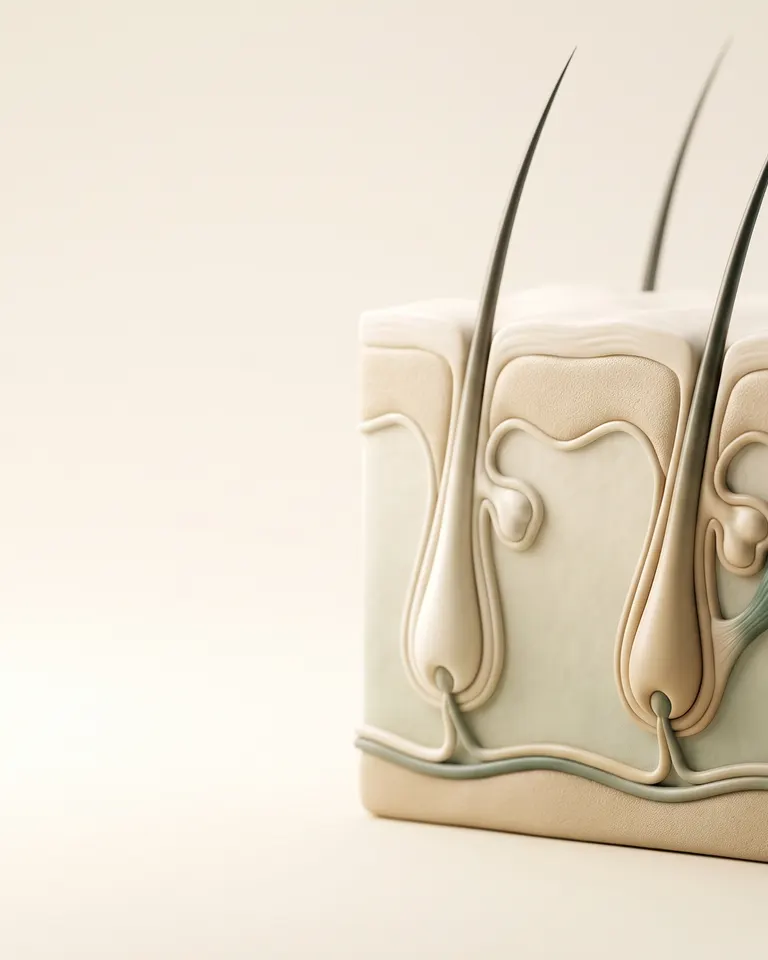
Within beard follicles, an enzyme called 5-alpha reductase converts testosterone into dihydrotestosterone, or DHT, a more potent androgen. DHT is what does most of the work on beard hair. The clearest evidence comes from a rare inherited condition in which this enzyme does not work properly: MedlinePlus Genetics notes that people with it do not develop much facial or body hair, even though they make testosterone. A small study published in the British Journal of Dermatology in 1982 likewise found that facial hair growth tracked blood DHT levels rather than testosterone.
The follicle's sensitivity is the deciding factor
Hormones act on a follicle through androgen receptors. Laboratory research has found that cells from beard follicles carry more androgen receptor than cells from scalp follicles that do not bald, which is one reason the beard responds to androgens so strongly. How many receptors a follicle has, and how responsive they are, is largely inherited.
This is why testosterone level on its own is a poor predictor of beard density. If you have been through puberty normally and have adult body hair, your testosterone is very likely in the normal range, and a patchy beard reflects follicle sensitivity rather than a hormone shortage. Clinically low testosterone can affect hair growth, and a doctor would look for its other signs before testing.
The same hormone can act in opposite directions in different places. DHT thickens beard hair, yet in men predisposed to pattern hair loss it gradually shrinks scalp follicles. Researchers call this the androgen paradox, and it is the reason medicines that lower DHT are used for scalp hair loss, as minoxidil and finasteride in India explains.
Genetics and family pattern
How thick your beard becomes, where it grows and when it finishes filling in are all strongly inherited. A genome-wide study of more than 6,000 people, published in Nature Communications in 2016, identified the first specific gene regions linked to beard thickness. Beard density is very likely shaped by many genes rather than one, which is part of why beards vary so much even within families.
Genes come from both parents, so look at the men on your mother's side as well as your father's. Older brothers and cousins at a similar age are often the most useful comparison, because you can see what their beards looked like at your age and what they became.
Variation between populations
Average beard density also differs between populations, as many inherited traits do. Cleveland Clinic notes that men from Mediterranean countries tend to grow thicker beards, and research has found that Chinese men on average have less facial hair than white men. Within India there is wide variation between regions, communities and families. These are averages across large groups, not predictions about any one man, and a lighter beard that is typical for your family is simply normal variation. It is not a deficiency and not a medical problem.
Two myths that waste time and money
Shaving makes a beard grow back thicker
It does not. A razor cuts the hair at the surface and has no effect on the follicle beneath, on how many follicles you have or on how quickly they mature. Regrowth feels coarser because the cut end is blunt rather than tapered, and short stubble can look darker against the skin. Shaving regularly through your twenties will neither speed up nor slow down the filling-in described above.
Testosterone boosters will thicken a beard
Supplements sold as testosterone boosters are widely advertised to young men, often with beard growth as an implied benefit. A 2020 analysis in the World Journal of Men's Health looked at 50 such products and found that most of their ingredients had no published evidence of raising testosterone, and 13 products contained zinc, vitamin B3 or magnesium above recommended upper limits.
Even if a supplement did raise testosterone, it would not follow that the beard would thicken. In men whose hormone levels are already normal, the limiting factor is follicle sensitivity, not the amount of hormone available. The US Food and Drug Administration has also repeatedly warned that some bodybuilding products sold as supplements contain hidden steroids or steroid-like substances, with risks that include liver injury and infertility. If you are worried about your hormones, a doctor can examine you and test them properly.
Your own case
Not sure whether your beard is still filling in?
A consultation looks at each zone of the beard under magnification, separates fine developing hair from genuinely bare skin, and checks for alopecia areata or other causes, so you know whether waiting is the right plan.
When patchiness is worth assessing
Most patchy beards in men under 25 are simply unfinished, and the right response is time. What changes that is hair being lost rather than hair not yet arriving, or patchiness that comes with other signs. The following are worth having examined rather than waited out.
- Sudden, smooth, round patches where hair used to grow, especially if they appear over a few weeks or new ones follow. This pattern suggests alopecia areata of the beard; alopecia barbae and round bald patches in the beard explains how it is recognised and why it is managed differently.
- Red, itchy, scaly or pustular areas with hairs that break or pull out easily, which suggest infection or inflammation of the follicles.
- Hair loss elsewhere at the same time, such as patches on the scalp or in the eyebrows.
- A very sparse beard with other signs that puberty has not fully progressed, such as little body hair, a voice that has not deepened or a late growth spurt.
- A beard that thins noticeably after years of being stable, particularly with other symptoms such as tiredness or weight change.
When to see a doctor
See a doctor promptly if any of the signs above apply to you, or if your beard has changed suddenly and you do not know why. If your beard is simply slower or sparser than you would like and nothing else is wrong, there is no urgency. It is still reasonable to ask for an assessment once you are in your mid-twenties and your photographs show no change across a year or more, or sooner if the patchiness is affecting how you feel.
Be cautious about treatments started without an examination. Topical minoxidil is sometimes prescribed off-label for a sparse beard, with limited evidence; whether minoxidil works for beard growth sets out what the trials show. A beard transplant moves scalp hair into the beard and is planned only once the pattern has settled; what a beard transplant realistically delivers explains how that hair behaves on the face.
Getting it assessed
At our clinics in Sector 39, Gurugram and Rohini, Delhi, a registered medical practitioner examines the beard zone by zone, separates developing hair from settled gaps, and rules out conditions that need treatment. If you are still filling in, you will be told so. If the pattern has settled and you want to discuss options, beard transplant at our Gurugram clinic and beard transplant at our Rohini clinic explain how candidacy is decided at each.
Beard growth and age: more questions
At what age does a beard stop getting thicker?
There is no single age. Facial hair usually starts in the mid-teens, and Cleveland Clinic notes that most beards keep developing in thickness and coarseness between about 18 and 30. Some men reach their full beard in their early twenties, and others are still seeing change near 30. Your own photographs over time are a better guide than a birthday.
Does a patchy beard mean low testosterone?
Usually not. If you have been through puberty normally and developed adult body hair, your testosterone is very likely in the normal range. Beard density depends mostly on how responsive your facial follicles are to hormones, which is inherited. A very sparse beard alongside other signs that puberty has not fully progressed is different, and worth discussing with a doctor.
Do testosterone boosters help grow a beard?
There is no good evidence that they do. A 2020 review of 50 testosterone booster products found that most of their ingredients had no published evidence of raising testosterone, and some products contained vitamins and minerals above safe daily limits. In men with normal hormone levels, extra testosterone is not a recognised beard treatment anyway.
Can I tell from my father what my beard will be like?
Partly. Beard density is strongly inherited, but genes come from both parents, so the men on your mother's side are as relevant as your father. Brothers and cousins at a similar age can be a useful comparison too. Family resemblance gives you a likely range, not a prediction.
Why is my moustache thick but my cheeks bare?
Follicles in different parts of the face respond to androgens at different rates and to different degrees. The moustache and chin usually fill first, and the upper cheeks and the strip joining moustache to beard often come last or stay sparse. That pattern is common and on its own is not a medical problem.
Can a beard thin out with age?
A beard can lose some density or turn grey over the decades, but new bald patches in a beard that used to be full are not a normal part of ageing. Smooth, round patches suggest alopecia areata, and inflamed or pustular patches suggest infection. Either should be examined rather than waited out.
Medical disclaimer. Information on this website is general patient education. It is not medical advice and does not create a doctor-patient relationship. Suitability, graft numbers and treatment plans are decided only after an in-person examination by a registered medical practitioner. Outcomes differ from person to person, and no particular outcome, density or timeline can be promised.
Related treatment
Considering beard transplant treatment?
This article is patient education. What applies to your own case is decided after an examination — the treatment page sets out how that works, what it costs and what to expect.