FUE vs FUT: Scarring, Donor Yield and Why the Strip Method Still Exists
One leaves a linear scar, the other leaves hundreds of small ones. A straight comparison of donor yield, healing, hair length and who each method genuinely suits.
Written and medically reviewed by Dr. Nyra, MBBS, MD (Dermatology)
FUE is often presented as the only current method, with the strip method described as outdated. That is a simplification, not a clinical conclusion. Follicular unit transplantation is still taught, still practised by experienced surgeons, and for a small, identifiable group of patients it remains the better engineering choice.
The opposite claim is no better. Punch extraction is routinely sold as though it left nothing behind. It does not. It replaces one line with hundreds or thousands of small round wounds, each healing with a pale mark and a permanently absent follicle. Both methods draw on a finite donor area and both alter it. The real question is which kind of scar, and at what cost in yield, healing and hairstyle.
How each harvest actually works
The recipient side is broadly identical: sites are made in the thinning area and grafts placed one at a time, at an angle and density the surgeon decides. Everything that genuinely differs happens at the back of the head.
The strip
A horizontal ellipse of scalp is excised from the safe donor zone at the back, roughly a centimetre tall and as long as the graft number demands, and the edges are closed with sutures or staples. The strip goes to a bench, where technicians working under stereomicroscopes slice it into individual follicular units, the natural clusters of one to four hairs in which scalp hair grows.
That microscopic dissection is the point of the method. The follicle is seen throughout, so tissue is trimmed deliberately rather than guessed at, and grafts arrive with a predictable cuff around the bulb.
The punch
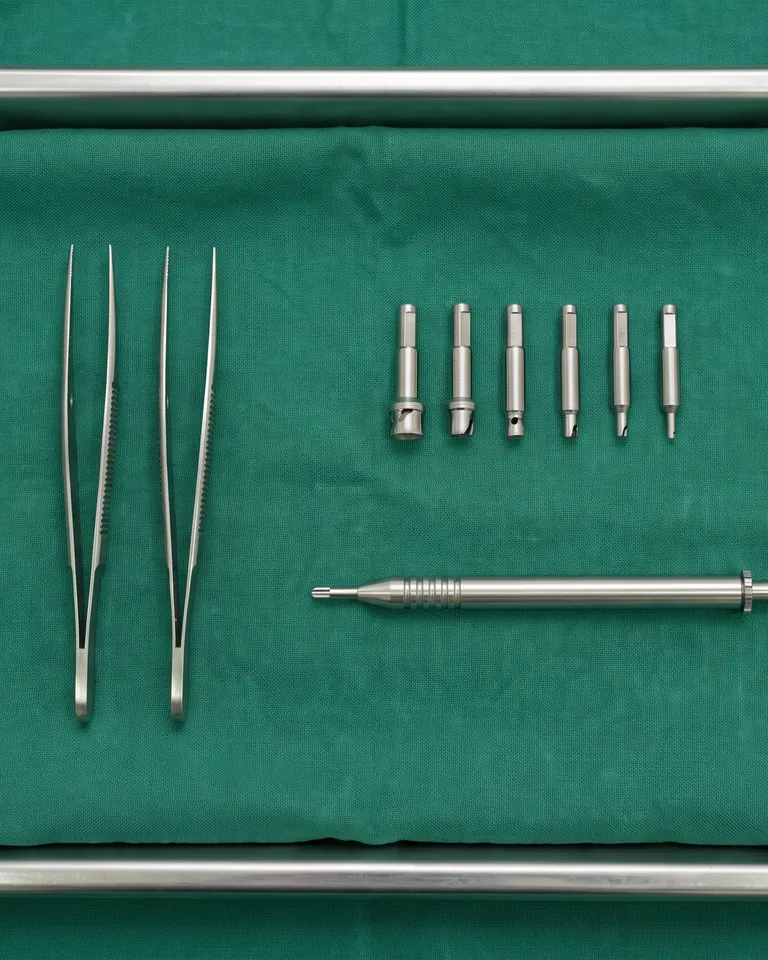
Each follicular unit is scored individually with a circular punch, typically under a millimetre across, then lifted out with forceps. Nothing is stitched; the holes close on their own. Because units come out one at a time, the harvest spreads across the back and both sides rather than sitting in a strip zone. The technical detail of follicular unit extraction is covered separately.
The trade-off is that the follicle below the skin is never seen while it is cut. Angle and depth are judged from the surface, and hairs that curve beneath it, common in coarse or curly hair, do not always follow the punch.
Scarring compared honestly
A strip leaves one linear scar. Well executed, in someone who heals normally, it is a fine white line hidden by hair of a couple of centimetres. Badly executed, or in someone whose tissue stretches, it widens into a visible band. Closure tension, the height of the ellipse and individual healing decide which you get, and only the first two are anyone's to control.
Punch extraction leaves diffuse punctate scarring: many small round marks across the donor zone. Individually they are hard to see. Collectively they matter twice over. At very short clipper lengths a heavily harvested area can look moth-eaten. More importantly, every extracted unit thins the area it came from, so taking too many, too closely, leaves a donor zone that reads as sparse even at ordinary lengths, and nothing reverses that. It is the failure mode treating the donor area as a one-time budget exists to prevent.
Both methods leave scars. One concentrates the scarring into a line you can cover with hair; the other spreads it across an area you cannot uncover if you later decide to shave.
Hair length, and going back to work
This is the practical difference patients underestimate. A punch harvest normally needs the donor area clipped very short, and for larger sessions the whole back and sides are shaved, which stays visible while the extraction points settle. For a strip, only a narrow band is trimmed and the hair above falls over the closure, so many patients look unremarkable within days.
The method with the smaller long-term footprint therefore often demands the more conspicuous short-term one. Keep your hair long and a strip may be invisible from the first day. Keep it at a grade 2 and the shave makes little difference, while the line would have been the thing on show.
Donor yield, transection and graft quality
Two questions get muddled here: how many grafts one session can produce, and how good they are.
On single-session volume, a strip generally has the advantage when very large numbers are needed, because a longer ellipse yields more units in one sitting than punch extraction can comfortably harvest without over-thinning a zone. Punch extraction reaches comparable totals across staged sessions or a longer operating day.
Transection — a follicle cut through during harvest — occurs in both and is not a fixed figure. It varies with the surgeon's experience, the punch used and your own hair: curl, calibre, laxity, the angle at which hairs leave the scalp. Under a stereomicroscope transection is visible and correctable at the bench; in punch extraction it is judged blind, which is why asking for a small test extraction first is reasonable.
Graft quality follows the same logic. Microscopic dissection gives units with consistent surrounding tissue; punch extraction tends to give leaner grafts that handle differently and tolerate less time outside the body. Neither is inherently better, and both are operator-dependent, which explains more about why two quotes for the same head differ than any equipment named on a price list.
Healing, sutures and numbness
After a strip, sutures or staples usually stay in for around a fortnight, with a defined soreness along the closure while tension settles. Numbness above the scar is common and typically fades over weeks to months, occasionally longer, because small sensory nerves are divided during the excision. Tightness in the first days is expected.
After punch extraction there is nothing to remove. The donor site scabs and settles over roughly a week, with a diffuse ache rather than a line of tenderness, and numbness is generally less pronounced. Against that, the harvest touches a far larger surface area, so redness can persist longer in some skin types.
Both share the same recipient-side course: crusting, then shedding, then months of waiting, none of which cares how the grafts were obtained. See what the first fortnight actually looks like and the full aftercare protocol.
| Consideration | Strip harvest | Punch harvest |
|---|---|---|
| Donor scar | One linear scar | Many small marks plus diffuse thinning |
| Shaving needed | A narrow band only | Usually the whole donor zone |
| Closure | Sutures or staples, removed later | None; wounds heal open |
| Numbness | More common above the scar | Usually less pronounced |
| Very large single sessions | Generally easier | Often staged |
| Very short hairstyles | Scar may show | Usually more forgiving |
When a strip still makes sense
Three situations, none of them rare.
Very large sessions in extensive loss. Where a substantial area needs covering in as few sittings as possible, yielding many well-dissected grafts at once is a genuine advantage. Whether that applies to you depends on measured supply, not a stage number, so what your Norwood stage does and does not decide is worth reading alongside this.
A narrow safe donor zone. The safe donor zone is not the whole back of the head, and in some men it is a slim band. Punch extraction needs width to spread the harvest; without it, units come from outside the safe zone, which means grafting hair that will itself be lost later. A strip taken within the band avoids that trap.
Hair worn long, permanently. If you have never worn a clipper cut and do not intend to, a concealed line matters little, while widespread donor thinning would show in the styles you actually wear.
Your own case
Does your donor area actually favour one of these methods?
Measuring donor density, safe-zone width, hair calibre and scalp laxity is what settles the method question, and that assessment is the part no comparison article can do for you.
When punch extraction is clearly preferable
The other side is equally specific.
Short hairstyles. If you wear a grade 1 or 2, or expect to, a linear scar is a permanent constraint on your haircut.
A strong aversion to a visible line. Some patients will not accept one at any width, and that is a legitimate preference rather than something to argue them out of.
Beard or body hair as donor supply. Only punch extraction can harvest the face or torso, which matters when scalp donor is limited. The same technique runs the other way for a beard transplant.
Small, precise sessions. Filling a scar, refining a temple or a modest hairline touch-up rarely justifies a strip.
Placement preferences. Punch extraction pairs with pre-made channels or implanter pens, so if that distinction matters, the implanter-pen approach and the comparison of FUE against DHI deal with it properly.
Combining both across a lifetime
Pattern hair loss is progressive, and surgery does not halt the underlying process (DermNet on androgenetic alopecia; NHS on hair loss). Many men operated on in their thirties want more done in their fifties, which makes the first procedure a decision about the second.
Surgeons therefore sometimes plan across methods: a strip first, while laxity is good and the safe zone intact, then punch extraction later from tissue above and below the closure. Reversing that order is harder, because a donor area already thinned by extraction leaves less scope for a comfortable closure. That sequencing argument is the strongest reason the strip method has not disappeared, and it bears on what corrective surgery can and cannot fix when a first procedure has overdrawn the donor supply.
How the decision is actually made
Not from an article, and not from a photograph. The variables are measured: donor density, safe-zone width, hair calibre and curl, scalp laxity, previous scarring, and the total area that will eventually need covering rather than the part bothering you today. Set against how you intend to wear your hair, those measurements decide the method. Sometimes either would work, and the choice comes down to your tolerance for a line against a shave.
What should worry you is a clinic that names the method before examining you, or dismisses one outright. Both answer different problems honestly, and the risks of each deserve setting out before you consent, which is what the expected, uncommon and permanent risks covers. To know who is making the call, the doctor's qualifications are a fair place to start, and the hair transplant assessment in Gurgaon sets out what a consultation involves. If the graft number is your real question, how a graft count is arrived at is the companion piece to this one.
FUE and FUT FAQs
Can a strip scar be camouflaged if I shave my head later?
Partly. Scalp micropigmentation can break up the visual line by tattooing dots into and around it, and hair can sometimes be grafted into a soft scar to soften the edge. Neither removes it. If a grade 1 or 2 clipper cut is your permanent hairstyle, plan the donor decision around that from the start rather than around a later fix.
Does one method cost less than the other?
The two are priced differently in most clinics because theatre time, staffing and consumables differ, but which works out lower depends on graft numbers and how the session is planned. There is no useful general answer. What actually moves a number is set out in how hair transplant cost is worked out and on the payment options page.
Can grafts be taken from the beard or chest instead of the scalp?
Yes, by punch extraction only, because a strip cannot be taken from the face or torso. Beard hair is thicker and coarser and behaves differently once placed, so it is generally used for density behind the hairline or in a crown rather than at the frontal edge. Suitability is judged by examining the donor hair itself.
Is punch extraction safer if I scar badly or form keloids?
Not automatically. A tendency to keloid or hypertrophic scarring can affect hundreds of small wounds as readily as one long one, and in some skin types the punctate marks become more visible rather than less. Tell the doctor about any previous raised or spreading scar before a method is chosen, not afterwards.
Does the recipient area have to be shaved as well?
Often not. Existing hair in a thinning recipient zone is usually kept and grafts are placed between the standing hairs. Complete shaving of the top is sometimes advised for very large sessions or dense packing, because visibility improves placement accuracy. It is a separate decision from what happens at the donor site.
When can I wear a motorcycle helmet again after donor harvesting?
Not in the first days, and the timing is judged case by case, because a helmet presses on both the recipient grafts and the healing donor site. A sutured closure and open punch wounds are also assessed differently. Gurgaon commuting makes this a practical planning question, covered in recovering from surgery in Gurgaon heat and traffic.
Medical disclaimer. Information on this website is general patient education. It is not medical advice and does not create a doctor-patient relationship. Suitability, graft numbers and treatment plans are decided only after an in-person examination by a registered medical practitioner. Outcomes differ from person to person, and no particular outcome, density or timeline can be promised.
Related treatment
Considering hair transplant treatment?
This article is patient education. What applies to your own case is decided after an examination — the treatment page sets out how that works, what it costs and what to expect.