Unshaven Hair Transplant, and When It Is Actually the Right Choice
A transplant without shaving your head is real, and it is not simply a better version of the same operation. It is slower, it caps how many grafts can sensibly be done in a day, and it suits some cases far better than others. Here is the honest version, so you can decide with the trade-offs in front of you.
- Full no-shave and partial-shave options
- Told honestly if your case needs a shave
- Graft ceiling explained before you book
- Gurugram · Mon–Sat · 10:00 – 20:00
Performed & reviewed by
Dr. Nyra
MBBS, MD (Dermatology) · Owner & Chief Consultant, DenceSpot Clinic
Discreet from day one
Existing hair covers the work as it heals.
Partial shave offered
A hidden donor window, hair down over it.
Longer day, planned for
Slower extraction is scheduled, not rushed.
Realistic graft ceiling
You are told the practical limit in advance.
Told when to shave
Large cases are better served trimmed.
The basics, plainly
What Unshaven Actually Means
In a standard procedure the donor area is trimmed short so the punch can follow the direction of each follicle accurately under magnification. Trimming is not a convenience for the clinic — it is what makes the follicle visible and the angle judgeable.
In an unshaven procedure that trimming does not happen. The punch has to be positioned around a follicle surrounded by long hairs, at an angle that has to be inferred from the visible shaft. Extracted grafts then have to be separated from that long hair, and placement is done between existing shafts without damaging them.
None of that changes the biology. A graft harvested this way grows on the same timeline as any other. What changes is throughput — the same number of grafts takes materially longer, and a surgical day does not stretch indefinitely.
That single fact drives everything else on this page: the higher cost, the lower practical graft ceiling, and why large cases are usually better served by trimming.
The version most people choose
Partial shave
The donor is trimmed in a strip or window low at the back, and the longer hair above is left down to cover it completely.
The recipient area stays untrimmed. Wearing your hair normally, nothing is visible.
You get most of the discretion of a fully unshaven approach with much better surgical conditions, and a higher graft ceiling. For the majority of people who arrive asking for no-shave, this is the better answer.
The trade-offs
What You Gain and What You Give Up
This is the section most pages on this subject leave out. Both columns are true at the same time.
What you gain
- No visible shave, so no obvious downtime
- Existing hair conceals healing from day one
- Return to work and social life much sooner
- No period of explaining a shaved head
For someone who cannot disappear for two weeks, this is not a vanity concern. It is often the difference between having the procedure and postponing it indefinitely.
What you give up
- A lower practical graft count per session
- A longer day in the chair for the same result
- Higher cost for the same number of grafts
- Fewer options if extensive coverage is needed
If your loss needs a large session, insisting on no trimming can mean either a compromised plan or several sessions. Neither is hidden from you at consultation.
A claim worth treating carefully
No-shave is not a superior technique
It is marketed that way, with names that suggest an advance on ordinary FUE. It is not. It is the same operation performed under harder conditions, chosen because the patient values discretion. That is a perfectly good reason to choose it. It is not a reason to expect better growth, better density or a better hairline, and any clinic implying otherwise is selling the label rather than the surgery.
Suitability
Who It Suits
Unshaven work fits a particular shape of case: a smaller graft requirement, enough surrounding hair to provide cover, and a real reason to avoid visible downtime.
It is a common choice for women, who often will not accept trimming and whose sessions tend to be in the size range where the approach works comfortably. It also suits refinement work — adding density to an earlier procedure, or softening a hairline — where the numbers are modest by nature.
Where it fits less well is extensive loss needing a large session, and cases where the donor has to be harvested carefully across a wide area to avoid over-concentration. Both need the visibility that trimming provides.
Generally a good fit
- A modest graft requirement
- Enough surrounding hair to give cover
- A genuine need to avoid visible downtime
- Refinement of an earlier procedure
- Women, where surgery is otherwise appropriate
Better served by trimming
- Extensive loss needing a large session
- A donor needing wide, spread-out harvesting
- Very fine or very dense surrounding hair
- Cases where donor safety is already marginal
The process
How an Unshaven Case Runs
Step 01
Assessment
Pattern staged, donor density measured, and the graft number your plan needs established before the shaving question is settled.
Step 02
The honest answer
Whether that number can be done unshaven, whether a partial shave serves you better, or whether the case needs trimming. Said before you book.
Step 03
Procedure day
A longer day than a shaven session of the same size, scheduled as such, with breaks. Local anaesthetic, home the same evening.
Step 04
Growth and review
The usual timeline: shedding, regrowth from around three to four months, fuller at roughly ten to twelve months.
Recovery
What the First Weeks Look Like
Healing follows the same course as any transplant. Small crusts form around each graft and are present for several days, and the donor has tiny extraction points that heal as pale dots.
The difference is cosmetic and it is the whole point of the approach: you have your own hair covering the recipient area from the moment you leave. Most people are comfortable being seen much sooner than after a shaven procedure.
Washing needs particular care, because the instructions have to be followed around hair that is still long. You will be shown exactly how, and it matters more here than usual.
The full timeline is in our recovery and aftercare guide, and your own instructions are given to you in writing.
Still true, even unshaven
- Crusting around grafts for several days
- Shedding of the new hair within weeks
- Growth from around three to four months
- No verdict before ten to twelve months
Extra care needed
- Washing carefully around long hair
- No brushing or combing over the grafts
- No styling products until cleared
- No tying hair back tightly
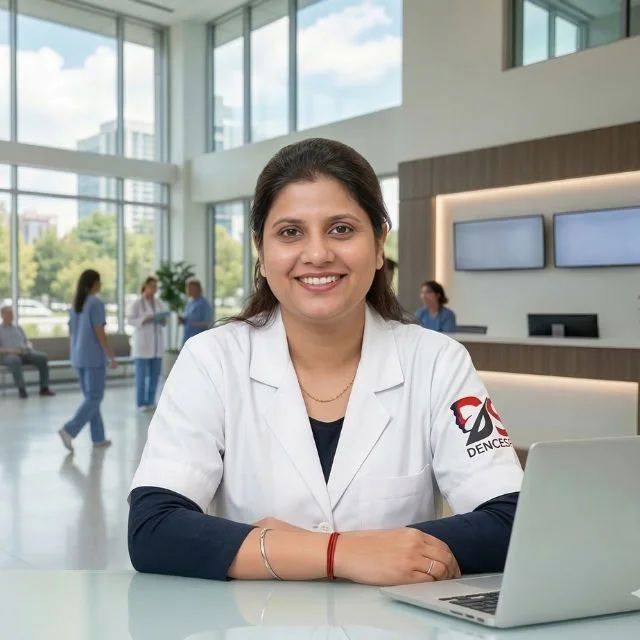
Who performs and reviews this treatment
Dr. Nyra, MBBS, MD (Dermatology)
Owner & Chief Consultant, DenceSpot Clinic
Qualified MBBS from Dr. D. Y. Patil Medical College, and holds an MD in Dermatology. Three years of clinical work in Germany followed — two at Bio Hair Clinic and one at St. Georg Klinikum Eisenach — before establishing DenceSpot in Gurugram.
Why the shaving question is settled after the graft number, not before it: patients often arrive having already decided they will not shave, and the risk is that the plan gets bent to fit that decision. The right order is to establish what the loss actually needs, then ask whether it can be delivered unshaven. Where it can, it is a good option and a genuinely useful one. Where it cannot, saying so is more useful than quietly reducing the graft count to make the marketing claim work.
Qualification
MBBS, MD (Dermatology)
Training
3 years, Germany
Specialization
Dermatology
Cost guidance
Unshaven Hair Transplant Cost in Gurgaon
Unshaven work generally costs more than a shaven session of the same graft count, because it takes longer and time is the principal cost in this procedure. That is stated openly rather than buried.
Number of grafts
From the mapped plan, as with any procedure
Fully unshaven or partial
A partial shave is quicker and priced accordingly
Hair characteristics
Fine or very dense hair makes the work slower
Session structure
Whether the plan needs staging across two days
If a clinic quotes the identical price for shaven and unshaven work of the same size, ask how. The time difference is real, and one of the two numbers is not.
See the full cost breakdown and payment and EMI options.
Get a Personalized Treatment Estimate
Send photos of the thinning area and the donor at the back, and tell us how much downtime you can realistically take. You will get an assessment appointment, not a sales pitch.
Send photos on WhatsApp Request an estimate by formYour details are used only to arrange your consultation.
Visit the clinic
Unshaven Procedures at Our Gurgaon Clinic
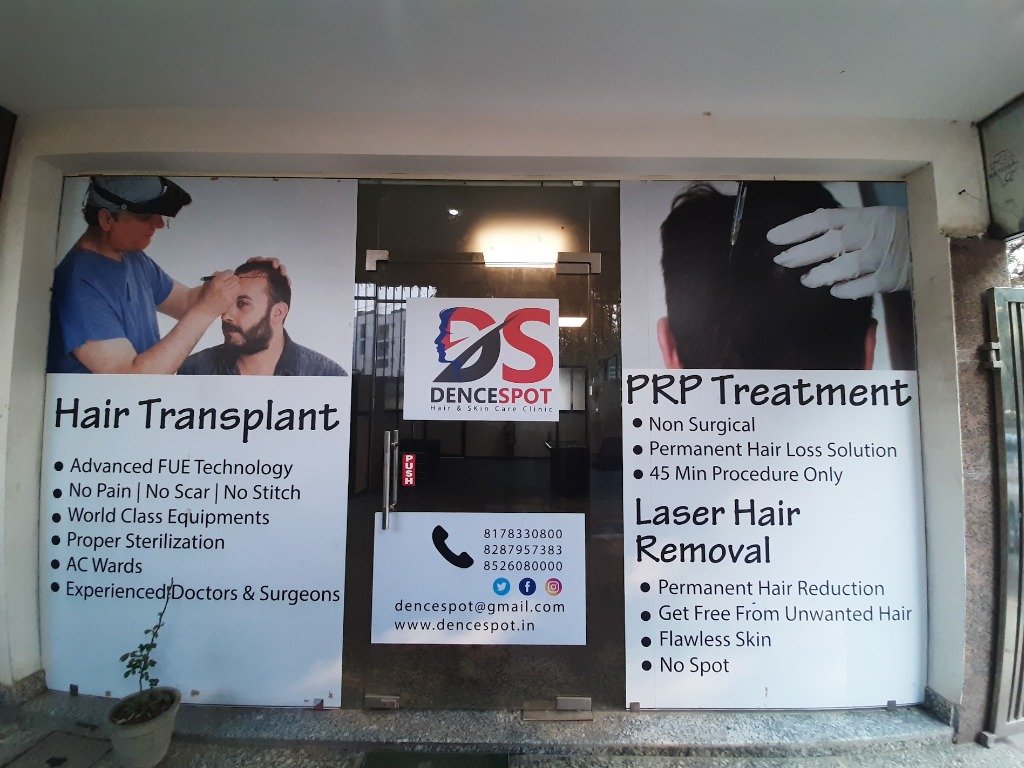
Assessment, surgery and every follow-up happen at our Sector 39 clinic in Gurugram, with the same doctor throughout. Patients travel to us from across Gurugram and neighbouring parts of South Delhi.
- Address
- 1123, Sector 39 Road, Jharsa, C Block, Sector 39,
Gurugram, Haryana 122003 - Phone
- +91 81783 30800
- Message +91 81783 30800
- dencespot@gmail.com
- Hours
- Mon–Sat · 10:00 – 20:00Sunday · closed
Getting here
Next step
Find Out Whether Your Case Can Be Done Without Shaving
Come in and have the graft requirement established first. You will get a straight answer on whether it can be delivered unshaven, whether a partial shave serves you better, and a written plan either way.
Suitability is determined after clinical assessment. This page is patient education and does not constitute medical advice.
Quick enquiry