Hair Transplant for Women, Assessed Before It Is Offered
Women can have hair transplants, and many women who want one should not have one. Female hair loss is more often diffuse, more often has a cause that can be treated, and more often involves the donor area itself. This page explains which cases surgery genuinely suits, and what we look for before saying yes.
- Reversible causes investigated first
- Donor stability checked, not assumed
- Unshaven approaches where they suit the case
- Gurugram · Mon–Sat · 10:00 – 20:00
Assessed & performed by
Dr. Nyra
MBBS, MD (Dermatology) · Owner & Chief Consultant, DenceSpot Clinic
Workup before surgery
Iron, thyroid and hormonal causes are looked for.
Donor examined
Diffuse thinning in the donor changes the answer.
Seen by a doctor
A dermatologist assesses you, start to finish.
Unshaven where possible
Discussed openly, with its limits explained.
Told when not to operate
Most women are better served medically.
The honest starting point
Why Female Hair Loss Is a Different Problem
A hair transplant does not create hair. It moves hair from one part of your scalp to another, and the entire operation rests on one assumption: that the hair at the back and sides is permanent. In typical male pattern loss that assumption usually holds, which is why the surgery works so predictably.
In women it frequently does not hold. Female pattern loss tends to be diffuse — a general thinning across the top and often the whole scalp, rather than a defined bald area with a safe zone behind it. When the donor region is thinning too, grafts taken from it carry that vulnerability with them. The hair is moved, and then it thins in its new position along with everything else.
The second difference is that reversible causes are far more common. Iron deficiency, thyroid disease, post-partum shedding, PCOS, certain medications and periods of significant physical or emotional stress all cause hair loss in women, and all of them respond better to treatment than to surgery.
This is why the assessment comes first and is not a formality. Operating on hair loss that had a treatable cause is the expensive mistake in this field, and it is not reversible — the donor hair is spent.
What we will often recommend
Investigation, then treatment
For a large proportion of women who enquire about surgery, the right answer is a proper diagnosis and medical treatment.
That is not a soft refusal. Diffuse thinning that responds to treatment gives a better and cheaper outcome than surgery could, and it keeps your donor supply intact for later if it is ever needed.
Start at women's hair loss treatment if you have not yet been investigated.
Suitability
When Surgery Genuinely Suits a Woman
There is a real set of female indications where transplantation works well. They share one feature: a defined problem area with a stable donor behind it.
Traction alopecia
Permanent follicle loss along the hairline and temples from years of tight braids, extensions or pulled-back styles. A clear indication, provided the tension has genuinely stopped — transplanted hair is damaged by pulling too.
A high or receding frontal hairline
Where the front has receded or has always sat high, and the rest of the scalp is stable. Hairline lowering by grafting is a common and well-suited female case.
Scars
From surgery, injury or burns, including cosmetic surgery scars at the hairline. Graft survival in scar tissue is lower, so it is often staged and discussed frankly.
Localised loss with a stable donor
A defined area rather than diffuse thinning, with clear density at the back and sides. This is the key distinction the examination establishes.
Established pattern loss, donor spared
Some women do have a defined pattern with an unaffected donor. Where the examination shows that, surgery is a reasonable option.
Eyebrows
Sparse brows after years of plucking are a separate and frequently suitable procedure. See eyebrow transplant.
When we will say no, or not yet
The situations where surgery is the wrong answer
- Diffuse thinning that includes the donor area
- Post-partum shedding that has not been given time
- Untreated thyroid disease or iron deficiency
- Uncontrolled PCOS or another hormonal cause
- Active alopecia areata or scarring alopecia
- Rapid loss that has not yet been diagnosed
- Traction that has not actually stopped
- Loss that started recently and is still moving
None of these are permanent refusals. Several of them become suitable once the underlying problem is treated and the picture settles. What they have in common is that operating now would spend donor hair inside a process that is still running.
The assessment
What Happens Before Surgery Is Even Discussed
The purpose of the first appointment is diagnosis, not booking. Female hair loss has a genuinely wide differential, and the treatment that follows depends entirely on which one you have.
That means a full history — when the loss started, how quickly, whether it followed pregnancy, illness, weight change, a new medication or a period of stress; your menstrual and hormonal history; family history; and what you have already tried.
Then examination: the pattern of loss, whether the thinning is diffuse or localised, the condition of the scalp itself, and direct measurement of donor density at the back and sides. That last measurement is the one that decides whether surgery is even mechanically possible.
Investigations are ordered where indicated. Iron studies and thyroid function come up often; hormonal tests where the history points that way. The point is to find anything treatable before considering an operation.
What to bring
- A list of every medicine and supplement
- Any recent blood test results you have
- Photographs showing how your hair looked before
- Dates — when it started, what else was happening
What you leave with
- A working diagnosis, or the tests to reach one
- An honest answer on surgical candidacy
- A treatment plan, medical or surgical
- A written estimate if surgery is appropriate
The procedure
How the Surgery Works for Women
Mechanically it is the same operation performed on men. Follicular units are extracted from the donor area, sorted under magnification, and placed into sites made across the affected region at the angle and direction of the surrounding hair. It is a day case under local anaesthetic.
Three things are usually handled differently. The first is shaving. Many women will not accept a shaved head, and they do not have to — the donor can often be trimmed in a concealed band with the hair above left long to cover it, and unshaven approaches are available for smaller sessions. They are slower and they suit some plans better than others.
The second is hairline design. A female frontal hairline is generally lower, rounder and without the pronounced temporal recession of a mature male one. Designing a female hairline to a male template is a recognisable error.
The third is what happens afterwards. Because female loss is more often ongoing, medical treatment usually continues alongside the surgery to protect the native hair the grafts do not replace.
Related reading
Unshaven hair transplant — what it can and cannot cover.
Hairline transplant — how a hairline is designed and agreed.
Women's hair loss treatment — the medical route.
Recovery and aftercare — the full timeline.
Timeline, once done
Shedding within weeks, growth from around three to four months, a fuller picture at roughly ten to twelve months. The same as any transplant, and no faster because it is wanted sooner.

Who performs and reviews this treatment
Dr. Nyra, MBBS, MD (Dermatology)
Owner & Chief Consultant, DenceSpot Clinic
Qualified MBBS from Dr. D. Y. Patil Medical College, and holds an MD in Dermatology. Three years of clinical work in Germany followed — two at Bio Hair Clinic and one at St. Georg Klinikum Eisenach — before establishing DenceSpot in Gurugram.
Why the assessment carries more weight here than the surgery does: a woman presenting with thinning hair has a wide differential — iron, thyroid, hormonal, post-partum, traction, medication, autoimmune, or genuine pattern loss. Several of those are fully treatable, and one of them is the only one surgery helps. Getting that distinction right is the entire job. Operating on a woman whose hair loss had a treatable cause spends donor supply she may need later and does not fix the problem she came in with.
Qualification
MBBS, MD (Dermatology)
Training
3 years, Germany
Specialization
Dermatology
Cost guidance
Hair Transplant Cost for Women in Gurgaon
Cost follows the graft number and the approach. Unshaven and partially shaved work takes considerably longer than a standard shaven session, and that is reflected in the estimate. We quote after assessment and give it to you in writing.
Number of grafts
From the mapped plan, not from a photograph
Shaven or unshaven
Unshaven work is slower and priced accordingly
Area treated
Hairline, a defined patch, or a scarred area
Condition of the skin
Scarred skin is slower and less predictable
Donor density
What can safely be taken from a stable donor
Ongoing medical treatment
Usually continues alongside, and has its own cost
If your assessment finds a treatable medical cause, the recommendation will be treatment. That is a much smaller cost than surgery, and it is the right one.
See the full cost breakdown and payment and EMI options.
Start With an Assessment, Not a Quote
Send photos of the parting, the hairline and the back of the head on WhatsApp, along with anything you know about when the loss started. You will get an appointment for a proper assessment.
Send photos on WhatsApp Book a consultationYour details are used only to arrange your consultation.
Visit the clinic
Female Hair Restoration at Our Gurgaon Clinic
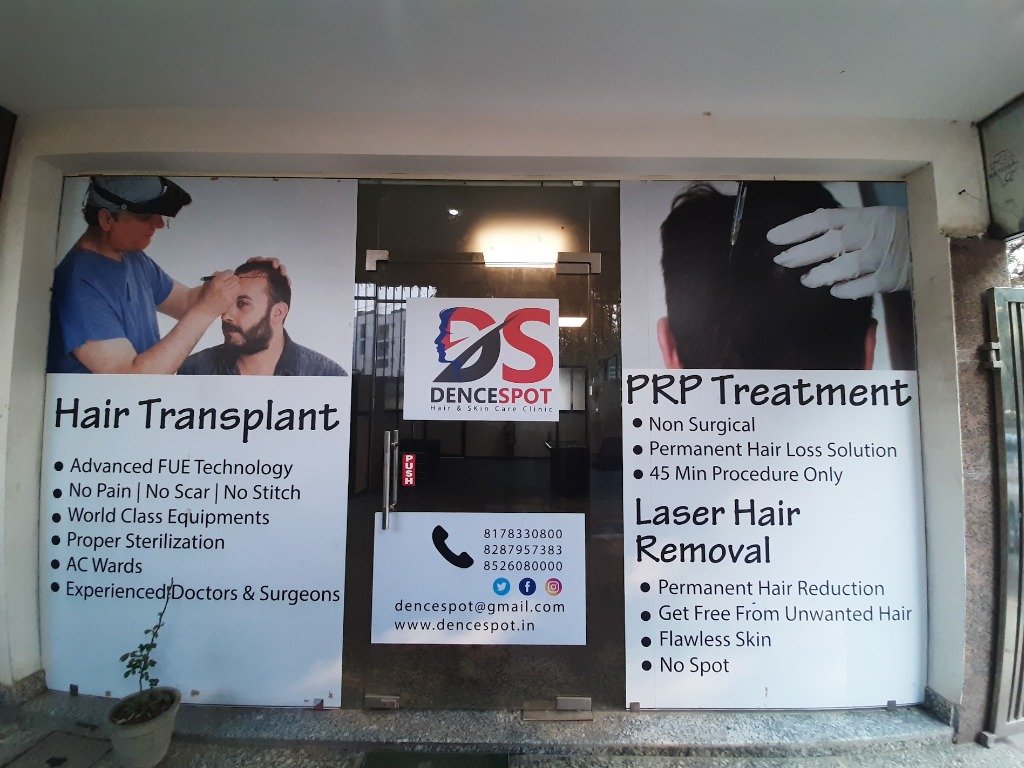
Assessment, investigation, treatment and any surgery all happen at our Sector 39 clinic in Gurugram, with the same doctor throughout. Patients travel to us from across Gurugram and neighbouring parts of South Delhi.
- Address
- 1123, Sector 39 Road, Jharsa, C Block, Sector 39,
Gurugram, Haryana 122003 - Phone
- +91 81783 30800
- Message +91 81783 30800
- dencespot@gmail.com
- Hours
- Mon–Sat · 10:00 – 20:00Sunday · closed
Getting here
Next step
Find Out What Is Actually Causing Your Hair Loss
Come in for a proper assessment before deciding on surgery. You will get an examination, investigation of anything treatable, an honest answer on whether grafting suits your pattern of loss, and a written plan either way.
Suitability is determined after clinical assessment. This page is patient education and does not constitute medical advice.
Quick enquiry