Does PRP Actually Work for Hair Loss, and What Happens If You Stop?
PRP is maintenance, not a cure, and the effect fades when you stop. What the published reviews report, who tends to respond, and how to judge whether yours is working.
Written and medically reviewed by Dr. Nyra, MBBS, MD (Dermatology)
Platelet-rich plasma is now widely offered for hair loss in India. It is a reasonable treatment for a narrow group of people and unlikely to help many others. What the evidence supports is less exciting than the way it is often described: an adjunct, with evidence that is real but modest, that has to be repeated indefinitely.
What PRP is, and what it is meant to do
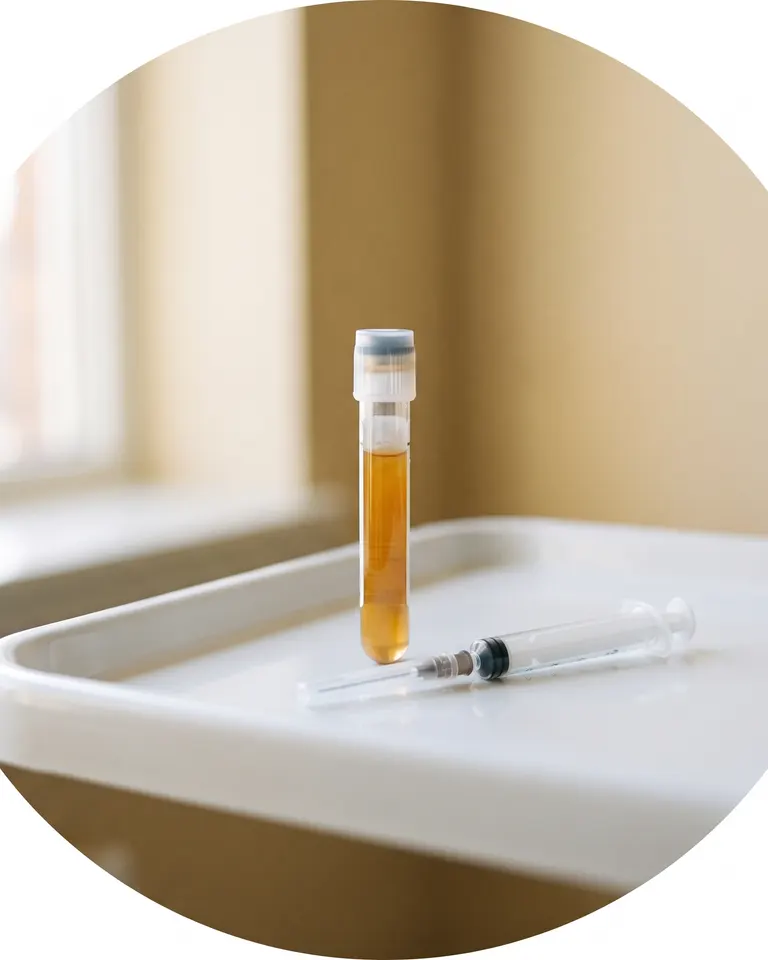
Your blood is drawn, spun in a centrifuge to separate the plasma fraction carrying a high concentration of platelets, and that concentrate is injected into the thinning scalp. Platelets carry growth factors, and the proposal is that delivering them around miniaturising follicles pushes those follicles back towards a longer growth phase, improving the calibre of hairs still present.
That is a mechanism, and a plausible one. The distance between a plausible mechanism and a proven clinical benefit is where most of the marketing lives. PRP does nothing to the androgen-driven process that drives pattern loss through the Norwood stages, and it creates no follicles where the follicle has gone. At most it improves hair that is still growing, and it has to keep doing so to keep the effect.
What the published reviews report
Systematic reviews of PRP in androgenetic alopecia have been published repeatedly over the past decade, and the shape of their conclusions is consistent. Most report an improvement in hair density or hair count against baseline or a control injection, then flag substantial limitations in the trials they pooled: small numbers, short follow-up, and outcome measures that differ from paper to paper. The reviewers describe the evidence as promising rather than settled, and that wording is doing work.
Dermatology reference sources reflect the same caution. DermNet lists platelet-rich plasma among treatments used in male pattern hair loss alongside the medical therapies with the larger evidence base, not in place of them, and the same holds for female pattern hair loss.
Why the protocols are so heterogeneous
The reason those reviews hedge is that the trials are not comparing the same treatment. There is no standardised PRP. Between studies, and between clinics, all of the following vary:
- The preparation system. Different kits and spin protocols yield different platelet concentrations, volumes and white-cell content.
- Whether the platelets are activated before injection, and with what.
- Injection depth, volume and spacing across the treated area.
- The number of sessions and the interval between them.
- How the outcome was measured — a photographic impression, a global assessment score, or a machine count of density in a tattooed reference area. Those are not comparable.
So when a clinic quotes a figure for how well PRP works, ask which protocol it came from and whether that is the protocol you are being offered. A figure from one study's protocol does not transfer to a different one, which is why quoted success rates deserve scepticism across this field.
Who tends to respond, and who does not
This is what decides whether the money is well spent, and it is settled at examination rather than by asking for the treatment by name.
The group that tends to respond
People with early to moderate pattern thinning, where the scalp under magnification still shows follicles present but miniaturised — hairs of visibly reduced calibre, thick and fine shafts mixed together. There is something there to improve. Trichoscopy establishes that, and doubles as the baseline against which later change is judged.
The group that does not
Scalp that has been bald for years. Where the follicle has been lost, no injection restores it and no growth factor recruits one that is not there. A smooth, shiny crown is not a PRP problem; it is a coverage problem, and the honest options are surgical or cosmetic. If that describes you, the comparison between PRP and a transplant is the more useful read.
A third group is worth naming: people whose shedding is not pattern loss at all. Diffuse shedding after illness, a crash diet, childbirth or a thyroid problem is a different condition, and injecting it changes nothing about the trigger. Telling reactive shedding apart from pattern hair loss comes first, and in women it matters more still, because a treatable cause sits behind the loss far more often — see how female pattern loss is assessed.
How sessions are usually spaced
Described here as usual practice, not as a promise. Most protocols run an induction phase of roughly three to four sessions about four weeks apart, then a formal review, then maintenance every few months if there has been a response worth maintaining. The spacing is convention, not rule.
Two things follow. Nothing can be judged early: hair cycles slowly, a change in shaft calibre is not visible within a month, and a course sold on a visible difference after the first session is being sold on something other than biology. And the review point matters more than the sessions do — a course with no scheduled assessment built into it is a subscription rather than a treatment plan, which is one of several things worth asking before you pay for a course.
Why the effect recedes if you stop
PRP does nothing to the underlying cause. In pattern hair loss the process is genetic and hormonal, runs continuously, and is not paused by an injection. What PRP appears to do, in the people it helps, is offset some of that ongoing loss for as long as it is delivered.
Stop, and the offset stops with it. The follicles resume miniaturising at whatever rate they were going to, and over the following months the gain recedes towards the trajectory you would have been on anyway. That is not the treatment failing; it is what maintenance treatments do, medical therapies for pattern loss included.
The useful question is not whether PRP works. It is whether it works enough, for you, to be worth repeating indefinitely — and that is a question about your examination findings and your budget, not about the treatment in the abstract.
PRP is not a one-off fix. Ask what happens when you stop; the answer should be the paragraph above.
PRP alongside medical therapy
In pattern hair loss PRP is rarely the whole plan. The established medical treatments act on the mechanism actually causing the loss and carry a far larger evidence base; the NHS overview of hair loss is a neutral summary of where they sit.
PRP is therefore usually an addition for someone already on appropriate medical therapy, or for someone who cannot tolerate it, with the limits of that choice explained honestly. What it should not be is a substitute presented as an equivalent. If you have been offered injections with no discussion of the medical options and their side-effect profiles, a conversation has been skipped, and it was the more important one.
You may also be offered GFC, exosomes or another branded variant. Those differ in preparation and in how much published evidence stands behind them — how PRP, GFC and exosomes actually differ covers it. Whatever the label, the maintenance logic above applies.
Your own case
Is your scalp the kind that responds to PRP, or the kind that will not?
Trichoscopy at a consultation shows whether follicles are miniaturised but still present, which is the finding that separates a reasonable course of PRP from money spent on scalp that has nothing left to stimulate.
How to judge whether yours is working
Self-assessment is unreliable here, predictably so. You see your scalp daily, which makes gradual change invisible, and you see it under different lighting, at different angles, with hair at different lengths. Any one of those produces a bigger apparent difference than the treatment does. What works instead is dull:
- Standardised photographs. Same lighting, distance, angle and hair length, dry hair, taken before the first session and repeated at fixed intervals. Reading before-and-after photographs properly explains what makes a comparison honest.
- Fixed review intervals, agreed beforehand rather than whenever you feel discouraged. Three months, six months, twelve months.
- Trichoscopy at the same marked site, so calibre and density are compared within one defined area, not by overall impression.
- Tracking shedding rather than appearance early on. A reduction in daily shedding often precedes any visible change in density.
Note what is absent: your own sense of whether it looks better. That is worth recording, but it is not evidence, and it moves with mood and lighting more than with hair.
When it is reasonable to stop paying for sessions
Stopping is a legitimate decision, and it is worth stating plainly when it makes sense. It is reasonable to stop when:
- A full induction course is complete and standardised photographs show no change. Not casual photographs — the fixed ones. If a proper comparison at six months shows nothing, continuing is optimism, not treatment.
- The loss is progressing at the same rate regardless. That suggests the underlying process is outrunning the adjunct, and the conversation should move to medical therapy or to whether surgery is appropriate for you.
- The maintenance cost is displacing something you need more. Indefinite maintenance is a real financial commitment, and stopping is a legitimate decision, not a failure.
- The diagnosis has changed. If examination later reveals a scarring alopecia or another cause, PRP is not the answer, and continuing only delays the treatment that is.
The corollary is that continuing is reasonable when there has been a documented improvement you want to keep and you accept that keeping it means maintaining it. That is a rational purchase. Buying it in the belief that it is permanent is not.
Which situation you are in is a question for examination, not for an article. A consultation with a dermatologist who examines the scalp establishes the diagnosis first, then whether follicles remain to be stimulated, and only then whether PRP at our Gurgaon clinic belongs in the plan. Often the answer is that a medical hair fall assessment is all you need. Consultations are available at both our clinics, in Sector 39, Gurugram and in Rohini, Delhi.
PRP for hair loss FAQs
Does PRP hurt, and can you work the same day?
The scalp injections sting, and most of the discomfort comes from the injection itself rather than from the blood draw. A topical anaesthetic or a cooling device reduces it. Tenderness and mild swelling for a day are common. Most people return to normal work the same day, though heavy training and alcohol are usually deferred for twenty-four hours.
Is there a blood test I should have before starting PRP?
A basic screen is reasonable, because thyroid disease, iron deficiency and other treatable causes change the diagnosis rather than just the treatment plan. Starting injections while an untreated deficiency is driving the shedding wastes both the sessions and the months. See which blood tests are worth doing.
Can PRP be done after a hair transplant?
It is sometimes offered around a transplant, usually with the aim of supporting the native hair surrounding the grafted area rather than the grafts themselves, since transplanted follicles are generally resistant to the process behind pattern loss. If it is offered to you, ask which hair it is meant to help and how that will be measured over the first year.
Who should not have PRP?
It is generally avoided in active scalp infection, in bleeding or platelet disorders, on anticoagulant therapy without advice, in some cancers, and during pregnancy. It is also the wrong treatment when the diagnosis is a scarring alopecia. That is a decision for examination, not for a form — ask the clinic directly if any of these apply.
How much does a course of PRP cost in Gurgaon?
It varies with the number of sessions, the preparation system used and whether maintenance is included, so a single figure is misleading. What matters more is what a quoted course actually includes. Our treatment cost page and payment and EMI options set out how that is worked out.
Does PRP help alopecia areata or telogen effluvium?
Those are different conditions with different treatments, and PRP is not standard care for either. Alopecia areata is usually managed with immunomodulating therapy, and telogen effluvium generally settles once the trigger is corrected. There is a plain summary of the latter on DermNet.
Medical disclaimer. Information on this website is general patient education. It is not medical advice and does not create a doctor-patient relationship. Suitability, graft numbers and treatment plans are decided only after an in-person examination by a registered medical practitioner. Outcomes differ from person to person, and no particular outcome, density or timeline can be promised.
Related treatment
Considering prp & non-surgical treatment?
This article is patient education. What applies to your own case is decided after an examination — the treatment page sets out how that works, what it costs and what to expect.