Beard Transplant in Gurgaon for a Fuller, Natural Beard Line
A beard transplant moves your own scalp follicles into patchy cheeks, a thin jawline, a gappy moustache or a scarred area. What separates a beard that reads as yours from one that reads as work done is the angle: facial hair lies far flatter against the skin than scalp hair, and every graft has to be set to match it. The doctor who designs your beard on your own face is the doctor who places the grafts.
- Beard mapped on your face before anything is quoted
- Single-hair grafts along every visible border
- FUE and DHI performed at the clinic
- Gurugram · Mon–Sat · 10:00 – 20:00
Performed & reviewed by
Dr. Nyra
Doctor-led consultation
Angle-matched placement
Density that suits a beard
Donor spent carefully
Written plan & follow-ups
The basics, plainly
What Is a Beard Transplant?
A beard transplant takes follicles from the back and sides of your scalp and places them into the beard area — cheeks, jawline, chin, moustache, sideburns, or a scar that will not grow hair. It is the same extraction technique used for a scalp hair transplant in Gurgaon. What changes completely is the design.
Scalp hair stands up from the skin. Facial hair lies almost flat against it, and the direction shifts across the face — sweeping down the cheek, fanning outward along the jaw, pointing inward under the chin, downward across the upper lip. Recipient sites have to be made to match that lie zone by zone. Grafts placed at a scalp angle stick out, and no amount of trimming hides it.
Density is the second difference. A natural beard is far less dense than a scalp, and the borders — the cheek line, the moustache edge, the sideburn — are made of single hairs, not clusters. Over-packing a beard produces the tufted, doll-like look people recognise instantly, and it spends donor hair that cannot be replaced.
Once healed, the transplanted hairs behave like the scalp hair they came from. They keep growing, so they need trimming. They can be shaved, shaped and grown out normally.
In one line
Scalp hair, relocated to your face and set to grow the way a beard grows. The extraction is routine; the angle and the density are where the result is won or lost.
Zone by zone
Areas a Beard Transplant Can Treat
Most cases are not “a beard” — they are one or two specific zones that never filled in. Each has its own angle, its own density target and its own difficulty.
Patchy cheeks
Bare or thin patches high on the cheek, often with a strong moustache and chin below them. Filling the gap so it blends into existing growth is the commonest reason men come in.
Cheek line & jawline
Building a clean upper border across the cheek and carrying density down the jaw. The cheek line is the most visible edge on a beard, so it is drawn on your face and agreed before a graft is placed.
Moustache & goatee
Thin upper-lip growth, a gap between moustache and chin, or a goatee that will not close. Upper-lip hair points sharply downward and the skin is mobile, so it is placed with particular care.
Sideburns
Rebuilding or extending sideburns, including cases where a previous scalp procedure left the temple and sideburn out of proportion with each other.
Scars in the beard area
Grafting into a stable scar — surgical, accidental, burn or cleft-lip repair — so growing hair breaks up the line. Scar tissue has a poorer blood supply, so expectations and graft survival are discussed openly first.
Full beard reconstruction
Building a beard where there is very little native growth. It is the largest ask on the donor area, is often staged across sessions, and is only planned where scalp donor supply genuinely allows it.
Techniques
Beard Transplant Techniques
Both techniques take grafts the same way. They differ in how each graft is put into the face — which, on a beard, is the part that matters. The choice is made zone by zone, and a single case often uses both.
Neither one is universally better
Any clinic that sells one technique as the answer for every beard is selling equipment, not a plan. The reasoning behind your recommendation is explained at the consultation and written into the estimate.
A note on “DHT”
Some clinic pages advertise a “DHT beard transplant”. DHT is dihydrotestosterone, a hormone involved in hair loss — not a surgical technique. The technique meant is DHI, direct hair implantation.
Step by step
Your Beard Transplant Journey
From the first appointment to the review at a year. Every stage happens at the Sector 39 clinic with the same doctor.
Consultation
Facial hair assessment
Donor evaluation
Beard design
Procedure
Recovery & aftercare
Progress reviews
On the day
How Does a Beard Transplant Work?
Design and marking
The agreed borders are redrawn on your face and checked with you sitting upright in natural light — a beard drawn on a reclined patient sits wrong when they stand up. Photographs are taken for your record.
Preparation
The donor strip of scalp is trimmed short and both donor and beard areas are anaesthetised locally. The injections are the uncomfortable part; after that the areas are numb.
Extraction
Follicular units are removed individually from the donor area. For a beard, single-hair units are separated out under magnification and reserved for the borders, where clusters would be visible.
Site creation
In an FUE case, recipient sites are made at the angle and direction of each zone — sweeping down the cheek, out along the jaw, in under the chin, down across the upper lip. In a DHI case this happens at the moment of placement instead.
Implantation
Grafts are placed one by one, singles at the edges and larger units kept to the interior where density is wanted. The pattern is deliberately irregular; a ruled edge is what makes a transplanted beard obvious.
Discharge and aftercare
You go home the same day with written instructions, medication where prescribed, and your first review already booked. Someone should drive you.
Plan the week around it
A beard transplant is not concealable the way a scalp procedure is under a cap. Small crusts sit on the face for roughly the first week. Most patients book time when they are not client-facing.
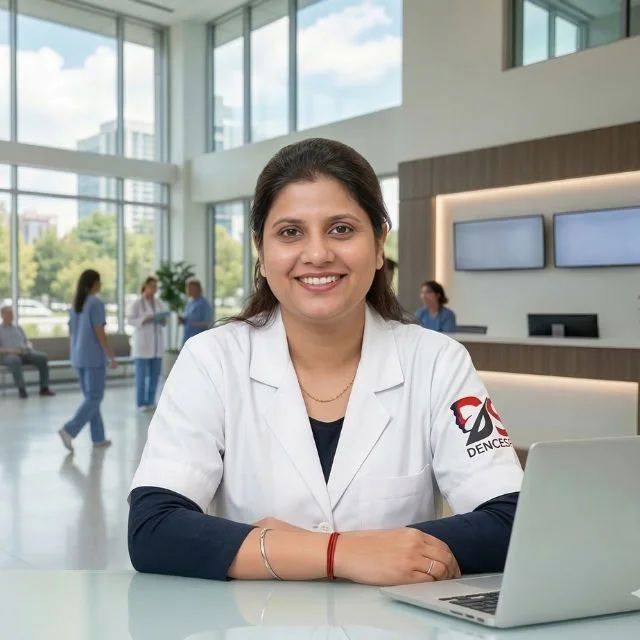
Who performs and reviews this treatment
Dr. Nyra, MBBS, MD (Dermatology)
Owner & Chief Consultant, DenceSpot Clinic
Qualified MBBS from Dr. D. Y. Patil Medical College, and holds an MD in Dermatology. Three years of clinical work in Germany followed — two at Bio Hair Clinic and one at St. Georg Klinikum Eisenach — before establishing DenceSpot in Gurugram.
Why a doctor should assess a beard, not a counsellor: patchy facial hair can be alopecia areata rather than genetics, and grafting into an active patch wastes grafts. Skin conditions in the beard area need treating first. And the donor arithmetic — beard grafts versus a scalp you may want covered at forty-five — is a medical judgement, not a sales one.
Qualification
MBBS, MD (Dermatology)
Training
3 years, Germany
Specialization
Dermatology
Cost guidance
Beard Transplant Cost in Gurgaon
Cost follows the plan, and the plan follows the assessment. A patchy-cheek correction and a full beard reconstruction are different procedures with very different graft counts, so we publish the factors that move the number and give you an itemised estimate in writing afterwards.
Zones being treated
Number of grafts
Existing growth
Technique
Complexity
Supporting treatment
Get a Personalized Treatment Estimate
Send clear photos of your cheeks, jawline and chin in daylight on WhatsApp, or request a call back. You will get an assessment appointment — not a sales pitch.
Recovery & results
What Generally Happens After a Beard Transplant
A general guide to the phases most patients describe. Your own timeline, and when you may trim or shave, is set by your doctor at your reviews.
First week
Tiny crusts around each graft, redness and some facial swelling. No touching, picking or shaving. Washing begins only when and how you are instructed.
Crusts clear, hairs shed
Crusting settles over the following weeks and the transplanted hairs commonly fall out while the follicles stay in place. Expected, not a failure.
New growth
Fine new hairs typically appear from around three to four months, unevenly and often finer than the surrounding beard at first.
Density and texture build
Coverage fills in through the middle months and the hairs coarsen toward beard character. Progress is documented photographically at each review.
Longer-term result
A fuller picture around ten to twelve months. Where a case was staged, or density in one zone needs topping up, a small second session is planned from here.
When can I shave?
Trimming with scissors or a guarded trimmer is usually permitted before a razor is, and both are cleared by your doctor at a review rather than by a date on a website. Shaving too early disturbs grafts that are not yet secure.
Individual outcomes vary
Your doctor will give personalized guidance based on your treatment. The timelines here are general patient education, not a promise of results, and no density or growth rate is guaranteed.
Tell your doctor about diabetes, thyroid disease, bleeding disorders, isotretinoin use, blood thinners and any history of keloid scarring at the consultation. Some of these change the plan; some change the timing; none of them are reasons to leave anything out.
Visit the clinic
Beard Transplant Clinic Serving Gurgaon
Consultations and procedures both take place at our Sector 39 clinic in Gurugram, which keeps the whole journey — assessment, design, procedure day and every follow-up — with the same doctor and the same team. Patients travel to us from across Gurugram and neighbouring parts of South Delhi.
- Address
- 1123, Sector 39 Road, Jharsa, C Block, Sector 39,
Gurugram, Haryana 122003 - Phone
- +91 81783 30800
- Message +91 81783 30800
- dencespot@gmail.com
- Hours
- Mon–Sat · 10:00 – 20:00Sunday · by appointment only
Getting here
Next step
Take the First Step Toward the Beard You Want
Bring your questions and your concerns. You will get a clinical assessment, a beard design drawn on your own face, an honest view of whether a transplant is appropriate for you, and a written plan if it is — with no pressure to book a date on the day.
Suitability is determined after clinical assessment. This page is patient education and does not constitute medical advice.
Quick enquiry