Before You Pay for a Course of PRP in Gurgaon, Ask These Questions
PRP on two Gurgaon price lists is rarely the same product. Preparation methods vary enormously and nothing standardises them. The questions that make a package comparable.
Written and medically reviewed by Dr. Nyra, MBBS, MD (Dermatology)
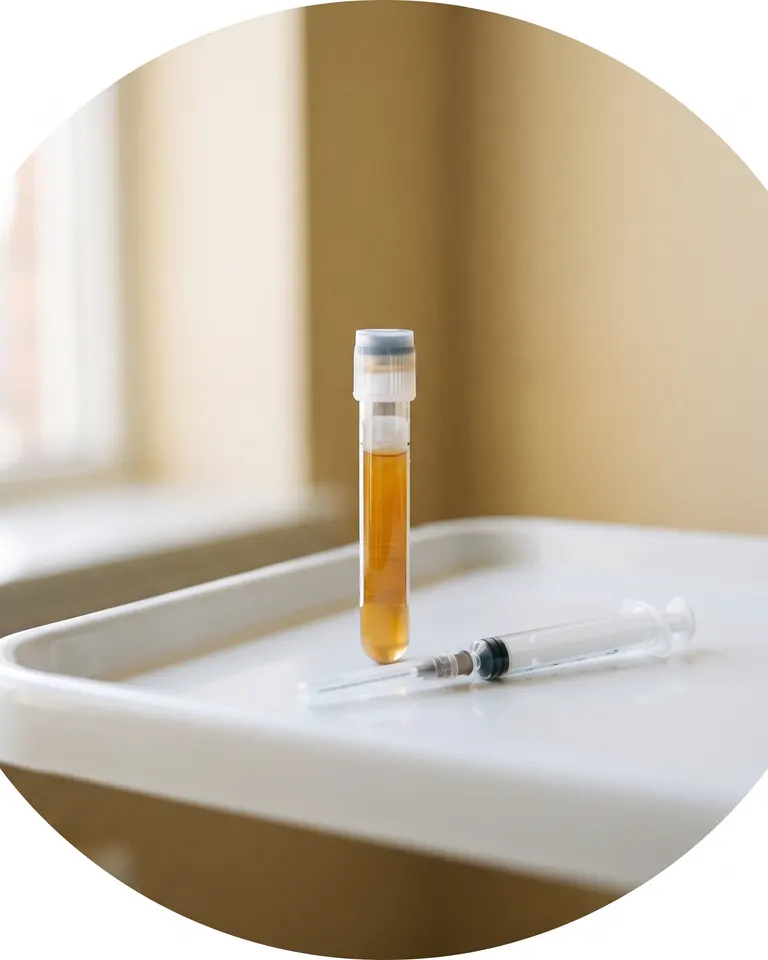
Before paying for a course of PRP in Gurgaon, ask six things: who will inject it, how the plasma is prepared, how many sessions are planned and how far apart, what the quoted price includes, how and when the response will be judged, and what happens if nothing changes. And ask one question before any of those: has anyone established why your hair is falling?
Those questions matter because PRP is a name, not a standard product. Two clinics on the same road can both list it while selling preparations made differently, injected in different volumes, on different schedules, with different terms for stopping. Until you have the answers, the two prices cannot be compared at all.
Why two PRP quotes are rarely for the same thing
No agreed protocol governs how PRP for hair is made or given. Each clinic chooses its own tubes or kit, its own centrifuge settings, whether to activate the platelets, how much to inject and how often. Every one of those choices changes what reaches your scalp, and none of them is visible on a price list.
This is not a fringe complaint. A 2018 review of PRP in androgenetic alopecia stated that there was still no standardised method of preparing and applying PRP, and the studies it gathered ranged from one to six sessions, spaced anywhere from two weeks to three months apart, with widely different volumes injected each time. The published trials disagree about what PRP is. Clinic menus disagree more.
So the useful comparison is not the per-session figure. It is the answers below, in writing, from each clinic you are considering. If you want the background on what PRP can and cannot do before the commercial questions, what the evidence on PRP actually supports covers it.
Has anyone established why your hair is falling?
This question decides whether the rest are worth asking. PRP is a supportive treatment for thinning where follicles are still present, most often early to moderate pattern hair loss. It does nothing for shedding driven by low iron, a thyroid problem or a recent illness, and it cannot regrow hair where follicles have already gone.
A proper assessment therefore comes before a quote: a history, examination of the scalp under magnification, and blood investigations where they are indicated. Commonly that means thyroid function, iron studies including ferritin, vitamin D and a full blood count, which also gives a platelet count, directly relevant to a treatment made from your own platelets. Which blood tests are worth doing for hair fall explains the reasoning, and how reactive shedding differs from pattern loss explains why the distinction changes the plan. In women the workup is usually broader still.
The NHS guidance on hair loss makes the same point from the patient's side: find out the cause before paying a private clinic for treatment. A clinic that books your first session before anyone has examined your scalp has decided what you need without finding out.
When PRP should be deferred or not offered
Ask what the clinic screens for. A reasonable list, though not a complete one, includes:
- Active infection or dermatitis over the area to be injected
- A low platelet count or a bleeding disorder
- Anticoagulant treatment, until it has been reviewed
- Blood cancers and some other active malignancies
- Poorly controlled systemic illness
- Pregnancy and breastfeeding
If nobody asked about your medication, including aspirin and regular anti-inflammatory painkillers, the screening was not done. Painkillers matter after a session too: aftercare in the first 72 hours after PRP covers them, along with washing and exercise.
Who draws the blood, who prepares it, and who injects?
Ask by name and qualification who will do each step, because they can be different people. The consultation may be with a doctor while the blood draw, the spin and sometimes the injections themselves are handed to a technician. You are entitled to know that before you pay, rather than discover it in the chair.
It matters in practice. Injecting at the right depth across a mapped area, recognising that a scalp should not be injected on a particular day, and managing a faint or a reaction are clinical tasks. So is deciding at review whether the course should continue. At this clinic, consultations and procedures are carried out by registered medical practitioners, and the hair PRP treatment page describes how a session runs; whichever clinic you choose, ask for the same clarity.
Registration is checkable. A doctor's name and registration number can be looked up on the medical council registers, the same check described in who is legally allowed to perform a hair transplant in India. It takes a few minutes and settles the question more reliably than a certificate on the wall.
How is the PRP prepared?
You do not need to learn the technicalities of centrifugation. You need a specific answer, and an assurance that it will be the same answer at every session, because a course only means something if the treatment inside it stays constant.
The system or kit
Ask what is used: a commercial kit, or tubes prepared in-house to a set protocol. Neither is automatically better. What should concern you is vagueness, such as an upgraded-sounding brand name for the PRP, which is a label rather than a method, or an answer that changes depending on which package you pick.
Single spin or double spin
A single spin separates the blood once and draws off the platelet-rich layer. A double spin separates it, then concentrates the platelet fraction again in a second run, and is often sold as the premium version. The comparison has barely been studied: a 2025 meta-analysis found only three randomised trials with ninety participants between them, and although the numbers leaned slightly towards single spin, the differences were not statistically significant. Neither method has been shown to be better, so neither justifies a surcharge.
Activation
Some protocols add an activating agent, commonly a calcium salt, just before injection; others rely on the platelets activating once they are in the scalp. There is no consensus that activation improves results. Ask whether it is used, with what, and why. The reasoning tells you more than the choice.
Volume and the area treated
Ask how much blood is drawn, how much prepared plasma is injected, and across which area. A defined crown patch and the whole top of the scalp are different jobs. A fixed volume spread across a larger area delivers less to each part of it, which is one reason a cheaper session covering more scalp is not necessarily a bargain.
How many sessions, how far apart, and when is it judged?
A typical plan is an initial course of three or four sessions about four weeks apart, then a formal review, then maintenance every three to six months if there has been a response worth keeping. Your own number should come from your assessment, be written down, and remain open to change at review.
The review is where most courses quietly fall apart. Ask three things:
- Will baseline photographs be taken before the first session? Same lighting, distance, angle and hair length, repeated at fixed points. Without them nobody, the clinic included, can tell whether anything changed. What makes a before-and-after comparison honest is worth reading before you accept anyone's.
- When is the review, and who carries it out? Reduced shedding, where it happens, is usually the first change; density and texture are generally judged from three to six months. A review held whenever you happen to ask is not a review.
- What is measured? Magnified images of the same marked area of scalp say far more than an overall impression, which moves with lighting and mood.
Be wary of any promise of visible change after the first session. Hair grows too slowly for that, and a course sold on that timeline is being sold on something other than biology.
What does the quoted price actually include?
A per-session price is the least informative number on a PRP quote. Ask for the whole course, itemised, and ask specifically what sits outside it:
- Consultation and assessment: included, or charged separately?
- Blood investigations: usually separate, and worth knowing about beforehand.
- Photography and review: these are the parts that tell you whether the rest is working, so they should not be optional extras.
- Anaesthetic cream or cooling: part of the session, or added on?
- Medical treatment: PRP rarely replaces it, and it is a separate line.
- Maintenance: what is expected after the initial course, and how often. That, not the first block, is the real commitment.
Our guide to PRP hair treatment cost in Gurgaon goes through what legitimately moves the number, and why a figure given before your diagnosis is a guess rather than a plan.
Your own case
Want these questions answered for your own scalp before paying for anything?
A consultation establishes what is causing the thinning, whether follicles remain that PRP could support, and, if it is appropriate, a written course with a set review date and no obligation to continue if the photographs show nothing has changed.
What happens if it does not work, and what else you may be sold
Ask this directly, and notice how comfortable the answer sounds. A proportion of people do not respond to PRP. That is not a failing of any particular clinic; it is true of the treatment, and it should be said before the first session rather than after the fourth.
The right response to no response is to stop and change the plan: towards medical treatment if it is not already running, or towards a different conversation if the examination points there. Whether you need PRP or a transplant is often that conversation. In practice, stopping is only possible if you have not already paid for sessions you have not had.
Package pressure worth recognising
PRP is widely sold as a prepaid block of six or ten sessions. The discount is real. The problem is that it removes your ability to act on a poor review, and removes the clinic's reason to raise one. Treat any of these as a signal to slow down:
- A discount that expires today, or applies only if you book the block before leaving
- A session count fixed before anyone has examined your scalp
- Injections offered the same day as the consultation, before indicated blood results are back
- No written terms on what happens to unused sessions if you stop
- PRP, GFC, mesotherapy and supplements bundled into a single plan with a single price
None of these proves bad faith on its own. Together they describe a sale arranged around the clinic's cash flow rather than around your review date.
GFC, exosomes and other upgrades
Once a PRP price is on the table, the next offer is often a higher tier. GFC, growth factor concentrate, is made from your own blood with an extra processing step that releases the growth factors and removes the cells. It is a legitimate variant, but its published evidence is smaller and newer than PRP's, and it has not been shown to outperform it. The GFC treatment page sets out the same evidence position, and any clinic charging more for GFC should be able to explain why.
Exosome products are different in kind. They are not made from your blood but manufactured from cultured cells, and they have the thinnest evidence of the three. If one is offered, ask what the product is, what cells it came from, who makes it and under what regulatory approval it is being used. How PRP, GFC and exosomes compare sets out why those questions matter.
Mesotherapy is a separate issue, because the word describes a way of delivering something rather than what is delivered. If it is added, ask exactly what is in the syringe; hair mesotherapy explains why. And when several injectables are given together, nobody can tell afterwards which of them did anything, so you lose the information you would need to drop one.
A checklist to take with you
- What is causing my hair loss, and which tests support that?
- Who assesses me, who prepares the PRP, and who injects it, by name?
- Which system is used, single or double spin, activated or not, and is it identical at every session?
- How much is injected, and across which area?
- How many sessions, how far apart, and what is the maintenance plan?
- When is the review, and what will be measured?
- What does the price include and exclude, in writing?
- If the review shows no change, what happens to the plan and to any money already paid?
A clinic that answers all eight without hesitating is one you can compare against another. PRP also usually sits alongside, not in place of, the prescription medicines for pattern hair loss, so expect that conversation too. How PRP is run at our Sector 39 clinic sets out the process step by step, and a consultation there starts with the diagnosis rather than the package.
Medical disclaimer. The information on this page is general patient education and is not a substitute for a consultation. Results vary between patients; individual treatment plans differ, and suitability for any procedure is determined only after clinical assessment by a qualified doctor. No outcome, density or timeline is guaranteed.
Related treatment
Considering prp & non-surgical treatment?
This article is patient education. What applies to your own case is decided after an examination — the treatment page sets out how that works, what it costs and what to expect.