GFC Treatment for Hair, Described Without the Marketing
Growth factor concentrate is made from your own blood, processed a step further than PRP. That processing difference is real. Whether it produces a better result is a different question, and the honest answer is that the evidence is not there yet. Here is what it is, and what we will not claim for it.
- Prepared from your own blood
- Given as a planned course, not a package
- Response tracked with photographs
- Gurugram · Mon–Sat · 10:00 – 20:00
Assessed & performed by
Dr. Nyra
MBBS, MD (Dermatology) · Owner & Chief Consultant, DenceSpot Clinic
Diagnosis first
Treatable causes are looked for before injecting.
Doctor-performed
Assessed and treated by a dermatologist.
Photographed, not guessed
Response measured against a baseline.
No superiority claims
We do not sell GFC as a proven upgrade.
Told if it will not help
It supports hair; it does not replace it.
The basics, plainly
What GFC Actually Is
Platelets in your blood carry growth factors — signalling proteins involved in tissue repair and, of interest here, in the hair follicle cycle. Every treatment in this family is built on the same idea: concentrate those and deliver them to the scalp.
PRP concentrates the platelets themselves and injects them, and they release their growth factors gradually once in the tissue. GFC takes a further processing step: the growth factors are released from the platelets during preparation, and the platelets and other cells are then removed. What is injected is the concentrate of those released growth factors.
That is a real and describable difference in preparation. It is worth being precise about what it does and does not establish. It means the injected material is different. It does not, on its own, mean the clinical result is better.
Like PRP, GFC is autologous — it comes from you, which is why the risk profile is favourable and why allergic reaction to the material itself is not a concern.
What it does not do
The limits, stated plainly
It does not regrow hair where the follicles are gone. Nothing injected into a bald scalp creates new follicles.
It does not stop pattern hair loss. The underlying process continues, which is why medical treatment usually runs alongside.
It does not replace a transplant for established baldness, and it is not a permanent result. Benefit requires maintenance.
The honest comparison
Why We Will Not Tell You GFC Beats PRP
GFC is frequently sold as the newer, better version of PRP, usually with a striking figure attached about how many times more concentrated the growth factors are. That figure may well be accurate. It is also not the claim that matters.
What can be said
- The preparation is genuinely different
- It is autologous, like PRP
- It is used for the same indications
- The safety profile is comparable
What cannot be said yet
- That it outperforms PRP clinically
- That it works where PRP has failed
- That fewer sessions are needed
- That the result lasts longer
The distinction worth holding onto
Concentration in a tube is not outcome on a scalp
A treatment can contain more of an active ingredient and not produce a proportionally better result, or any better result at all. Demonstrating clinical superiority requires comparative studies, and the published evidence base for growth factor concentrate is considerably less mature than the one behind PRP, which itself is not a cure for pattern hair loss.
So we describe GFC accurately, offer it where it fits, and decline to price it as a proven upgrade. If a clinic tells you it definitively outperforms PRP, ask what they are basing that on.
For the other side of this comparison, see hair PRP treatment.
Suitability
Who GFC Is For
It is a supportive treatment for hair that is still there. That single sentence decides most of the candidacy question.
It is most reasonable in early to moderate thinning, where follicles are miniaturising but present, and where the aim is to support them alongside medical treatment. It is also used after a transplant to support the surrounding native hair, which the surgery does not address.
It is not the right treatment for an area that is genuinely bald, for hair loss with an untreated underlying cause, or as a way of avoiding a conversation about surgery when surgery is what the pattern actually calls for.
Reasonable to consider
- Early to moderate thinning with follicles present
- Alongside medical treatment for pattern loss
- Supporting native hair after a transplant
- Where you prefer an autologous option
Not appropriate
- Established baldness with follicles gone
- Active scalp infection or inflammation
- Certain blood, clotting and platelet disorders
- Untreated thyroid, iron or hormonal causes
The process
How a Course of GFC Runs
Step 01
Assessment
History, scalp examination, and investigation of reversible causes. If something treatable is found, that is treated first.
Step 02
Baseline photographs
Standardised images before anything starts, because memory is unreliable and progress in hair is slow.
Step 03
Treatment sessions
Blood drawn, processed, and the concentrate injected across the thinning areas. Under an hour, spaced weeks apart.
Step 04
Review
Response compared against the baseline images. If there is no response, you are told, and the plan changes.
On the day and after
What a Session Involves
Blood is drawn as it would be for any blood test. It is processed in the clinic, which takes a short time, and the concentrate is then injected into the scalp across the areas being treated.
The injections are uncomfortable rather than painful for most people. Some tenderness, and occasionally mild swelling, is normal for a day or so. Most people go back to normal activity the same day.
You will be given specific aftercare instructions. In general, the scalp is left alone for the rest of the day, heavy exercise and heat exposure are avoided briefly, and anything that irritates the scalp is postponed.
Progress is judged against your baseline photographs at review, not week to week in a mirror. Hair changes slowly, and daily observation mostly measures lighting.
Usually fine the same day
- Returning to work
- Normal daily activity
- Eating and drinking as usual
Briefly avoid
- Heavy exercise and heavy sweating
- Saunas, steam and swimming pools
- Harsh chemical treatments on the scalp
- Anything your instructions specifically list

Who performs and reviews this treatment
Dr. Nyra, MBBS, MD (Dermatology)
Owner & Chief Consultant, DenceSpot Clinic
Qualified MBBS from Dr. D. Y. Patil Medical College, and holds an MD in Dermatology. Three years of clinical work in Germany followed — two at Bio Hair Clinic and one at St. Georg Klinikum Eisenach — before establishing DenceSpot in Gurugram.
Why this page argues against its own product: growth factor concentrate is a reasonable treatment sitting inside a category that is routinely oversold. The pattern is familiar — a newer preparation, a bigger number on the concentration, and a price premium justified by a comparison nobody has demonstrated. Offering it honestly means describing what it is, being explicit that the evidence is less mature than PRP's, and making sure the underlying diagnosis has actually been established before anyone injects anything.
Qualification
MBBS, MD (Dermatology)
Training
3 years, Germany
Specialization
Dermatology
Cost guidance
GFC Treatment Cost in Gurgaon
GFC is priced per session, and what matters is the course planned for you rather than a single-session figure. That comes out of your assessment, so it is quoted afterwards and given to you in writing.
Sessions in the course
Planned from your diagnosis and response
Area being treated
A defined patch differs from the whole top of the scalp
Treatment running alongside
Medical therapy is usually part of the plan
Review and photography
Included, because response has to be measured
Be cautious with packages of a fixed number of sessions sold before an examination. A course should be planned from your diagnosis and adjusted by your response, and it should be possible to stop it if you are not responding.
See cost and EMI options, and hair PRP treatment for the alternative in the same family.
Start With a Diagnosis
Send photos of the parting, the crown and the hairline in daylight, and tell us when the thinning started and what you have already tried.
Send photos on WhatsApp Book an assessmentYour details are used only to arrange your consultation.
Visit the clinic
GFC Treatment at Our Gurgaon Clinic
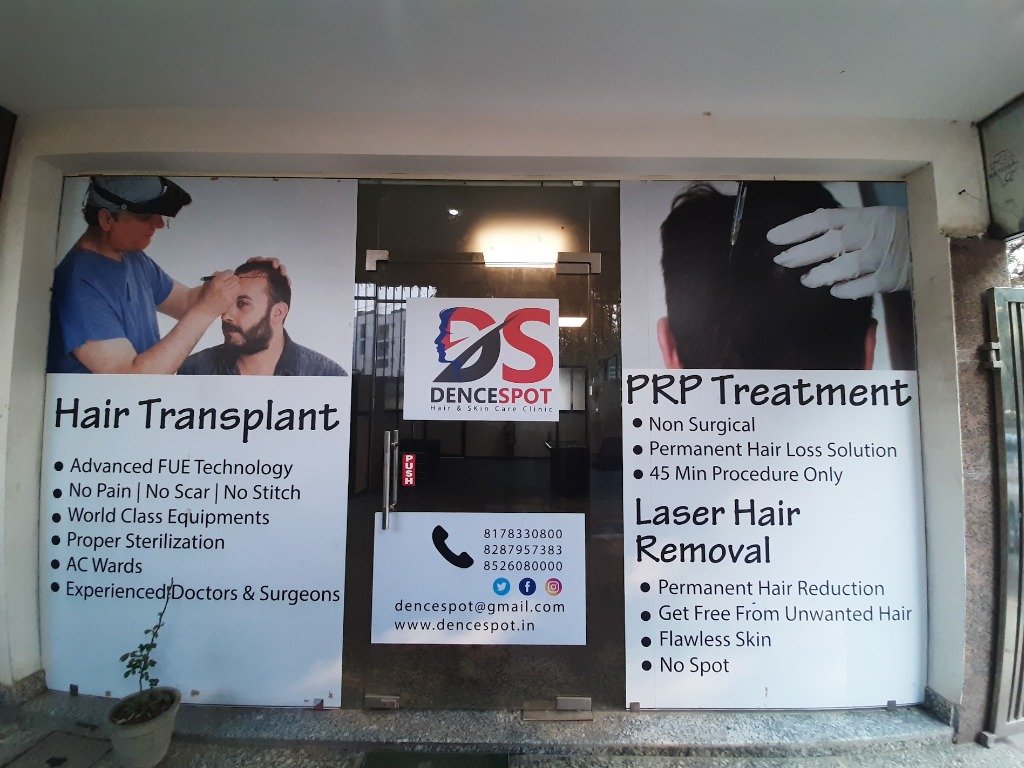
Assessment, treatment sessions and every review happen at our Sector 39 clinic in Gurugram, with the same doctor throughout. Patients travel to us from across Gurugram and neighbouring parts of South Delhi.
- Address
- 1123, Sector 39 Road, Jharsa, C Block, Sector 39,
Gurugram, Haryana 122003 - Phone
- +91 81783 30800
- Message +91 81783 30800
- dencespot@gmail.com
- Hours
- Mon–Sat · 10:00 – 20:00Sunday · closed
Getting here
Next step
Find Out Whether GFC Is the Right Treatment for You
Come in for a proper assessment first. You will get an examination, investigation of anything treatable behind your hair loss, and a straight answer on whether a growth factor course is worth your money in your case.
Suitability is determined after clinical assessment. This page is patient education and does not constitute medical advice.
Quick enquiry