PRP vs GFC vs Exosomes: Comparing the Injectable Hair Treatments Honestly
Three injectables, three very different levels of evidence. What each preparation actually is, where the published data is thin, and why price says nothing about effect.
Written and medically reviewed by Dr. Nyra, MBBS, MD (Dermatology)
Walk into three clinics in Gurgaon with the same thinning crown and you may be offered three different injections, each presented as the natural upgrade from the last. PRP is the oldest, GFC is sold as its refinement, exosomes are the newest name. That sequence is commercial, not scientific.
What follows compares them on what genuinely differs: what is in the syringe, where it comes from, what regulatory status it holds, and how much published work stands behind it. None of the three cures pattern hair loss, and none grows hair on skin that has been smooth and bald for years — a limit examined in the choice between PRP and surgery.
What PRP actually is
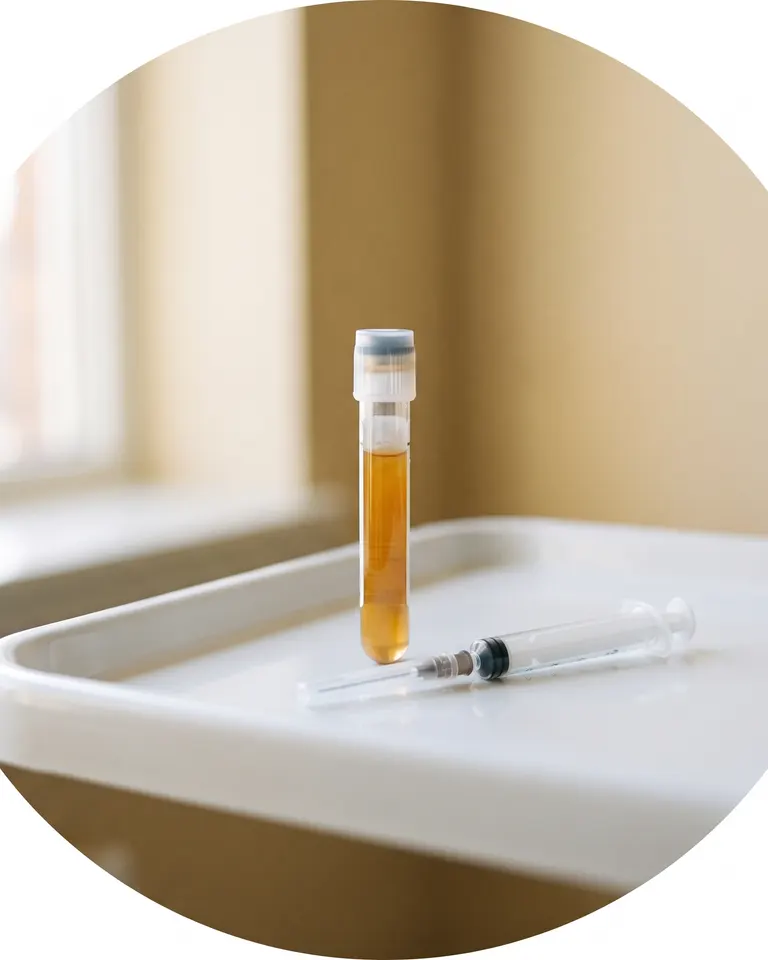
Platelet-rich plasma is made from your own blood. A sample is drawn, spun in a centrifuge so the plasma and platelet layer separates from the red cells, and that fraction is injected across the thinning scalp. It is autologous — nothing foreign enters your body — which is why its safety profile is reassuring.
The rationale is that platelets carry granules of growth factors, and that releasing those signals around miniaturising follicles supports the growth phase. The mechanism is inferred rather than mapped, and it only makes sense where living follicles remain. In androgenetic alopecia follicles shrink progressively before they disappear (DermNet on male pattern hair loss), so the window for any injectable is early and moderate thinning.
PRP is also not one product. Spin speed, manual tubes or a proprietary kit, whether the platelets are activated, the final concentration and the volume injected all vary, and nothing standardises them. Two quotations that both say PRP may describe different preparations, which is why the questions to ask before paying for PRP matter more than the label.
What GFC is, and how it differs from PRP
Growth factor concentrate starts in the same place: your own blood, spun down. The extra step is that the platelets are deliberately activated inside the tube, releasing their growth factors into the plasma, and the platelet bodies and cellular debris are then separated out. What is injected is a largely cell-free concentrate.
The argument for it is coherent. Removing debris and white cells may reduce the inflammatory sting, and a controlled release step is more predictable than relying on platelets to activate in the scalp. Patients often report GFC as the more comfortable of the two.
What GFC is not is a different class of medicine. It is a processing variant of the same autologous material, made with a proprietary kit and a longer laboratory step. Calling it a generational leap overstates the distance, and the head-to-head work needed to show one outperforms the other is limited.
What exosome products are, and the regulatory questions in India
Exosomes are extracellular vesicles: very small membrane-bound packets that cells release, carrying proteins and genetic material and involved in signalling between cells. Biologically the area is interesting. Commercially, it is where this comparison changes character.
The decisive difference is that exosomes do not come from you. Commercial preparations are derived from cultured cells — commonly mesenchymal stem cells originating in donor tissue such as umbilical cord, placenta or fat, and in some products from plant or bovine milk sources. That makes them an outside biological material with a manufacturer, a batch number and a shelf life.
That raises a regulatory question the other two do not. In India, preparations derived from human cells fall within the new drug framework and need approval from the Central Drugs Standard Control Organisation for a stated indication; use outside an approved indication or a registered trial is not an approved treatment. Ask what the product is, what cells it came from, who makes it, and under what approval it is going into your scalp. A clinic that cannot answer has told you something useful.
How the published evidence compares
PRP has by far the largest published literature of the three, and that literature is repeatedly called heterogeneous: protocols differ, groups are small, follow-up is short. Careful sources call it supportive rather than established, and neither the NHS overview of hair loss nor the standard dermatology references place injectables beside the treatments with the deepest track record. Those remain minoxidil and finasteride as used in India.
GFC has a much smaller literature, most of it recent, much of it from single centres, and little of it comparing GFC directly against a well-prepared PRP in the same patients.
Exosomes have the thinnest evidence of the three for hair. What exists is early, small and often linked to the companies producing the material, and long-term safety data for repeated scalp injection is absent. That is not a claim that exosomes fail; it is a statement that nobody yet knows how well they work.
Rank the three by depth of evidence and you get, in most clinics, the reverse of the price list.
| Preparation | Source | Published evidence in hair loss |
|---|---|---|
| PRP | Your own blood | Largest, but heterogeneous and short-term |
| GFC | Your own blood, platelets removed | Smaller, recent, few comparisons against PRP |
| Exosomes | Cultured donor or non-human cells | Thinnest; long-term scalp data absent |
Session schedules and maintenance intervals
PRP is usually an induction course of roughly monthly sessions, commonly three to six, then maintenance every few months. GFC schedules are similar, sometimes shorter on the argument that the dose is more concentrated. Exosome protocols vary most, and are often set by a supplier's instructions rather than by trial data.
Underneath all three sits the same fact, and it is the part patients are told least clearly: these are maintenance treatments. Any benefit depends on continuing, and when you stop, the underlying process resumes. Read what actually happens when you stop PRP before committing to a course.
Judge the response at four to six months, on photographs taken at the same distance, angle and lighting each time. The mirror at week three tells you nothing, and neither does a clinic photograph shot under different lighting — a problem covered in how to read before-and-after photographs.
Discomfort, downtime, and who should not have any of them
The blood draw is the easy part. Scalp injections sting, most noticeably along the frontal hairline, and topical anaesthetic or a ring block helps. Expect soreness for about a day, occasionally mild forehead swelling the next morning, and no dressings.
When an injectable is the wrong answer
None of the three suits active infection or unexplained inflammation over the site, a bleeding or platelet disorder, or unreviewed anticoagulant use. Active chemotherapy, uncontrolled systemic illness, and pregnancy or breastfeeding are ordinarily reasons to defer. The autologous preparations depend on your own blood, so significant anaemia is better corrected first.
The commonest wrong answer, though, is a timing error rather than a contraindication. Diffuse, recent shedding may be telogen effluvium rather than pattern loss (DermNet on telogen effluvium), and injecting anything before iron, thyroid function or a recent trigger is addressed spends money on the wrong problem. The distinction is set out in telogen effluvium against pattern hair loss, and the workup in the blood tests worth running for hair fall. Skin that is smooth with no visible follicles has nothing left to stimulate.
Your own case
Not sure whether an injectable suits your pattern of loss at all
An examination establishes what is causing the shedding, whether living follicles remain in the thinning area, and whether an injectable adds anything to the medical treatment you should be on first.
Why a higher price does not indicate a stronger effect
The three are presented as tiers, and the tiering is real — but it reflects what the clinic pays for consumables and how new the name is, not how well the product works. A preparation made in ordinary tubes costs the clinic very little. A proprietary kit costs more. An imported vial costs more again, with a novelty premium on top.
The mechanism is easy to see once you look for it. PRP is offered widely enough that it competes on price, so a higher tier becomes commercially necessary. GFC filled that slot; exosomes now sit above GFC. Each arrives described as what serious clinics have moved to. What moved is the price point.
Treat a bundle of all three with particular care: when three things are given at once, no response can be attributed to any of them. Figures belong on the pages that carry them — how PRP is run at this clinic covers the treatment, the cost and payment options page handles the money, and injections against surgery is a separate calculation under what a hair transplant costs in Gurgaon.
Questions to ask before buying a multi-session package
Packages secure revenue before you know whether the treatment suits you. That is not automatically unfair, but ask these before you pay, not after the second session.
- What exactly is being injected? For exosomes, ask for the source, manufacturer and regulatory status in writing.
- Who performs the injections? A doctor should — the principle set out in who may legally perform hair procedures in India.
- Is the protocol identical every session? Consistency is the minimum condition for a course meaning anything.
- How and when is the response assessed? A named month and standardised photographs, not an opinion at the desk.
- What happens if there is no response? Ask whether the package simply continues, and whether any of it is reviewable.
- What does maintenance cost afterwards? That figure, not the package, is the real commitment.
- Has a diagnosis been made? If nobody has examined your scalp under magnification or asked about your thyroid and iron status, you are buying treatment before anyone established what you have.
A clinic that answers all seven plainly is one you can compare against another. One that answers by calling the newest product the most advanced has not answered — the scepticism guarantees and quoted success rates deserve in surgery applies here too.
If you would rather start with the cause of the shedding than with which injection to buy, the hair fall assessment is the entry point, and the dermatologist who runs the clinic is the person who examines you.
Medical disclaimer. The information on this page is general patient education and is not a substitute for a consultation. Results vary between patients; individual treatment plans differ, and suitability for any procedure is determined only after clinical assessment by a qualified doctor. No outcome, density or timeline is guaranteed.
Related treatment
Considering prp & non-surgical treatment?
This article is patient education. What applies to your own case is decided after an examination — the treatment page sets out how that works, what it costs and what to expect.