Hair Mesotherapy, and the Question You Should Ask First
Mesotherapy is not one treatment. It is a way of delivering something into the scalp, and what that something is varies from clinic to clinic with no standard formulation. That single fact explains most of the confusion around it, and it is where an honest conversation about it has to start.
- You are told exactly what is being injected
- Offered as an adjunct, not a primary treatment
- Diagnosis established before any course starts
- Gurugram · Mon–Sat · 10:00 – 20:00
Assessed & performed by
Dr. Nyra
MBBS, MD (Dermatology) · Owner & Chief Consultant, DenceSpot Clinic
Diagnosis first
Treatable causes are ruled out before injecting.
Full disclosure
You are told what the preparation contains.
Evidence stated honestly
Limited, and we say so rather than imply otherwise.
Response measured
Photographed against a baseline, not guessed.
Stoppable
No response means the plan changes, not continues.
The basics, plainly
What Mesotherapy Is, and What It Is Not
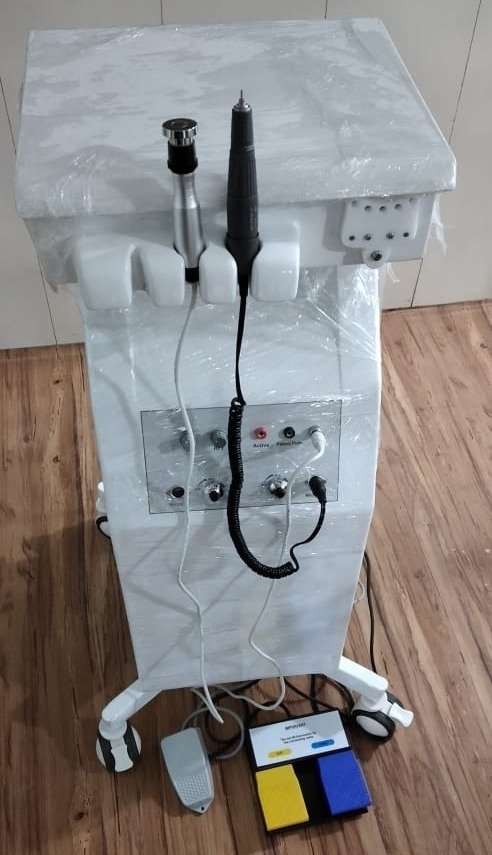
Mesotherapy describes a delivery technique: many small injections placed into the superficial layers of the skin, using very fine needles, spread across the treatment area. On the scalp that means a grid of small injections over the thinning region.
The word tells you how something is being given. It does not tell you what. Preparations used for hair typically contain combinations of vitamins, minerals, amino acids and other agents, and they differ between clinics and between manufacturers. There is no single agreed formulation the way there is a single agreed molecule behind an established medicine.
This matters more than it sounds. It means that a claim about "mesotherapy" is a claim about an unspecified mixture, and that a study of one preparation does not necessarily say anything about another. It is the main reason the evidence in this area is hard to interpret and the marketing is so variable.
So the first thing to establish with any clinic offering it, including this one, is exactly what is in the syringe.
Where we place it
Adjunct, not backbone
For pattern hair loss, the established medical treatments are the backbone of a plan. That is where the evidence is.
Mesotherapy is offered as something that may be added to that, for patients who want it, with the uncertainty stated.
It is not offered as a way to avoid treatment that works, and it is not sold as a primary solution for pattern hair loss.
The evidence question
Being Straight About How Well It Is Supported
This is a medical page, so the uncomfortable part goes near the top rather than in the small print.
The evidence is limited
It is weaker than for the established medical treatments for pattern hair loss, and weaker than for PRP. That is the current position and we state it rather than working around it.
Formulations are not standardised
Different clinics inject different mixtures. Evidence about one preparation does not automatically apply to another, which makes general claims about "mesotherapy" close to meaningless.
Response is not predictable
We cannot tell you in advance whether you will respond, and neither can anyone else. What we can do is measure it properly and stop if there is nothing happening.
What this means for you
Reasonable to try, wrong to rely on
If you have an established diagnosis, are already on treatment that has evidence behind it, and want to add something further, mesotherapy is a reasonable thing to consider with the uncertainty understood. Plenty of medicine is practised in that space.
If you are considering it instead of investigating why your hair is falling, or instead of a treatment that has been shown to work, that is the wrong decision and we will say so. Start at hair fall treatment for how the diagnosis is actually made.
Where it sits
Compared With the Other Options
Medical treatment for pattern hair loss has the strongest evidence of anything discussed on this page, and it is the foundation of most plans. Whether it is appropriate for you depends on your diagnosis, your history and your preferences.
PRP uses your own blood and has a considerably more developed evidence base than mesotherapy. If you are choosing between injectable supportive treatments, that difference is worth weighing.
GFC is also autologous, prepared a step further than PRP. Its evidence is less mature than PRP's, and it is described honestly on its own page rather than sold as an upgrade.
Microneedling is a different mechanical approach, sometimes used alongside topical treatment. It is a separate conversation with its own considerations.
Read next
Hair fall treatment — diagnosis and the medical route.
Hair PRP treatment — the better-evidenced injectable.
GFC treatment — growth factor concentrate, described plainly.
Hair microneedling — the mechanical alternative.
The order that makes sense
Diagnose the cause. Treat anything reversible. Start treatment with evidence behind it. Then consider what to add.
Skipping the first three steps to get to the fourth is the common and expensive mistake.
The process
How a Course Would Run
Step 01
Assessment
History, scalp examination, and investigation of reversible causes. Allergies and medication reviewed before anything is injected.
Step 02
The conversation
What the preparation contains, what the evidence does and does not support, and whether something better established should come first.
Step 03
Sessions
Baseline photographs, then a course of sessions spaced weeks apart. Each session is short and you return to normal activity the same day.
Step 04
Honest review
Compared against baseline images. If nothing is happening, you are told that and the plan changes rather than repeating.
Safety and aftercare
What to Expect Around a Session
The needles are very fine and the injections are superficial, so most people describe it as uncomfortable rather than painful. A session is short, and normal activity resumes the same day.
Tenderness, redness, small raised bumps at the injection points and occasional bruising are the usual after-effects, and they settle within days. Less commonly, a reaction to a component of the injected preparation can occur — which is precisely why you should know what is in it and why your allergy history is reviewed first.
As with any injection, infection is uncommon but possible, and anything unusual afterwards should be reported rather than waited out.
Usual and expected
- Tenderness for a day or so
- Redness across the treated area
- Small bumps at injection points
- Occasional bruising
Tell us promptly about
- Spreading redness, heat or swelling
- Fever after a session
- A rash or any allergic-type reaction
- Pain that increases rather than settles

Who performs and reviews this treatment
Dr. Nyra, MBBS, MD (Dermatology)
Owner & Chief Consultant, DenceSpot Clinic
Qualified MBBS from Dr. D. Y. Patil Medical College, and holds an MD in Dermatology. Three years of clinical work in Germany followed — two at Bio Hair Clinic and one at St. Georg Klinikum Eisenach — before establishing DenceSpot in Gurugram.
Why this treatment is offered with caveats rather than enthusiasm: mesotherapy sits at the weak end of the evidence in hair medicine, and it is sold hardest to people who have not yet been told why their hair is falling. The clinically useful sequence is to establish the diagnosis, treat anything reversible, and start treatment that has been shown to work. Mesotherapy can reasonably be added to that. It is not a substitute for any part of it, and a patient who leaves with a course of injections and no diagnosis has been sold something rather than treated.
Qualification
MBBS, MD (Dermatology)
Training
3 years, Germany
Specialization
Dermatology
Cost guidance
Hair Mesotherapy Cost in Gurgaon
Priced per session, with the course planned from your assessment. It is quoted afterwards and given in writing, alongside whatever else is in your plan.
Sessions in the course
Planned from diagnosis and adjusted by response
Area treated
A defined patch differs from the whole scalp
Preparation used
Stated openly as part of the plan
Treatment alongside
Medical therapy is costed separately
Be particularly careful with large prepaid packages here. Where the evidence is uncertain and response cannot be predicted, you want the ability to stop after review, not a commitment made before anyone examined you.
See cost and EMI options.
Start With a Diagnosis
Send photos of the parting, crown and hairline in daylight, with a note of when the shedding started and what you have already tried.
Send photos on WhatsApp Book an assessmentYour details are used only to arrange your consultation.
Visit the clinic
Scalp Treatments at Our Gurgaon Clinic
Assessment, treatment and every review happen at our Sector 39 clinic in Gurugram, with the same doctor throughout. Patients travel to us from across Gurugram and neighbouring parts of South Delhi.
- Address
- 1123, Sector 39 Road, Jharsa, C Block, Sector 39,
Gurugram, Haryana 122003 - Phone
- +91 81783 30800
- Message +91 81783 30800
- dencespot@gmail.com
- Hours
- Mon–Sat · 10:00 – 20:00Sunday · closed
Getting here
Next step
Find Out Why Your Hair Is Falling Before Treating It
Come in for a proper assessment. You will get an examination, investigation of anything reversible, and a straight recommendation — which may be a better-evidenced treatment than this one.
Suitability is determined after clinical assessment. This page is patient education and does not constitute medical advice.
Quick enquiry