Scalp Micropigmentation Adds No Hair, and That Is the Point
It is a cosmetic tattoo. Tiny dots of pigment reduce the contrast between your scalp and your hair, so thinning reads as denser and scars stop catching the eye. It spends no donor supply, which is exactly why it belongs in plans where grafts are the scarce resource.
- Costs no donor hair at all
- Density built gradually across sessions
- Hairline design agreed before the first session
- Gurugram · Mon–Sat · 10:00 – 20:00
Assessed & planned by
Dr. Nyra
MBBS, MD (Dermatology) · Owner & Chief Consultant, DenceSpot Clinic
No donor hair spent
Your finite graft supply stays intact.
Design agreed first
Hairline position settled before any pigment.
Built up gradually
Too dark too early is the hard mistake to fix.
Maintenance explained
Fading and touch-ups stated upfront.
Told what it commits you to
Including keeping hair short, where that applies.
The basics, plainly
What It Is and What It Does
Scalp micropigmentation deposits tiny points of pigment into the scalp. Each dot is sized and placed to read, at normal viewing distance, like the cross-section of a short hair emerging from the skin.
The effect is entirely about contrast. Thinning hair looks thin largely because pale scalp shows through dark hair, and the eye reads that contrast as sparseness. Darken the scalp and the same amount of hair looks considerably denser, without a single hair having been added.
That principle produces three distinct uses: creating the appearance of a closely shaved head across an area of real baldness, adding apparent density under hair that is thinning but present, and camouflaging scars by reducing the contrast between pale scar tissue and surrounding scalp.
It is worth restating what it is not. It is not a treatment for hair loss. Nothing about it slows, stops or reverses the process underneath, which carries on exactly as it would have done.
The advantage that matters
It costs you no donor hair
Every graft placed by a transplant comes out of a permanent, finite supply at the back and sides of your head.
Pigment draws on none of it. For someone with limited donor supply and a large area to improve — a wide crown especially — that is not a minor point. It is often the difference between a workable plan and an unaffordable one.
This is why it appears so often alongside surgery rather than instead of it.
Applications
The Three Things It Is Genuinely Good At
The shaved-head look
Across established baldness, pigment can replicate the appearance of closely cropped hair. It is the most transformative use and the one with the biggest commitment attached: the surrounding hair has to stay short for the illusion to hold.
Density under thinning hair
Where hair is thinning but present, darkening the scalp beneath removes the contrast that makes it look sparse. Subtle, low-commitment, and frequently the most useful application for people not ready for surgery.
Scar camouflage
Linear donor scars from strip surgery and dot scarring from over-aggressive extraction both stand out because they are paler than the scalp around them. Reducing that contrast makes them substantially less noticeable.
Where it fits with surgery
Usually alongside, not instead
The combination that works well: grafts placed where hair genuinely needs to exist and be styled, pigment used where the area only needs to look denser or where a boundary needs blending. That divides the work according to what each tool is actually good at, and it stretches a limited donor supply considerably further.
It is a standard part of the conversation on crown restoration, where grafts are consumed fastest, and on repair cases, where the donor is often already depleted.
Before you commit
The Parts Marketing Pages Leave Out
None of these are reasons not to have it. They are reasons to go in with your eyes open, because the decision is close to irreversible.
It fades, and it needs topping up
Pigment softens over years and can shift in tone. Touch-up sessions are part of owning it, not evidence that something went wrong. Budget for them.
Removal is difficult
Laser removal over multiple sessions is possible, slow, and sometimes incomplete. Do not treat it as a reversible experiment. Be certain about the hairline before the first session.
The hairline ages with you
A pigmented hairline placed too low or too aggressively has exactly the same problem as a surgical one placed badly, except it also does not grow. Design for the face you will have later.
It commits you to short hair
Where it is creating a shaved look, growing the surrounding hair out breaks the match between pigment dots and stubble. That is a lasting style commitment worth thinking about honestly.
Operator skill decides everything
Dot size, depth, spacing and pigment tone all have to be right. Poor work is visible, and it is far harder to fix than to avoid. Look at healed results, not fresh ones.
Hair loss continues underneath
Pigment does not treat anything. If your loss is still progressing, the area needing coverage will keep growing, and the plan has to anticipate that.
The process
How Treatment Is Built
Step 01
Assessment
Pattern of loss, skin and scalp condition, healing and scarring history, and an honest discussion of whether pigment, grafts or both suit your case.
Step 02
Design and tone
Hairline position, density and pigment tone agreed before anything begins — because this is the part that is hard to undo.
Step 03
Layered sessions
Density built gradually across several sessions spaced days to weeks apart. Deliberately conservative early, because adding is easy and removing is not.
Step 04
Maintenance
Review as it settles, then periodic touch-ups over the years as the pigment fades. Planned from the start rather than raised later.
Safety and suitability
What Is Checked Beforehand
This is a tattooing procedure, so the safety considerations are those of tattooing: sterile technique, single-use needles, pigment quality and the competence of the person holding the device.
Clinically, it is not appropriate over active scalp infection or inflammation, and any skin condition affecting the scalp needs assessing first. A history of keloid or abnormal scarring is important to disclose, as are conditions and medications that affect healing.
Reactions to tattoo pigment are uncommon but recognised, and your history of any previous reaction is relevant.
Aftercare matters more than people expect. The scalp is kept dry and untouched for a defined period, sun exposure is avoided, and sweating, swimming and steam are paused. Ignoring this affects how the pigment settles and how long it lasts.
Tell us about
- Any keloid or abnormal scarring history
- Skin conditions affecting the scalp
- Previous reactions to tattoo pigment
- Medication affecting healing or bleeding
Aftercare basics
- Keep the scalp dry as instructed
- No sun exposure on the treated area
- No swimming, saunas or heavy sweating
- Do not pick or scratch as it settles

Who performs and reviews this treatment
Dr. Nyra, MBBS, MD (Dermatology)
Owner & Chief Consultant, DenceSpot Clinic
Qualified MBBS from Dr. D. Y. Patil Medical College, and holds an MD in Dermatology. Three years of clinical work in Germany followed — two at Bio Hair Clinic and one at St. Georg Klinikum Eisenach — before establishing DenceSpot in Gurugram.
Why pigment gets discussed in surgical consultations here: donor hair is the scarce resource in every hair restoration plan, and the crown in particular can consume an enormous number of grafts for a result that pigment could partly deliver at no donor cost. Treating micropigmentation as a serious option rather than a lesser alternative usually produces a better plan — grafts spent where hair has to be real and stylable, pigment used where the area only needs to stop reading as bald.
Qualification
MBBS, MD (Dermatology)
Training
3 years, Germany
Specialization
Dermatology
Cost guidance
Scalp Micropigmentation Cost in Gurgaon
Cost follows the area being covered and the number of sessions the plan requires, so it is quoted after assessment. Touch-ups over the following years are a real part of the total and are discussed at the start rather than presented later.
Area covered
A scar, a crown, or a full shaved-look treatment
Sessions required
Density is layered, so several are normal
Complexity
Scar tissue behaves differently and needs care
Maintenance
Periodic touch-ups as pigment fades
Compare on healed results rather than price. Photographs taken immediately after a session look darker and sharper than the same work does months later, and the difference between competent and poor pigmentation is not visible on day one.
Find Out If It Suits Your Case
Send photos of the area concerned in daylight — including any scarring — and tell us how you currently wear your hair and how you would like to.
Send photos on WhatsApp Book an assessmentYour details are used only to arrange your consultation.
Visit the clinic
Scalp Pigmentation Planning at Our Gurgaon Clinic
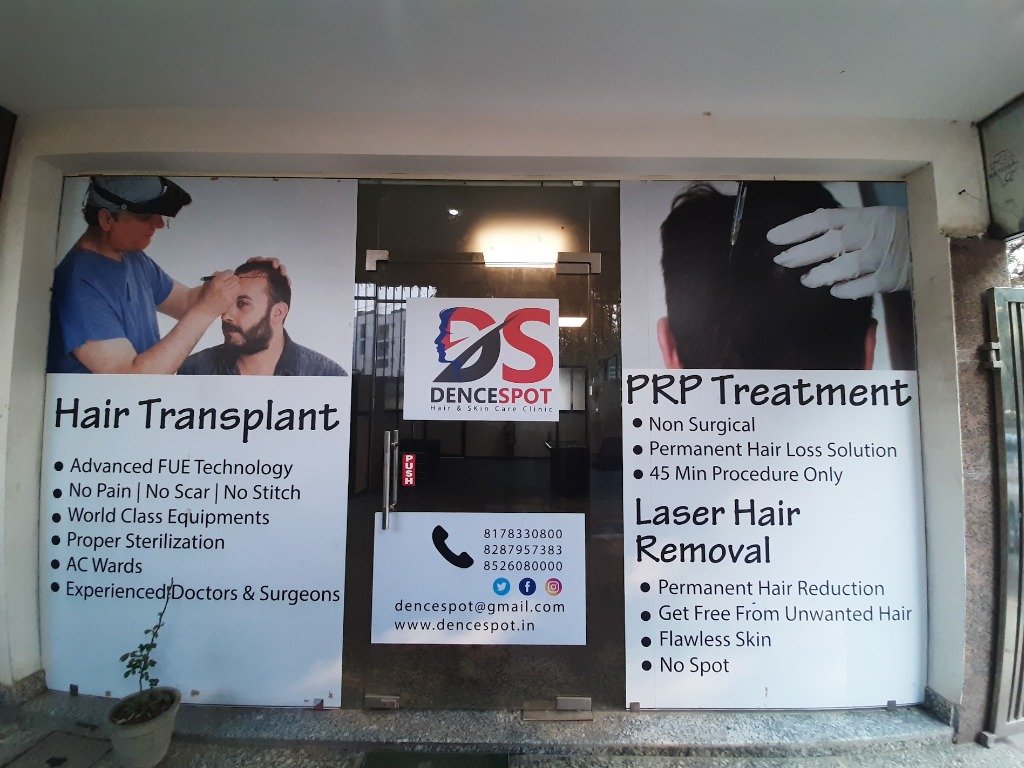
Assessment and planning happen at our Sector 39 clinic in Gurugram, alongside the surgical options, so the two can be considered together. Patients travel to us from across Gurugram and neighbouring parts of South Delhi.
- Address
- 1123, Sector 39 Road, Jharsa, C Block, Sector 39,
Gurugram, Haryana 122003 - Phone
- +91 81783 30800
- Message +91 81783 30800
- dencespot@gmail.com
- Hours
- Mon–Sat · 10:00 – 20:00Sunday · closed
Getting here
Next step
Find Out Whether Pigment, Grafts or Both Make Sense
Come in and have the area assessed against your donor supply. You will get an honest view of what pigment can do, what it commits you to, and whether a combined plan would stretch your options further.
Suitability is determined after clinical assessment. This page is patient education and does not constitute medical advice.
Quick enquiry