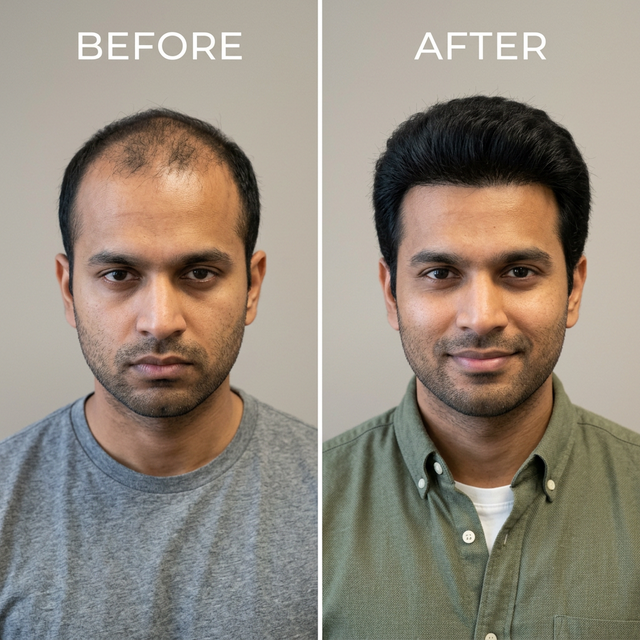
PRP (Platelet-Rich Plasma) therapy has emerged as one of the most promising non-surgical treatments for increasing hair density. Backed by a growing body of clinical evidence, PRP delivers concentrated growth factors directly to weakened hair follicles, stimulating them to produce thicker, stronger hairs and pushing dormant follicles back into the active growth cycle. But does PRP truly increase hair density in a measurable, meaningful way? Here is what the science says.
Hair density -- the number of active hair follicles per square centimeter of scalp -- is one of the most important metrics in hair restoration. When density drops below a certain threshold, thinning becomes visible to the naked eye, parting lines widen, and the scalp begins to show through. For millions of men and women dealing with androgenetic alopecia, telogen effluvium, or diffuse thinning, the central question is straightforward: can any treatment actually reverse this decline and bring density back? PRP therapy has become a leading contender, and the clinical data increasingly supports its effectiveness.
What Clinical Evidence Says About PRP and Hair Density
The evidence for PRP as a hair density booster has strengthened considerably over the past decade. Multiple randomized controlled trials, systematic reviews, and meta-analyses have examined the impact of PRP on measurable hair density outcomes.
A landmark 2019 meta-analysis published in Dermatologic Surgery reviewed 11 randomized controlled trials and concluded that PRP therapy leads to a statistically significant increase in hair density compared to placebo. Patients receiving PRP showed an average density improvement ranging from 20 to 40 percent over 6 to 12 months of treatment, depending on the protocol used and the severity of baseline hair loss.
A 2020 study in the Journal of Cosmetic Dermatology measured hair density using trichoscopy before and after a course of PRP sessions. The researchers found that patients experienced a mean increase of approximately 33.6 hairs per square centimeter after four sessions, a substantial improvement that was both statistically and clinically significant. Another study published in the International Journal of Trichology reported similar findings, with PRP-treated areas showing significantly higher follicular density and a greater proportion of terminal (thick) hairs compared to untreated control areas.
What makes these findings particularly compelling is that many of these studies used objective measurement tools -- digital trichoscopy, phototrichograms, and standardized photography -- rather than relying solely on subjective patient assessments. The density improvements are real, measurable, and reproducible across different patient populations and clinical settings.
How PRP Increases Hair Density: The Biological Mechanism
Understanding how PRP works at the cellular level explains why it is effective at boosting density. When concentrated platelets are injected into the scalp, they release a cascade of bioactive proteins and growth factors that act on the hair follicle in several ways:
- Reactivation of Dormant Follicles: Growth factors such as PDGF (Platelet-Derived Growth Factor) and FGF (Fibroblast Growth Factor) stimulate the dermal papilla cells at the base of the follicle, pushing resting (telogen) follicles back into the active growth (anagen) phase. This directly increases the number of actively growing hairs per square centimeter.
- Reversal of Follicle Miniaturization: In androgenetic alopecia, DHT causes follicles to progressively shrink, producing thinner and shorter hairs with each growth cycle. PRP growth factors counteract this by stimulating cell proliferation within the follicle, encouraging it to produce thicker terminal hairs instead of fine vellus hairs. This improves both the count and the quality of visible hair.
- Enhanced Blood Supply: VEGF (Vascular Endothelial Growth Factor) promotes the formation of new blood vessels around the follicle (angiogenesis). Better blood supply means more oxygen, nutrients, and hormonal signals reach the follicle, supporting robust hair production.
- Prolonged Growth Phase: PRP extends the duration of the anagen phase, meaning each hair grows for a longer period before entering the shedding cycle. Longer growth phases translate to longer, thicker hairs and a reduction in the proportion of follicles in the resting or shedding phases at any given time.
- Anti-Inflammatory Effects: Chronic low-grade inflammation around the follicle (perifollicular inflammation) is increasingly recognized as a contributing factor to hair loss. PRP contains anti-inflammatory cytokines that reduce this inflammation, creating a healthier environment for sustained hair growth.
The net effect of these mechanisms is a measurable increase in the number of actively growing hairs, an improvement in hair shaft diameter, and a healthier scalp environment that supports long-term density retention. To learn more about the science of PRP, read our detailed guide on what PRP hair treatment involves.
What Studies Reveal: Density Numbers and Outcomes
To put the density improvements into perspective, here are findings from key clinical studies:
- Alves and Grimalt (2016): Patients with androgenetic alopecia showed a mean increase of 33.6 hairs per square centimeter in PRP-treated areas after three monthly sessions, compared to no significant change in placebo-treated areas.
- Gentile et al. (2015): A controlled half-head study found that PRP-treated scalp areas showed a 31 percent increase in hair density at 12 months, along with a significant increase in the number of terminal hairs.
- Gupta and Carviel (2017): A systematic review of 14 studies concluded that PRP consistently improved hair density metrics across different preparation methods, injection protocols, and patient demographics. The authors noted that higher platelet concentrations correlated with better outcomes.
- Singh et al. (2020): A study on Indian patients specifically found that PRP therapy increased hair density by an average of 27 percent after six sessions, with results sustained at 9-month follow-up when maintenance sessions were continued.
These numbers are encouraging, but it is important to note that individual results vary. Some patients experience dramatic density improvements, while others see more modest gains. The variables that influence outcomes are worth understanding.
Factors That Affect How Much Density PRP Can Deliver
Not every patient will experience the same degree of density improvement from PRP. Several factors influence the outcome:
- Stage of Hair Loss: PRP works best in early to moderate stages of hair thinning (Norwood 2-4 in men, Ludwig 1-2 in women). In these stages, many follicles are still present but miniaturized or dormant, giving PRP something to work with. In advanced baldness where follicles are permanently destroyed, PRP cannot regenerate what no longer exists.
- Platelet Concentration: Higher platelet concentrations in the PRP preparation correlate with better outcomes. Research suggests that a platelet concentration of 4-7 times the baseline blood level is optimal. Advanced preparation techniques, including double-spin centrifugation, can achieve higher concentrations.
- Number and Frequency of Sessions: Consistency matters. Patients who complete the full initial course of 4-6 sessions and continue with maintenance treatments tend to see better and more sustained density improvements than those who undergo only one or two sessions.
- Patient Age: Younger patients with more recent onset of hair loss generally respond better to PRP. This is because their follicles tend to have greater regenerative potential. However, older patients can still see meaningful improvements.
- Overall Health and Nutrition: Nutritional deficiencies -- particularly in iron, zinc, vitamin D, and biotin -- can impair the body's response to PRP. Similarly, chronic illnesses, hormonal imbalances, and high stress levels can reduce treatment effectiveness.
- Smoking and Lifestyle: Smoking constricts blood vessels and reduces oxygen delivery to the scalp, directly undermining one of PRP's key mechanisms of action. Patients who smoke tend to see reduced density gains.
For an in-depth look at strategies for improving hair density beyond PRP, see our comprehensive guide on how to increase hair density with proven methods.
Want to Know If PRP Can Boost Your Hair Density?
Our expert dermatologists at DenceSpot Clinic in Gurgaon use advanced trichoscopy to measure your current hair density and create a personalized PRP treatment plan designed for maximum density improvement.
Book Free ConsultationCombining PRP with Other Treatments for Maximum Density
While PRP is effective on its own, the best density outcomes are often achieved through combination therapy. Here are the most evidence-backed combinations:
PRP with Microneedling
Microneedling creates hundreds of micro-channels in the scalp using fine needles. When performed immediately before PRP injection, these channels allow the platelet-rich solution to penetrate deeper and more uniformly into the tissue surrounding the follicles. Additionally, the controlled micro-injuries from microneedling trigger their own wound-healing cascade, releasing additional growth factors that compound the effects of PRP. Studies have shown that the PRP plus microneedling combination can increase density improvements by 30-50 percent compared to PRP injections alone.
PRP with Minoxidil
Minoxidil is a vasodilator that increases blood flow to the scalp and prolongs the anagen phase. When used alongside PRP, the two treatments work synergistically: PRP provides a concentrated growth factor stimulus while minoxidil maintains increased blood flow between PRP sessions. Patients using both treatments often see faster onset of density improvements and more sustained results.
PRP After Hair Transplant
For patients with more advanced hair loss, a hair transplant provides immediate density restoration in bald areas, while PRP helps protect and strengthen the remaining native hair. Post-transplant PRP has also been shown to improve graft survival rates and accelerate the growth of transplanted follicles. This combination is particularly powerful because it addresses both areas of complete loss (through transplant) and areas of thinning (through PRP).
PRP with Low-Level Laser Therapy
Low-level laser therapy (LLLT) uses specific wavelengths of light to stimulate cellular activity in the hair follicle. When combined with PRP, LLLT can enhance blood circulation and cellular metabolism in the scalp, creating an optimal environment for the growth factors delivered by PRP to exert their effects. The combination has shown promising results in preliminary studies.
Realistic Expectations: What PRP Can and Cannot Do for Density
Setting accurate expectations is essential for patient satisfaction. Here is a straightforward assessment of what PRP can realistically achieve for hair density:
What PRP Can Do
- Increase hair density by 20-40 percent in areas where dormant or miniaturized follicles are still present
- Improve hair shaft diameter (thickness), making existing hair appear fuller and more voluminous
- Reduce the rate of ongoing hair loss by strengthening follicles and extending the growth phase
- Improve scalp health, reduce perifollicular inflammation, and enhance blood supply to the follicles
- Complement and enhance the results of other treatments including minoxidil, microneedling, and hair transplant surgery
What PRP Cannot Do
- Regenerate hair in areas where follicles have been permanently destroyed (scarring alopecia, late-stage baldness)
- Provide overnight results -- meaningful density improvements require 3-6 months of consistent treatment
- Serve as a permanent one-time fix -- ongoing maintenance sessions are necessary to sustain density gains
- Replace the need for a hair transplant in cases of advanced baldness
The patients who are most satisfied with their PRP results are those who understand these boundaries from the start. For a broader understanding of what PRP is and how it works, read our foundational guide.
Tips to Maximize Hair Density Gains from PRP
If you are planning to undergo PRP treatment, here are evidence-based strategies to ensure you get the best possible density outcomes:
- Complete the Full Treatment Course: Do not stop after one or two sessions. The growth factor stimulus from PRP is cumulative, and density improvements build progressively over 4-6 sessions. Stopping early significantly limits your results.
- Commit to Maintenance Sessions: After the initial course, schedule maintenance PRP sessions every 3-6 months. This sustains the density gains and prevents regression.
- Optimize Your Nutrition: Ensure adequate intake of protein, iron, zinc, biotin, vitamin D, and omega-3 fatty acids. These nutrients are essential building blocks for hair production. Consider a targeted supplement if blood tests reveal deficiencies.
- Quit Smoking: Smoking reduces platelet function and impairs blood circulation to the scalp. Quitting can meaningfully improve your PRP results.
- Manage Stress Actively: Chronic stress triggers telogen effluvium and can counteract the density-building effects of PRP. Regular exercise, adequate sleep, and stress-reduction practices support better outcomes.
- Ask About Combination Therapy: Discuss with your dermatologist whether adding microneedling, minoxidil, or low-level laser therapy to your PRP plan could accelerate your density improvement.
- Avoid Harsh Scalp Treatments: Chemical straightening, frequent bleaching, and aggressive heat styling damage the hair shaft and stress the follicle. Minimize these during your PRP treatment course.
- Stay Hydrated: Proper hydration supports blood volume and platelet quality, both of which directly affect the potency of your PRP preparation.
- Choose an Experienced Clinic: The quality of PRP preparation matters. Clinics that use advanced centrifugation protocols and standardized platelet concentration techniques tend to deliver better density outcomes. At DenceSpot, we use optimized preparation methods to ensure consistently high growth factor concentrations.
Start Building Hair Density with PRP at DenceSpot
Our dermatologists use digital trichoscopy to measure your baseline density and track improvements objectively throughout your treatment. Get a customized PRP plan designed to maximize your density gains at our Gurgaon clinic.
Book Free ConsultationThe Bottom Line
The clinical evidence is clear: PRP does increase hair density, and it does so through well-understood biological mechanisms. Multiple randomized controlled trials and meta-analyses have demonstrated statistically significant density improvements of 20-40 percent in patients with early to moderate hair loss. PRP works by reactivating dormant follicles, reversing miniaturization, enhancing blood supply, and prolonging the growth phase -- all of which contribute to a measurable increase in the number and quality of hairs per square centimeter.
The best results come from a complete treatment course of 4-6 initial sessions followed by regular maintenance, ideally combined with complementary therapies like microneedling or minoxidil. Factors like overall health, nutrition, lifestyle, and the stage of hair loss all influence the degree of improvement, but for the right candidate, PRP offers a safe, clinically validated path to meaningfully denser hair.
If you are experiencing hair thinning and want to explore whether PRP can help restore your hair density, book a free consultation with our team at DenceSpot Clinic in Gurgaon. We will assess your current density, discuss your goals, and create a treatment plan tailored to deliver the best possible results.
Frequently Asked Questions
Does PRP actually increase hair density?
Yes. Multiple clinical studies and meta-analyses have confirmed that PRP therapy leads to a statistically significant increase in hair density, typically ranging from 20 to 40 percent improvement over a 6-12 month treatment course. Results depend on the degree of hair loss, platelet concentration, and adherence to the treatment schedule.
How many PRP sessions are needed to see a density increase?
Most patients begin to notice measurable density improvement after 3-4 sessions spaced 3-4 weeks apart. Maximum density gains are usually observed after completing 4-6 initial sessions followed by periodic maintenance treatments every 3-6 months.
How long does it take for PRP to improve hair density?
Reduced hair fall is typically noticed within 4-6 weeks. Visible density improvement begins around month 3-4, with significant gains becoming apparent by 6-9 months. Maximum results from the initial treatment course are usually seen by 12 months.
Can PRP restore density on a completely bald scalp?
PRP cannot restore density in areas where hair follicles have been permanently destroyed. It works by revitalizing dormant or miniaturized follicles that still have regenerative potential. For completely bald areas, a hair transplant combined with PRP is the recommended approach.
Is PRP more effective for density when combined with microneedling?
Yes. Research shows that combining PRP with microneedling produces significantly better density outcomes than either treatment alone. Microneedling creates micro-channels that allow PRP to penetrate deeper into the scalp and also triggers an additional wound-healing response that amplifies growth factor activity.
What factors can reduce the effectiveness of PRP for hair density?
Factors that may reduce PRP effectiveness include smoking, poor nutrition, chronic stress, advanced stage hair loss with extensive follicle destruction, inconsistent treatment sessions, certain medications like blood thinners, and underlying medical conditions such as thyroid disorders or iron deficiency.
Does PRP increase hair thickness as well as density?
Yes. PRP increases both hair density (the number of active hairs per square centimeter) and hair caliber (the thickness of individual hair strands). Growth factors in PRP stimulate the dermal papilla cells to produce thicker, more robust terminal hairs rather than fine vellus hairs.
How long do PRP density results last without maintenance?
Without maintenance sessions, PRP density gains typically begin to diminish after 6-12 months as the underlying hair loss condition continues its natural progression. Regular maintenance sessions every 3-6 months are recommended to sustain and build upon the initial density improvements.