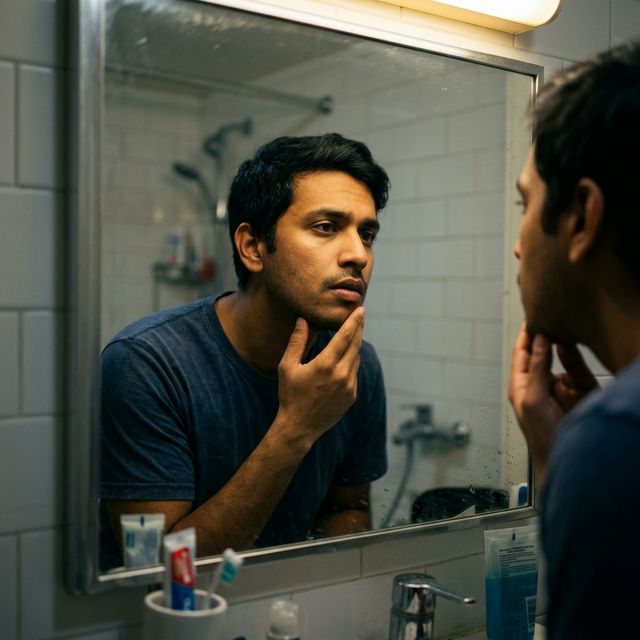
Why My Beard Is Not Growing is a common topic of discussion. Looking in the mirror at smooth cheeks or a desperately patchy neckbeard inevitably leads to the frustrating question: "Why is my beard not growing?"
Why My Beard Is Not Growing is a common topic of discussion. At DenceSpot Clinic Gurgaon, this is one of the most common medical inquiries we face from male patients. The truth is, the absence of facial hair is not caused by "laziness" or a lack of magical beard oils. It is dictated by a ruthless combination of genetics, androgen receptor sensitivity, hormones, and hidden nutritional deficiencies. In this massive 1,500-word deep dive, we break down exactly why your facial hair has stalled, what exactly biological patchiness is, and list the medical solutions to force growth.
The Primary Culprit: Your Genetics & DNA
Why My Beard Is Not Growing is a common topic of discussion. Before examining your diet or stress levels, you must confront biology. Your DNA definitively codes for two absolute realities regarding your facial hair:
- Follicle Count: Your genetics dictate exactly how many hair follicles were formed on your face while you were in the womb. If your DNA simply did not place follicles on your cheeks, your cheeks will be permanently bare skin.
- Androgen Receptor Sensitivity: Having high testosterone is useless if the hair follicles on your face are not "sensitive" to it. Your genetics dictate how aggressively your facial follicles react to the hormones floating in your blood.
Why My Beard Is Not Growing is a common topic of discussion. If you are of East Asian or Indigenous American descent, or if your father and grandfathers struggle to grow facial hair, the reason your beard is not growing is overwhelmingly genetic. No amount of natural remedies will change your DNA. The only way to bypass poor genetics is by physically relocating hair follicles via an FUE Beard Transplant.
Hormonal Factors: Testosterone & DHT
Why My Beard Is Not Growing is a common topic of discussion. Facial hair is a secondary sex characteristic driven exclusively by male hormones. While scalp hair actually falls out when exposed to high DHT (causing baldness), facial hair absolutely requires high levels of these hormones to thrive.
- Testosterone: This primes the hair follicle and controls the physical thickness of the hair shaft.
- DHT (Dihydrotestosterone): This powerful androgen is responsible for the rapid linear growth of the hair and triggering dormant peach-fuzz into thick terminal hairs.
Why My Beard Is Not Growing is a common topic of discussion. If you suffer from clinically low testosterone (hypogonadism), your beard growth will severely stall. Symptoms of low T include fatigue, low libido, loss of muscle mass, and heavily stunted facial and body hair. A blood test checking your free and total testosterone is highly recommended.
Alopecia Barbae: The Autoimmune Attack
If your beard was previously thick and massive, but suddenly stopped growing and began falling out in perfect, smooth circular patches, you are not dealing with genetics—you are dealing with an autoimmune disease called Alopecia Barbae.
This occurs when your body's immune system mistakenly identifies your beard hair follicles as foreign invaders and attacks them, causing the hair to fall out rapidly. This is heavily triggered by extreme stress. Treatment usually requires topical steroids or localized clinical PRP Therapy injections to suppress the immune response and restart the growth phase.
| Cause of Growth Failure | Key Symptoms | Medical/Clinical Solution |
|---|---|---|
| Missing Genetics | Lifelong smooth cheeks, age > 25, family history of no beards. | Permanent FUE Beard Transplant. |
| Low DHT/Testosterone | Fatigue, low muscle mass, incredibly slow, thin growth everywhere. | Endocrinology consult (TRT), heavy resistance training, better sleep. |
| Alopecia Barbae | Sudden, perfectly circular bald patches appearing overnight. | Corticosteroid injections or clinical PRP Therapy. |
| Severe Nutrient Deficiency | Beard hair is brittle, snaps easily, looks dull, heavy shedding. | Biotin/Zinc supplementation and dietary overhaul. |
Age: The Patience Principle
Millions of 19-year-old men panic, asking why their beard isn't growing like a Viking's. The truth is biological maturation. While you may hit puberty at 14, facial hair maturation is incredibly slow. The majority of men do not see their maximum genetic beard density until they are between 25 and 30 years old. If you are under 22, the only "treatment" you currently need is absolute patience. Your androgen receptors are still waking up.
Lifestyle Killers: Stress, Sleep, and Diet
If your genetics are sound but your beard growth is agonizingly slow, your lifestyle is choking the biological process.
Nutritional Deficiencies
Hair is non-essential tissue. If your diet is horrific, your body cuts off nutrients to the facial hair to keep your vital organs alive. To fix this, you must radically pivot to a high-protein diet. Learn exactly which foods supercharge hair growth, focusing heavily on eggs (Biotin), red meat (Zinc/Iron), and Avocados. You should also audit your intake and read up on which specific vitamin deficiencies halt keratin production entirely.
Sleep Deprivation & High Cortisol
Testosterone is naturally synthesized when you are asleep. Consistently sleeping 5 hours a night suppresses your hormones. Coupled with high anxiety, your body floods with Cortisol (the stress hormone). Cortisol acts as a fierce vasoconstrictor, shrinking your blood vessels and literally starving the facial hair follicles of the blood they need to generate a hair shaft. It is paramount that you learn how to maintain hair-care habits starting with 8 hours of deep sleep.
The Illusion: "My Beard Stopped Growing"
A very common complaint is that a beard was growing rapidly, but suddenly "stopped" at a certain inch mark. This is not a pathology; it is the Terminal Length.
Every hair follicle runs on a timer (the Anagen phase). Some men's facial hair grows for 6 months before shedding; others grow for 6 years. If your beard stops getting longer, you have simply reached your genetic terminal length constraint. Furthermore, if you never use beard oil or balm, the ends of your beard will relentlessly break and snap off at the exact rate it grows, creating the optical illusion that it has stopped growing entirely. Master proper grooming techniques to prevent breakage.
When You Need Clinical Intervention
If you are past the age of 26, you eat perfectly, exercise, and have zero stress, yet your cheeks and jawline are utterly barren, biology has closed the door. In these cases, it is critical not to waste money on organic oils that cannot fundamentally alter your DNA.
FUE Beard Transplants for Genetic Absence
If your beard is not growing because the follicles do not exist, an advanced FUE Beard Transplant is the definitive medical cure. Our surgical team at DenceSpot Clinic will elegantly extract permanent, healthy hair follicles from the back of your scalp and physically implant them into your face.
Because these are permanent, DHT-resistant follicles, they will immediately begin growing on your face within a few months. Once matured, you will possess a thick, dense, full beard that you can shave and trim forever. If you are doubting the efficacy, just review the phenomenal clinical data asking is a beard transplant permanent? (Yes, it is). View the life-altering transplant results in our Gallery to see how we build beards from scratch.
PRP for Weak and Stalled Growth
If you have hair everywhere on your face but it is thin, see-through, and refusing to thicken up, Platelet-Rich Plasma (PRP) is highly effective. The concentrated growth factors from your blood force the weak, stalling follicles into an aggressive Anagen overdrive state. Patients always want to know does PRP really work? The clinical answer is a resounding yes for thickening weak shafts. You will start to see the thickening transformation within the standard PRP timeline of 8-12 weeks.
Tired of Waiting for a Beard That Won't Grow?
If you are past 25 and still dealing with bare cheeks and a wispy goatee, genetics are the sole culprit. Take control of your aesthetics. Consult with Dr. Nyra at DenceSpot Clinic Gurgaon today to see if a permanent FUE Beard Transplant is the clinical solution you need.
Book a Free Beard Consultation NowFrequently Asked Questions
Is it completely genetics if my beard is not growing?
Genetics play the largest role. Your DNA determines how many hair follicles exist on your face and how sensitive they are to testosterone and DHT. If your father could not grow a beard, you likely cannot either.
Why did my beard suddenly stop growing?
If a previously fast-growing beard violently stalls or falls out in circular patches, you may have Alopecia Barbae (an autoimmune response), extreme stress, or a sudden collapse in nutritional health.
At what age should a man accept his beard will not grow?
Most men see their facial hair maximize in density by age 25 to 30. If you are 30 and have bare cheeks, natural hormonal maturation has finished, and it will not grow in without a transplant.
Does low testosterone cause a lack of beard growth?
Yes. Testosterone primes the facial follicles, and DHT drives the linear growth. Clinically low testosterone will severely stunt the speed and thickness of facial hair development.
Can stress physically stop my beard from growing?
Absolutely. Chronic stress massively elevates cortisol, which restricts blood vessels. It chokes the root of your follicles from receiving nutrients, effectively forcing the hair into a resting state.