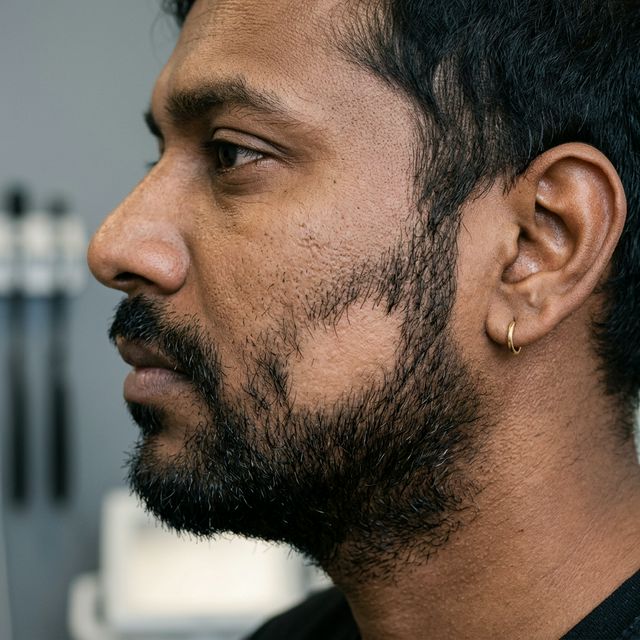
What Is Patchy Beard is a common topic of discussion. Men throw the term around constantly, but medically and biologically, what is a patchy beard? Understanding the anatomy of your face is the very first step toward actually solving the uneven gaps in your facial hair.
What Is Patchy Beard is a common topic of discussion. At DenceSpot Clinic Gurgaon, diagnosing the root cause of poor facial hair density is our specialty. To the untrained eye, severe patchiness is just "bad luck." To a dermatologist or a hair restoration surgeon, a patchy beard tells an incredibly detailed story about your genetics, your androgen sensitivity, and your follicle distribution. In this 1,500-word anatomical guide, we explain the hardcore science behind what creates a patchy beard in the first place, differentiate between bare skin and dormant hair, and reveal the clinical realities of achieving total density.
The Definition: What is a Patchy Beard?
What Is Patchy Beard is a common topic of discussion. A "patchy beard" is an aesthetic condition where facial hair grows with severe inconsistencies in density. Instead of a solid, uniform sheet of thick hair covering the jawline and cheeks, the growth is interrupted.
What Is Patchy Beard is a common topic of discussion. You may experience heavy, dark growth on the chin (the goatee zone) and neck, but simultaneously suffer from glaring bald spots, see-through areas on the upper cheeks, or a disconnected mustache that refuses to link to the rest of the beard.
Vellus Hairs vs. Terminal Hairs: The Core Issue
What Is Patchy Beard is a common topic of discussion. To understand patchiness, you must understand the two wildly different types of hair that inhabit a man's face:
- Vellus Hairs: These are the short, incredibly fine, unpigmented (transparent) hairs often called "peach fuzz." They barely protrude from the skin and offer zero visual density.
- Terminal Hairs: These are the thick, dark, coarse, deeply rooted hairs that constitute a true, masculine beard.
What Is Patchy Beard is a common topic of discussion. The Biological Patch: When a man has a patchy beard, the "bald patch" is usually not actually hairless. In 80% of cases, the patch is completely covered in fine vellus hairs. The problem is that his body has failed to convert those invisible vellus hairs into dark terminal hairs. Because the vellus hairs are transparent, the skin beneath shows through easily, creating the illusion of a massive bald spot.
Why Does Patchiness Happen? (The 3 Causes)
If you recently googled why your beard stopped growing or looks incredibly uneven, the answer almost always lies in one of three biological buckets.
1. Androgen Receptor Disparity (Genetics)
This is the leading cause of patchy beards. Facial hair requires the hormone DHT (Dihydrotestosterone) to transition from vellus to terminal. However, the DHT must bind to "Androgen Receptors" located inside the hair follicle.
Due to genetics, a man's chin and mustache areas are usually packed with highly sensitive androgen receptors—so hair grows thick and aggressively there. However, the cheeks and connectors often have very weak or very few androgen receptors. Therefore, even if your body floods with testosterone and DHT, the cheek follicles remain "deaf" to the hormone. The hair on your chin becomes thick and terminal, while the cheek hair permanently remains fine, patchy vellus fuzz.
2. Lack of Genetic Follicles
In roughly 20% of patchy beard cases, the skin in the patch is completely, entirely smooth. There are no vellus hairs. There are no pores. The skin is as barren as the palm of your hand.
If you are past the age of 25, this means your DNA simply did not construct hair follicles in those specific zones during your fetal development in the womb. No serum, oil, or vitamin on planet Earth will force your body to sprout a brand-new organ (a follicle) out of smooth skin. For these men, Surgical Beard Transplants are the singular, absolute only cure.
3. Alopecia Barbae
If your beard was historically thick and perfectly connected, but has suddenly developed perfectly smooth, circular, coin-sized bald patches in recent weeks, you are suffering from Alopecia Barbae. This is a stress-induced autoimmune disorder where your white blood cells attack the facial hair follicles. It requires immediate clinical intervention, often via steroid treatments or localized PRP injections.
| Type of Patchiness | Visual Marker | Biological Reason |
|---|---|---|
| The "Vellus" Patch | Spot looks bald from afar, but up close is covered in blonde peach-fuzz. | Weak androgen receptors failed to convert hair to terminal thickness under DHT. |
| The Smooth-Skin Gap | Disconnect between mustache and beard; skin is glossy and completely bare. | Total genetic lack of hair follicles in that specific anatomical dermal zone. |
| The Circular Coin Patch | Sudden, perfectly round bald spot on an otherwise aggressively thick beard. | Alopecia Barbae (autoimmune inflammatory attack). |
The Difference Between Patchy Growth and "The Awkward Phase"
Millions of men misdiagnose themselves with a genetically patchy beard simply because they lack patience. Hair on the face grows at vastly different speeds.
At week 4 of growing a beard, almost every man alive will look patchy. The dense clusters on the chin grow at ½ inch per month, while the sparse hairs on the cheeks might take two full months to reach the identical length. To truly confirm if you have a medically patchy beard, you must let the facial hair grow completely uninterrupted, without trimming anything but the neckline, for an absolute minimum of 90 days. During this time, read up on essential vitamins required to maintain heavy growth.
How Dermatology Solves Patchy Beards
If you have waited 4 months, your diet is impeccable (you know exactly what foods drive keratin production), and your patches remain glaringly obvious, it is time for medical aesthetics.
Minoxidil & Organic Vasodilators
If your patches are full of fine vellus hairs, applying a 5% Minoxidil solution or pure Peppermint Essential Oil twice daily acts as a ferocious vasodilator. It floods the dormant patch with extreme blood flow, artificially forcing those weak androgen receptors to wake up and transition the vellus hairs into thick, dark terminal hairs. Learning strict skincare routines combined with micro-needling heavily amplifies this biological hack.
The Gold Standard: FUE Facial Beard Transplantation
If your patch is completely smooth skin, or you simply want a thick, lumberjack-level dense beard without applying chemical serums twice a day for a year, an advanced FUE Beard Transplant is the ultimate and permanent fix.
At the DenceSpot Clinic, Dr. Nyra elegantly bypasses your weak facial genetics entirely. We extract permanent, robust, DHT-resistant hair follicles from the thick "safe zone" at the back of your scalp. These powerful follicles are then artistically, surgically driven directly into the bald patches on your cheeks and jaw.
Because the surgeon constructs the density manually, the results are immaculate. Once the transplanted hair begins growing, it acts exactly like native facial hair. You can shave it smooth, and it will aggressively grow back into a dense, connected full beard forever. It's totally natural because it is your own DNA. When patients ask is a beard transplant actually permanent for life?, the answer is an undisputed yes. You can view the stunning patch repairs in our Transformative Patient Gallery.
PRP to Thicken Sparse Edges
If the border of your patch has hair, but it is incredibly weak and wispy, utilizing your blood's own growth factors via clinical PRP Therapy injections can force massive thickening of the hair shaft. Patients are frequently amazed when learning how effectively PRP works, and the rapid timeline of the PRP results.
Ready to Connect the Patches Permanently?
If you understand the biology of your patchy beard and realize that natural oils won't fix missing genetics, it is time to take action. Consult with Dr. Nyra at DenceSpot Clinic Gurgaon today to see if a permanent FUE Beard Transplant is the clinical key to your aesthetic confidence.
Book a Free Clinical Consultation TodayFrequently Asked Questions
What is the medical definition of a patchy beard?
A patchy beard is characterized by uneven facial hair density, where certain areas (usually the cheeks and connectors) exhibit sparse, thin, or completely absent terminal hairs compared to thicker areas like the chin.
Is a patchy beard purely genetic?
Yes, the physical distribution of hair follicles on your face is determined before birth by your genetics. If you have large patches completely devoid of peach fuzz, it is an inherited genetic trait.
What is the difference between slow growth and a patch?
Slow growth means the hair is there but taking months to lengthen. A true patch means the skin is utterly bare or only contains invisible, unpigmented vellus hairs that fail to mature under testosterone.
Can a patchy beard look good?
Absolutely. By maintaining sharp cheeklines and neat necklines, a patchy beard looks intentional and highly styled rather than unkempt. Styling is half the battle with uneven density.
Can you truly "cure" a naturally patchy beard?
If the patches are caused by a lack of hair follicles, serums will fail. The only definitive, biological cure for missing hair follicles is an FUE surgical beard transplant to physically fill the gaps.