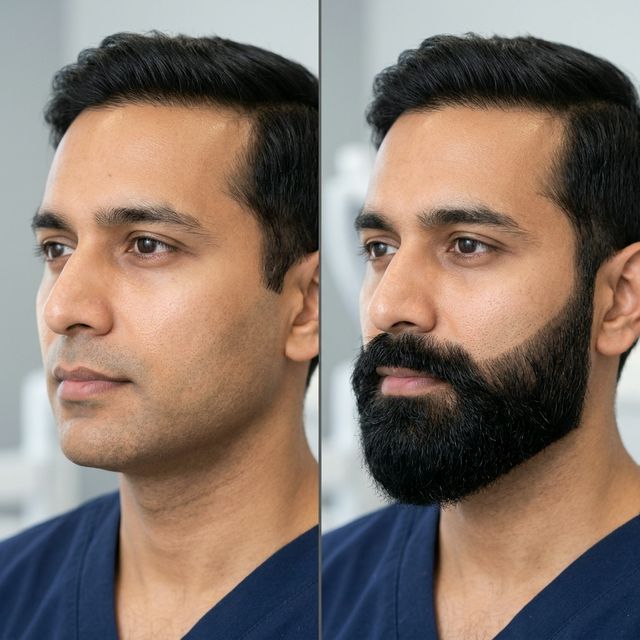
Do Beard Transplants Work is a common topic of discussion. Men who have completely exhausted dermarolling, topical Minoxidil, and aggressive vitamin regimens look toward surgery as the final frontier. But considering the financial and chronological investment, the ultimate hesitation is always binary: Do beard transplants actually work, or is it temporary?
Do Beard Transplants Work is a common topic of discussion. At DenceSpot Clinic Gurgaon, we specialize entirely in permanent facial hair restoration. While cosmetic marketing often blurs lines, surgery is grounded in absolute biological science. In this definitive 1,500-word clinical review, we will explain the medical survival rates of hair grafts, explore exactly why the FUE surgery is safe, explicitly outline the timeline of results, and definitively answer how permanent these results truly are.
The Science: Why They Biologically "Work"
Do Beard Transplants Work is a common topic of discussion. To understand why beard transplants work with such staggering success, you must grasp the concept of Donor Dominance. This is the foundational law of all beard transplantation.
Do Beard Transplants Work is a common topic of discussion. The hair growing on the back of your head (the occipital region) is genetically distinct from the hair on the top of your head or the front of your face. It is completely immune to DHT (Dihydrotestosterone), the hormone responsible for male pattern baldness. Because it is immune, it never falls out.
Do Beard Transplants Work is a common topic of discussion. When Dr. Nyra utilizes microscopic FUE tools to extract a hair follicle from the back of your head and implants it into the bald patch on your cheek, the follicle retains its original genetic immunity. It does not "adopt" the completely hairless genetics of your cheek. Be sure to review exactly why patches form organically. Because the follicle retains its immunity and robustness, it takes root in the facial blood supply and grows permanently. This law ensures a near-perfect survival rate.
The Timeline of Efficacy: When Does it Actually Work?
Do Beard Transplants Work is a common topic of discussion. One primary reason men mistakenly claim beard transplants "don't work" is a fundamental misunderstanding of the healing timeline. The final aesthetic result is not instantaneous.
Months 1 to 2: The "Shedding" Deception
This is the most terrifying phase. Three weeks after the surgery, every single newly transplanted beard hair will suddenly shed and fall out. Patients panic, assuming the procedure entirely failed. In reality, this is Surgical Shock Loss. The trauma of the transfer forces the follicle organ beneath the skin into an aggressive resting state (Telogen phase). The follicle is alive and healthy beneath the skin, but it ejected the temporary hair shaft above the skin. Review fundamental beard growth cycles to understand this resting phase.
Months 3 to 6: The True Sprouting
Around month 3, the follicles wake up. Brand new, perfectly dense hair will begin breaking through the skin exactly where the bald patches used to be. It may initially appear slightly wiry, but it softens over time.
Months 9 to 12: The Final Verdict
By a full year, the hair has completely matured. The density has thickened, and the patient has a perfectly normal, entirely natural, permanent beard that requires standard grooming and maintenance just like native facial hair.
| Post-Op Timeline | Visible Hair Status | Underlying Biological Action |
|---|---|---|
| Week 1 - Week 3 | Hairs visible but covered in tiny scabs. | Follicles are actively taking root in new facial blood supply. |
| Month 1 - Month 2 | Completely bald (Shock Loss Phase). | Follicles are in deep resting phase gathering energy to rebuild. |
| Month 4 - Month 6 | New, thin hairs actively sprouting. | Early Anagen active growth phase initiated permanently. |
| Month 12 | 100% Full thick beard. | Hair shafts have matured, thickened, and texturized normally. |
Do the Transplanted Hairs Look "Real"?
This is where the difference between a high-end clinic and a cheap black-market clinic becomes disastrously obvious. Yes, when executed properly, it is physically impossible to distinguish transplanted hair from native facial hair.
To achieve this, Dr. Nyra meticulously targets ONLY "single-hair follicular units" from the back of the head. Scalp follicles often grow in bundles of 2 to 4 hairs. If a lazy surgeon implants a 4-hair bundle into your cheek, it looks incredibly "pluggy," fake, and doll-like, because native beard hair only grows as single, independent hairs. Furthermore, the surgeon must use microscopes to carefully map the "angle of incidence." If they implant the follicle pointing straight 90-degrees outwards, the hair will grow like a porcupine instead of flowing smoothly down the jawline. You are paying heavily for the aesthetic artistry when investigating beard transplant costs.
Are They Truly Permanent?
If you perform aggressive micro-needling or use topical solutions on vellus "peach fuzz" hair, you must wait a grueling 12 months for the hair to turn terminal, and even then, if you stop applying the serum too early, the hair falls out permanently.
Surgical transplants completely bypass this terrifying guessing game. Because the organ (the follicle) being transplanted physically matured on your scalp a decade ago, it is already a robust terminal hair. It does not require infinite daily chemicals to survive on your face. Once the surgery heals, you own that hair forever. You do not have to endure the anxiety of wondering why your beard suddenly stopped.
If you want heavy scientific evidence on sheer longevity, review the comprehensive guide on the absolute permanence of follicular transplants.
Dietary Support for Heavy Growth
While the follicle is permanent and the survival rate is 95%+, you have to fuel the engine. Once the hairs awaken in Month 4, they require gigantic amounts of Protein, Biotin, and Keratin building blocks to quickly construct the massive new hair shaft. You must investigate exactly what foods support hyper-growth and aggressively eliminate any underlying nutritional deficiencies that might throttle your total density.
For patients who are entirely afraid of surgery but desperate for thickness from their existing native hair, clinical PRP therapy using heavy blood-platelet growth factors is a spectacular alternative. Patients consistently ask if PRP really works, and the clinical data supports extremely positive, rapid thickening outcomes.
Want Proof That Beard Transplants Work?
Stop relying on hearsay. The biological evidence is undeniable. Come see the thousands of successful face transformations at DenceSpot Clinic Gurgaon. Consult with Dr. Nyra today to see how FUE permanent restoration will finally connect your patchy beard for the rest of your life.
Book a Free Clinical ConsulationFrequently Asked Questions
Do beard transplants actually work permanently?
Yes. Over 95% of the hair follicles implanted during an FUE beard transplant will survive, take root, and grow permanently for the remainder of your life.
Will the transplanted hair look like a natural beard?
Yes, because the surgeon specifically isolates single-hair grafts (rather than multi-hair clusters) and implants them at the exact downward-pointing angle of native facial hair, rendering the result completely natural.
Why does the transplanted beard hair fall out after 3 weeks?
This is a normal biological phenomenon called "Shock Loss." The trauma of the surgery forces the follicle into a resting phase. After 2 to 3 months, it will wake up and grow permanently.
Can I shave the transplanted beard?
Yes! The transplanted follicles are fully living, biological organs. Once healed (usually around 3 months), you can shave it down to the skin with a razor, and it will immediately grow back normally.
Where do they get the hair for a beard transplant?
The surgeon extracts genetically permanent, DHT-resistant hair from the "safe donor zone" heavily concentrated at the back of your scalp. This hair never goes bald, ensuring the beard never goes bald.