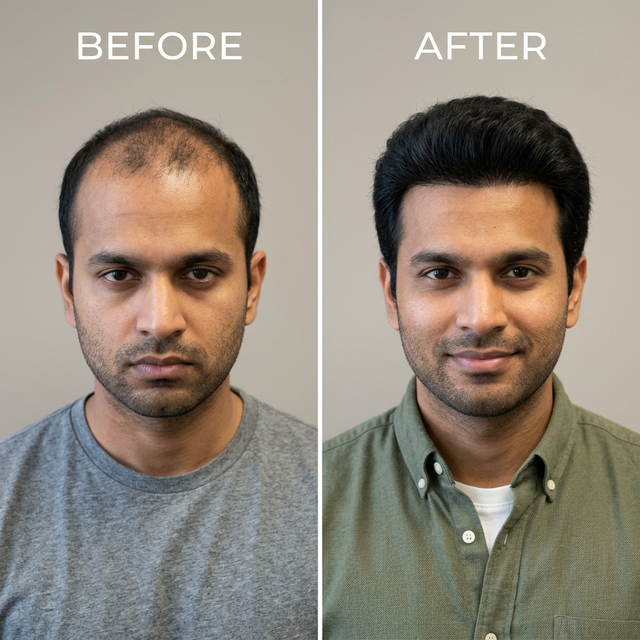
Male pattern baldness affects roughly 50% of men by age 50, and PRP (Platelet-Rich Plasma) therapy has emerged as one of the most popular non-surgical treatments to combat it. But can PRP actually stop androgenetic alopecia in its tracks? The honest answer is nuanced -- PRP can meaningfully slow progression and improve density in early to moderate stages, but it is not a cure. This guide explains exactly what PRP can and cannot do for male pattern baldness, backed by clinical evidence.
If you are a man noticing a receding hairline, thinning crown, or widening part, you have likely come across PRP therapy in your research. The internet is full of dramatic before-and-after photos and bold claims, but separating marketing from medical reality matters when you are making decisions about your hair. In this guide, we present an evidence-based, no-nonsense look at PRP for male pattern baldness -- including the stages where it works well, where it falls short, how it compares with other treatments, and when you should consider alternatives. If you are new to PRP entirely, start with our overview of what PRP hair treatment is.
Understanding Male Pattern Baldness: The Role of DHT and Genetics
Male pattern baldness, clinically called androgenetic alopecia, is driven by a combination of genetics and hormones. The primary culprit is dihydrotestosterone (DHT), a potent androgen derived from testosterone by the enzyme 5-alpha-reductase. In men who are genetically predisposed, DHT binds to androgen receptors on hair follicles in the scalp -- particularly at the temples, frontal hairline, and crown -- and triggers a process called follicular miniaturization.
Over time, affected follicles produce progressively thinner, shorter, and lighter hairs during each growth cycle. The anagen (growth) phase shortens while the telogen (resting) phase lengthens. Eventually, the follicle shrinks to the point where it can only produce a tiny vellus hair or stops producing visible hair altogether. This process is gradual and typically follows predictable patterns classified by the Norwood-Hamilton scale, ranging from stage 1 (no significant loss) to stage 7 (extensive baldness with only a horseshoe-shaped rim of hair remaining).
The critical point to understand is this: once a follicle has been fully miniaturized and destroyed, no topical or injectable treatment can bring it back. This biological reality is what sets the boundaries for what PRP -- or any non-surgical therapy -- can achieve. For a broader understanding of hair loss causes, see our complete guide to controlling hair fall.
What PRP Can Do for Male Pattern Baldness
PRP delivers a concentrated dose of growth factors -- including PDGF, VEGF, EGF, and TGF-beta -- directly to the scalp. These growth factors stimulate several processes that are beneficial for hair follicles affected by androgenetic alopecia:
- Prolonging the Anagen Phase: PRP growth factors signal follicles to stay in the active growth phase longer, counteracting the shortened growth cycles caused by DHT
- Increasing Blood Supply: VEGF promotes new blood vessel formation around follicles, improving nutrient and oxygen delivery to the dermal papilla
- Reversing Miniaturization (Partially): In follicles that are thinning but not yet dead, PRP can stimulate the dermal papilla cells to produce thicker, more robust hairs
- Reducing Inflammation: Chronic perifollicular inflammation is a contributing factor in androgenetic alopecia. PRP has anti-inflammatory properties that can help create a healthier scalp environment
- Slowing Progression: By strengthening existing follicles, PRP can slow the rate at which hair loss advances to the next Norwood stage
To learn more about the science behind PRP and how platelets work, read our article on what PRP is and how it works.
PRP Results by Norwood Stage: What the Evidence Shows
Not all stages of male pattern baldness respond equally to PRP. Here is an honest breakdown based on published clinical studies and our experience at DenceSpot Clinic:
Norwood 2-3: Strong Response
Men in the early stages of hair loss -- mild recession at the temples or early thinning at the crown -- are the best candidates for PRP. At these stages, the majority of follicles are still alive but beginning to miniaturize. Clinical studies have reported 30-40% improvement in hair density after a course of 4-6 PRP sessions. Hair fall reduction is often noticeable within the first month, and visible thickening typically appears by months 3-4. For men at Norwood 2-3, PRP can serve as a primary treatment, potentially delaying or even eliminating the need for more aggressive interventions.
Norwood 4-5: Moderate Response
At these intermediate stages, there is a mix of miniaturized follicles and areas where follicles are significantly weakened. PRP can still provide meaningful improvement -- typically 15-25% increase in density in the areas that still have viable follicles. However, results are less dramatic than in earlier stages, and PRP alone is usually insufficient. Combining PRP with finasteride, minoxidil, or microneedling significantly improves outcomes at this stage.
Norwood 6-7: Limited Response
In advanced baldness where large areas of the scalp are smooth and follicles have been permanently destroyed, PRP has limited value as a standalone treatment. It may help strengthen the remaining hair along the sides and back, and it can slow further loss in transitional zones, but it will not regrow hair in fully bald areas. At these stages, a hair transplant is the most effective option for restoring coverage, and PRP can play a valuable supporting role before and after surgery.
Clinical Evidence: What the Research Says
The evidence base for PRP in androgenetic alopecia has grown substantially over the past decade. Key findings include:
- A 2019 meta-analysis of 11 randomized controlled trials published in Dermatologic Surgery confirmed that PRP produces statistically significant improvements in hair count and hair density compared to placebo
- A 2020 study in the Journal of Cosmetic Dermatology found that men receiving PRP showed a mean increase of 33.6 hairs per square centimetre after 3 months of treatment
- Research in the International Journal of Trichology demonstrated that PRP combined with microneedling outperformed either treatment alone in men with androgenetic alopecia
- A 2021 comparative study found PRP to be comparable in efficacy to topical minoxidil 5% for early-stage male pattern baldness, with fewer side effects and better patient compliance
However, it is important to acknowledge limitations in the existing research. Study sizes are often small, protocols vary widely between clinics, and long-term data beyond 12-18 months is still limited. The quality of PRP preparation and injection technique also significantly affects outcomes, which is why choosing an experienced clinic matters.
PRP vs Finasteride vs Minoxidil for Male Pattern Baldness
Each of the three major non-surgical treatments for androgenetic alopecia works through a different mechanism, and understanding this helps set realistic expectations:
Finasteride
Finasteride is the only treatment that directly addresses the root cause of male pattern baldness by blocking DHT production. It reduces serum DHT levels by approximately 70%, which slows or stops further miniaturization in most men. It is taken as a daily oral tablet (1 mg) and has the strongest long-term evidence base. The downside is potential sexual side effects in 1-2% of users and the fact that results reverse when you stop taking it.
Minoxidil
Minoxidil is a topical vasodilator that increases blood flow to the scalp and extends the growth phase of hair follicles. It does not address DHT but can stimulate regrowth and thicken existing hair. It requires twice-daily application and results also reverse upon discontinuation.
PRP
PRP delivers growth factors that stimulate follicle activity, improve blood supply, and reduce inflammation. It does not block DHT directly. Its advantages include no systemic side effects, no daily medication, and the use of your own biological material. Its disadvantage is that it requires periodic clinic visits and does not address the hormonal driver of the condition.
The honest takeaway: for male pattern baldness specifically, finasteride addresses the cause while PRP and minoxidil address the symptoms. Used together, they produce better results than any single treatment alone.
Wondering If PRP Is Right for Your Hair Loss Stage?
Get an honest assessment from our expert dermatologists at DenceSpot Clinic, Gurgaon. We use trichoscopy and scalp analysis to determine exactly which treatments will work for your Norwood stage -- no overselling, just evidence-based recommendations.
Book Free ConsultationCombining Treatments for the Best Results
The most effective approach to male pattern baldness is rarely a single treatment. At DenceSpot, we recommend a combination strategy tailored to the patient's Norwood stage, age, and goals:
- Norwood 2-3: PRP (4-6 sessions) + minoxidil 5% topical + microneedling every 4-6 weeks. Consider adding finasteride if progression is rapid.
- Norwood 3-4: PRP + finasteride 1 mg daily + minoxidil. This triple combination addresses both the cause (DHT) and the symptoms (follicle weakness, poor blood supply). Microneedling further enhances PRP absorption and results.
- Norwood 5+: Hair transplant (FUE or FUT) for bald areas, with PRP + finasteride + minoxidil to protect remaining native hair and support graft survival.
This layered approach treats male pattern baldness from multiple angles and consistently outperforms any single-treatment strategy in clinical practice.
When PRP Is Not Enough: The Case for Hair Transplant
It is important to be honest about the limits of PRP. You should consider a hair transplant instead of (or in addition to) PRP if:
- You are at Norwood stage 5 or above with significant bald areas
- You have been on PRP and medical therapy for 6-9 months with insufficient results
- You want to restore a hairline or fill in large areas where follicles are permanently gone
- Trichoscopy shows extensive follicle destruction rather than miniaturization
A hair transplant moves DHT-resistant follicles from the back and sides of the head to bald areas, providing a permanent solution for those regions. PRP remains valuable after transplant -- it accelerates healing, supports graft survival, and protects existing non-transplanted hair from further thinning. For more on what to expect from transplant surgery, read our guide on hair transplant myths vs facts.
Setting Realistic Expectations
If you are considering PRP for male pattern baldness, here is what you should honestly expect:
- PRP will not cure androgenetic alopecia. The genetic and hormonal drivers remain active. PRP manages the condition; it does not eliminate it.
- Results require maintenance. Without ongoing sessions every 3-6 months, improvements will gradually fade as DHT continues to affect follicles.
- Earlier intervention yields better results. The more living follicles you have, the more PRP has to work with. Starting treatment at the first signs of thinning gives the best outcomes.
- Results vary between individuals. Factors including age, genetics, overall health, platelet count, and the quality of PRP preparation all influence outcomes. Not every patient will see the same degree of improvement.
- Combination therapy is usually superior. PRP works best when paired with at least one other treatment -- finasteride, minoxidil, microneedling, or all three.
- PRP is an investment in slowing the clock. Think of it as buying time for your hair rather than reversing time. For many men, that distinction makes PRP well worth it.
The Bottom Line
Can PRP stop male pattern baldness? Not entirely -- but it can be a powerful tool in slowing its progression and improving hair density, particularly when caught early. For men at Norwood stages 2-4, PRP offers a safe, non-surgical option with no systemic side effects and genuine clinical evidence behind it. For more advanced stages, PRP plays a supporting role alongside hair transplant surgery and medical therapy.
The key is honest diagnosis, realistic expectations, and a treatment plan tailored to your specific stage and goals. At DenceSpot Clinic in Gurgaon, we begin every consultation with a thorough scalp analysis and an honest conversation about what each treatment can and cannot do for you. No overselling, no false promises -- just evidence-based care.
If you are ready to take action against hair loss, book a free consultation with our team today. The earlier you start, the more options you have.
Take the First Step Against Male Pattern Baldness
Get a detailed trichoscopy analysis and personalized treatment plan from our experienced dermatologists. We combine PRP with advanced therapies for maximum results at every Norwood stage.
Book Free ConsultationFrequently Asked Questions
Can PRP stop male pattern baldness completely?
PRP cannot completely stop or reverse male pattern baldness, especially in advanced stages. However, it can significantly slow the progression, reduce hair fall, and improve hair density in early to moderate stages (Norwood 2-4). It works best as part of a multi-therapy approach.
What Norwood stage responds best to PRP?
Norwood stages 2 and 3 respond best to PRP therapy, with studies showing up to 30-40% improvement in hair density. Stage 4 can still see moderate benefits. Stages 5 through 7, where significant follicle loss has occurred, typically see limited results from PRP alone.
Is PRP better than finasteride for male pattern baldness?
PRP and finasteride work through different mechanisms. Finasteride blocks DHT systemically, while PRP delivers growth factors locally. Neither is universally better -- they complement each other. Many dermatologists recommend using both together for the best results in androgenetic alopecia.
How many PRP sessions are needed to see results for male pattern baldness?
Most men with androgenetic alopecia need 4-6 initial sessions spaced 3-4 weeks apart, followed by maintenance sessions every 3-6 months. Visible improvement in hair density typically becomes noticeable by 3-4 months after starting treatment.
Can PRP regrow hair on a completely bald crown?
If the follicles in the crown area are completely gone and the scalp is smooth and shiny, PRP will not regrow hair there. PRP can only revive follicles that are miniaturized or dormant, not those that have been permanently destroyed. A hair transplant is the better option for fully bald areas.
Does PRP work without finasteride or minoxidil?
PRP can produce results on its own, particularly for early-stage thinning. However, clinical evidence suggests that combining PRP with finasteride, minoxidil, or both delivers significantly better outcomes for male pattern baldness than any single treatment alone.
How long do PRP results last for male hair loss?
PRP results are not permanent because androgenetic alopecia is a progressive condition. Without maintenance sessions every 3-6 months, the benefits gradually diminish over 6-12 months. Ongoing treatment is needed to sustain improvements in hair density and thickness.
When should I consider a hair transplant instead of PRP?
If you are at Norwood stage 5 or above, have large areas of complete baldness, or have not responded to 6-9 months of PRP and medical therapy, a hair transplant is likely the more effective option. PRP can still be used after transplant to protect existing hair and support graft survival.