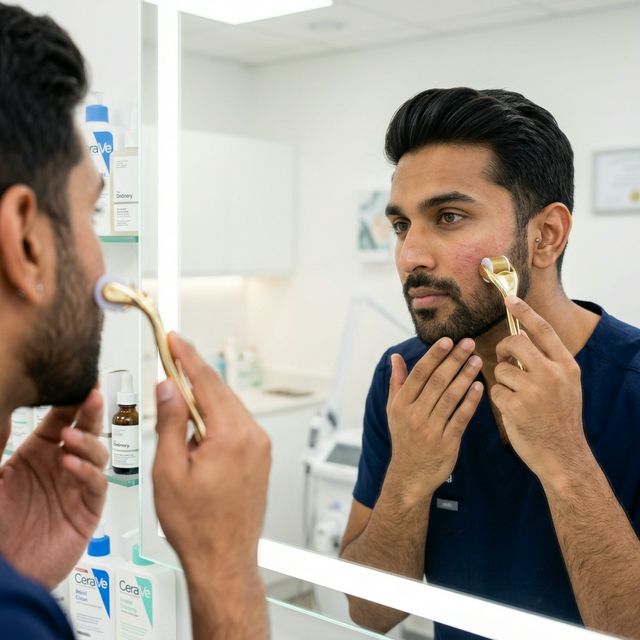
What is microneedling? It is the question every patient asks when searching for a natural, highly effective anti-aging or scar-reduction procedure. Also known as Collagen Induction Therapy (CIT), this treatment has completely revolutionized modern aesthetic medicine by utilizing the body's own biological healing mechanisms.
Welcome to DenceSpot Clinic Gurgaon, where we exclusively focus on scientifically proven, medical-grade aesthetic treatments. Whether you are dealing with profound acne scarring, frustrating hyperpigmentation, or general signs of aging, you have undoubtedly encountered the term "microneedling" online. When exploring what is microneedling, it is crucial to understand all the medical facts before committing to a procedure. This exhaustive 1,500-word guide breaks down the biological science of the treatment, exactly how it generates new skin tissue, and why it is universally praised by dermatologists worldwide over more invasive laser procedures.
The Medical Definition: What is Microneedling?
At its absolute core, understanding what is microneedling requires a basic understanding of human biology and wound healing. Microneedling is a minimally invasive dermatological procedure that uses a mechanical medical device (commonly a dermapen or an advanced roller) fitted with dozens of vibrating, ultra-fine, sterile surgical needles.
These tiny needles rapidly puncture the epidermis (the top layer of the skin) and penetrate down into the dermis (the deeper structural layer). By creating thousands of microscopic "micro-injuries" or "micro-channels," the treatment forcefully triggers the body's innate trauma response.
When the brain registers these thousands of tiny pinpricks, it immediately assumes the skin has suffered a massive physical trauma. To heal this "trauma," the body rushes an enormous volume of blood, oxygen, and specialized healing cells to the exact area. Most importantly, it completely overrides the skin's standard maintenance cycle and shifts instantly into hyper-active collagen and elastin production. These two vital structural proteins—collagen and elastin—are the absolute building blocks of thick, smooth, tight, youthful skin. If you are researching skin treatments in Gurgaon, this biological fact makes microneedling one of the most powerful natural regenerative tools ever developed.
The Biological Journey: What Happens Under the Skin?
The topic of what is microneedling is highly relevant for anyone considering treatment for severe scarring. The process of Collagen Induction Therapy happens in three distinct, fascinating chronological phases:
1. The Inflammation Phase (Days 1 to 3)
The precise moment the surgical needles pierce the skin, platelets in your blood are released. These platelets instantaneously begin clotting the micro-wounds and release highly potent growth factors. These growth factors initiate an acute (short-term) inflammatory response. Immune cells rush in to disinfect the microscopic wounds, remove any cellular debris, and significantly amplify local blood flow. This sudden rush of blood is exactly why a patient's face looks extremely red and feels warm immediately following the treatment.
2. The Proliferation Phase (Days 3 to 14)
During the second week, the tissue begins rebuilding itself from the inside out. Your body generates brand-new granulation tissue, heavily infused with massive amounts of fresh Type III Collagen and elastin fibers, to physically close the micro-channels. Furthermore, your body actively builds an entirely new micro-vascular network, growing new microscopic blood vessels to permanently increase the localized blood supply to the skin's surface. This increased circulation imparts that famous "microneedling glow."
3. The Remodeling Phase (Weeks 2 to 6+)
During this final, long-term phase, the body physically changes the soft, initial Type III collagen into the much stronger, highly durable Type I collagen. The newly formed tissue permanently tightens, thickens, and physically lifts. If there were divots or "craters" in the face (such as pitted acne scars), the fresh collagen physically pushes those deep scars upwards from underneath, leveling them out with the surrounding healthy skin. This is why many patients who explore carbon facial alternatives ultimately choose microneedling for deep anatomical scarring.
What Exact Conditions Does Microneedling Treat?
Many patients ask us about what is microneedling during their consultations and what specific facial flaws it can eliminate. The sheer versatility of this treatment is its greatest strength. Because we are fundamentally forcing the skin to build entirely new, flawless tissue, we can use it to treat a massive variety of aesthetic concerns.
1. Deep Atrophic Acne Scarring
When a severe cystic pimple heals rapidly, it often destroys the local collagen, leaving behind a permanent physical depression in the skin (an ice-pick, boxcar, or rolling scar). Topical creams can never fill a physical hole. Microneedling physically breaks up the rigid, knotted scar tissue anchoring the depression downward, and stimulates dramatic local collagen production that physically acts as filler, pushing the floor of the scar upward until it is flush with the healthy skin. Many of our patients alternate between microneedling and clinical chemical peels to address both the depth and the dark discoloration of old scars.
2. Fine Lines and Wrinkles (Anti-Aging)
As we pass the age of 25, our natural biological collagen production completely plummets. This loss of physical scaffolding allows gravity to pull the skin downward, creating permanent creases, fine lines around the eyes (crow's feet), and horizontal forehead wrinkles. Microneedling forcefully replaces that lost collagen scaffolding, physically thickening the dermis and smoothing out lines from within.
3. Enlarged Pores
Contrary to popular belief, you cannot physically "shrink" a pore with an astringent toner. Pores appear massive because the collagen wall surrounding the pore has weakened and collapsed outward. By aggressively rebuilding the collagen around the perimeter of the pore, the pore structure is tightened and reinforced, drastically reducing its visible circumference on the skin surface.
4. Scalp Alopecia and Hair Loss
Interestingly, this exact same micro-injury mechanism works spectacularly on the scalp. Creating micro-channels in a thinning scalp vastly improves blood circulation to starving hair follicles. When combined inextricably with PRP therapy, microneedling forces dormant follicles into an active growth state. Read our full clinical analysis on whether advanced hair treatments like PRP work when combined with needling, or explore our dedicated Hair Microneedling page.
Microneedling vs. Laser Resurfacing
Understanding what is microneedling naturally leads to comparisons with deep ablative laser treatments. For decades, the only way to effectively treat severe acne scarring was to use an aggressive CO2 laser to literally burn away the top layer of skin.
While lasers are highly effective, they use extreme thermal heat. This intense heat can frequently damage the melanocytes (pigment-producing cells) in the skin. For patients with darker skin tones (Fitzpatrick Skin Types III, IV, and V—which includes the vast majority of Indian skin), applying aggressive laser heat carries a terrifying risk of Post-Inflammatory Hyperpigmentation (PIH), where the skin permanently turns brown or black after the laser burn heals.
Microneedling completely bypasses this critical issue. Because it relies entirely on mechanical injury (a physical needle puncture) rather than thermal injury (a laser burn), the melanocytes remain completely intact and undisturbed. This makes microneedling spectacularly safe and highly effective for all skin types and ethnicities without the terrifying risk of permanent pigmentation damage.
The Importance of Medical-Grade Devices
A quick internet search will yield thousands of cheap, plastic "$15 derma rollers" available for home delivery. At DenceSpot Clinic, we strongly condemn the use of at-home rollers for deep collagen induction. An at-home roller uses needles mounted perfectly on a rotating drum. As the drum rolls across the face, the needle enters the skin at one angle, and violently exits the skin at a completely different angle. This physically tears the skin in a "V" shape rather than puncturing it cleanly, leading to profound microscopic scarring and permanent damage over time.
Clinical, medical-grade microneedling devices (such as the Dermapen 4) operate on a vertical stamping mechanism. The engine rapidly fires a sterile needle cartridge perfectly up and down into the skin at an astonishing 120 times per second. This creates a flawless, perfectly vertical microscopic channel with absolutely zero tearing, pulling, or lateral damage. Furthermore, a highly trained dermatologist can electronically adjust the exact depth of the surgical needles (from 0.25mm to 2.5mm) in real-time, depending on the exact thickness of the skin area being treated (e.g., very shallow around the delicate eyes, very deep over thick scar tissue on the cheeks).
Stop Letting Scars Control Your Confidence
If you are exhausted from covering up deep pits, dark spots, or aging skin with heavy makeup, microneedling is the biological cure you have been waiting for. Meet with Dr. Nyra at DenceSpot Clinic Gurgaon for a comprehensive assessment.
Book Your Free Skin AnalysisThe Safety, Hygiene, and Post-Care Protocols
When puncturing the skin hundreds of thousands of times in a single session, absolute clinical sterility is not optional; it is mandatory. All advanced clinics exclusively utilize sealed, single-use, gamma-irradiated titanium needle cartridges that are opened immediately in front of the patient and destroyed directly after the single session. The face is aggressively disinfected with medical-grade chlorhexidine before the procedure begins. When you trust a professional, you eliminate the catastrophic risk of a massive staph infection that haunts those who attempt this in their dirty bathroom at home.
Frequently Asked Questions
What is microneedling in dermatology?
Microneedling is a minimally invasive dermatological procedure that uses a device equipped with fine needles to create hundreds of microscopic punctures in the top layer of the skin. This triggers the body's natural wound healing process, producing new collagen and elastin.
What conditions does microneedling treat best?
It is highly effective for treating acne scars, fine lines, wrinkles, large pores, hyperpigmentation, surgical scars, and even hair loss when combined with PRP or topical medications.
How many microneedling sessions are needed?
Most dermatologists recommend a series of 3 to 6 sessions spaced 4 to 6 weeks apart for optimal collagen induction and visible skin rejuvenation.
What is the recovery time for microneedling?
Recovery is minimal. Most patients experience redness resembling a mild sunburn for 24 to 48 hours. By day three, the skin usually returns to its normal tone, though mild peeling may occur.
Can microneedling ruin your skin?
If performed by a qualified dermatologist in a sterile clinical environment, it is incredibly safe. However, aggressive at-home derma rolling with unsterilized tools can cause severe infections, scarring, and hyperpigmentation.