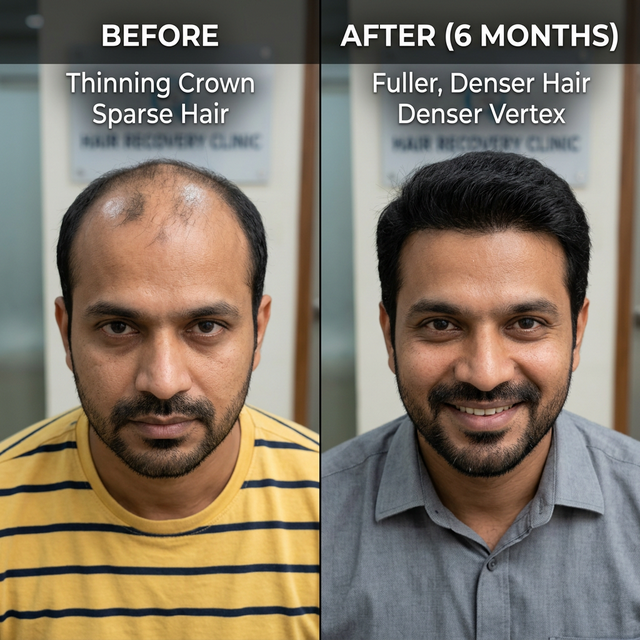
Many patients ask us about Does Prp Work For Hair during their consultations. "Doctor, does PRP actually work for hair?" — This is the most common question we hear from patients visiting our PRP hair treatment clinic in Gurgaon. The short answer is yes — and the science backs it up.
At DenceSpot Clinic, Does Prp Work For Hair is a very common point of discussion. Platelet-Rich Plasma (PRP) therapy has become one of the most popular non-surgical treatments for hair loss worldwide. But with so many treatments promising results, it is natural to be sceptical. In this article, we present the clinical evidence, real patient outcomes, and honest expectations — so you can make an informed decision.
What Does the Science Say About PRP for Hair?
The topic of Does Prp Work For Hair is highly relevant for anyone considering treatment. PRP therapy is not based on marketing hype — it is supported by peer-reviewed clinical research. Here is what major studies have found:
The topic of Does Prp Work For Hair is highly relevant for anyone considering treatment. 2014 Study (Journal of Cutaneous and Aesthetic Surgery): Patients receiving PRP injections showed a significant increase in hair count — an average of 33.6 additional hairs per cm² compared to baseline. The study concluded that PRP is a safe and effective treatment for androgenetic alopecia.
2015 Italian Study (Stem Cells Translational Medicine): Researchers found that PRP-treated areas showed a 45.9% increase in hair density compared to untreated areas. Hair thickness also improved significantly.
2019 Meta-Analysis (Dermatologic Surgery): A comprehensive review of 11 randomized controlled trials confirmed that PRP significantly improves hair density and thickness in patients with pattern hair loss. The evidence was rated as moderate to high quality.
How Does PRP Work for Hair Growth?
Understanding the mechanism helps you appreciate why PRP is effective. Your blood contains platelets loaded with growth factors — proteins that signal tissue repair and cell regeneration. Here is the step-by-step process:
- Blood Collection: A small amount of blood (15-20ml) is drawn from your arm — similar to a routine blood test.
- Centrifugation: The blood is placed in a centrifuge that spins at high speed, separating platelet-rich plasma from red blood cells.
- Activation: The concentrated PRP — containing 5-10 times more platelets than normal blood — is prepared for injection.
- Micro-Injection: PRP is injected into thinning areas of the scalp using fine needles, delivering growth factors directly to weakened follicles.
The growth factors in PRP — including PDGF, TGF-β, VEGF, and EGF — stimulate dormant follicles, improve blood supply to the scalp, and extend the active growth phase of hair. This is why PRP works particularly well when combined with microneedling treatment — the micro-channels enhance absorption of growth factors.
Real Results: What Patients Actually Experience
At DenceSpot Clinic, we have treated hundreds of patients with PRP therapy. Here is a realistic timeline of what most patients experience:
Month 1-2: Reduced Hair Fall
The first noticeable change is a significant reduction in daily hair shedding. Patients who were losing 100-150 hairs per day typically report a drop to 30-50 hairs. This is the earliest sign that PRP is working.
Month 3-4: New Growth Begins
Fine baby hairs begin appearing in previously thinning areas. These are vellus hairs that will gradually thicken over the coming months. Hair texture also starts improving — becoming softer and more manageable.
Month 5-6: Visible Thickness
This is when most patients — and their family members — notice a visible difference. Hair density improves, the scalp becomes less visible through the hair, and overall volume increases significantly.
Month 6-12: Optimal Results
With maintenance sessions, results continue to improve. Hair reaches its maximum thickness and density. At this stage, maintenance PRP every 4-6 months helps sustain the gains. For advanced cases, combining PRP with a hair transplant delivers the best long-term outcome.
Who Gets the Best Results from PRP?
PRP does not work equally for everyone. Here is an honest breakdown of who benefits most:
Ideal Candidates (70-90% Success Rate)
- Early to moderate hair thinning (Norwood Grade 2-4)
- Diffuse thinning in women
- Recent onset hair loss (within 5 years)
- Post-hair transplant patients (PRP accelerates graft survival)
- Patients with hair miniaturization but follicles still alive
Moderate Candidates (40-60% Success Rate)
- Advanced thinning (Norwood Grade 5-6)
- Hair loss lasting more than 10 years
- Patients with underlying medical conditions affecting hair
PRP May Not Work For
- Completely bald areas where follicles have permanently died
- Scarring alopecia (cicatricial alopecia)
- Hair loss due to active autoimmune conditions
During your consultation at DenceSpot Clinic, our dermatologists perform a thorough hair loss assessment including trichoscopy to determine whether PRP is right for you.
PRP vs Other Hair Loss Treatments
How does PRP compare to other popular options?
PRP vs Minoxidil
Minoxidil requires daily application for life — stopping it reverses gains. PRP requires only periodic sessions and uses your body's own biology. Many patients use both together for synergistic results.
PRP vs Hair Transplant
A hair transplant is a surgical solution for advanced baldness. PRP is non-surgical and works best for early to moderate thinning. The two treatments are complementary — PRP strengthens existing hair while transplants restore bald areas.
PRP vs LED Therapy
LED light therapy stimulates cellular energy in follicles. When combined with PRP, the results are enhanced because LED prepares the follicles to respond better to growth factors.
Why Choose DenceSpot Clinic for PRP Treatment?
- Advanced Double-Spin Technique: We use FDA-approved double centrifugation to extract the highest platelet concentration.
- Experienced Dermatologists: Our doctors have performed thousands of PRP sessions with consistently high success rates.
- Customized Protocols: Every patient gets a treatment plan tailored to their specific hair loss pattern and severity.
- Combination Approach: We often combine PRP with microneedling, LED therapy, or medical management for optimal results.
Ready to See Real Results?
Book a consultation with our hair restoration experts and find out if PRP is right for your hair loss pattern. Early treatment delivers the best results.
Book PRP ConsultationFrequently Asked Questions
How long does it take for PRP to show results on hair?
Most patients begin noticing visible improvement after 3-4 sessions, typically within 3-6 months. Hair becomes thicker and shedding reduces significantly by the 4th session.
What is the success rate of PRP for hair growth?
Clinical studies show PRP has a 70-90% success rate in reducing hair fall and improving hair density when performed on suitable candidates with early to moderate hair thinning.
Does PRP work permanently for hair?
PRP is not a one-time permanent fix. It requires maintenance sessions every 6-12 months to sustain results. However, the improvements in hair thickness and density are long-lasting with proper follow-up.
Is PRP better than minoxidil for hair growth?
PRP and minoxidil work through different mechanisms and can complement each other. PRP uses your own growth factors for natural stimulation, while minoxidil improves blood flow. Many dermatologists recommend combining both for optimal results.
Does PRP work for completely bald areas?
PRP works best on areas where hair follicles are still alive but miniaturized. For completely bald areas where follicles have died, PRP alone may not be effective — a hair transplant may be needed.
How many PRP sessions are needed for hair growth?
A standard PRP protocol involves 3-4 initial sessions spaced 3-4 weeks apart, followed by maintenance sessions every 4-6 months to maintain and build upon results.