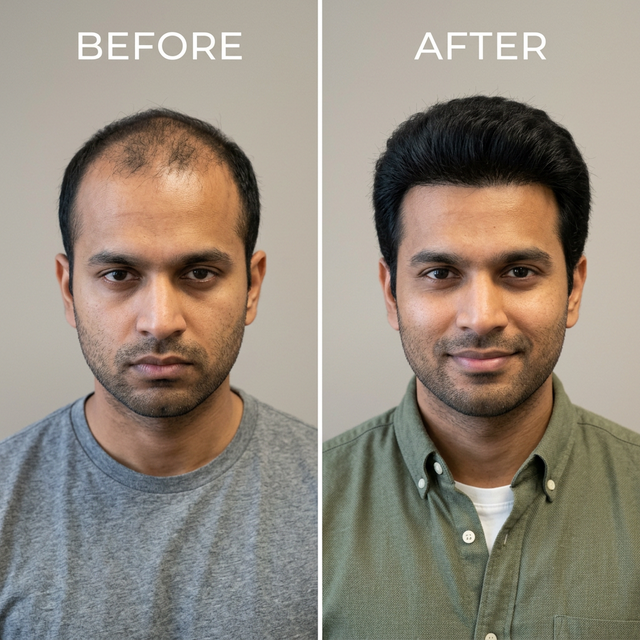
Understanding Does Prp Grow New Hair can significantly impact your final results. "Will PRP give me new hair, or will it just make my existing hair a bit thicker?" This is one of the most important questions patients ask at our PRP clinic in Gurgaon. The honest answer involves understanding how hair follicles actually work.
Many patients ask us about Does Prp Grow New Hair during their consultations. The distinction between "new hair growth" and "improved thickness" matters because it sets realistic expectations. Many clinics overpromise — claiming PRP creates brand new follicles. The truth is more nuanced, but equally impressive. Let us explain.
The Truth: PRP Does Both — But Not How You Think
Understanding Does Prp Grow New Hair can significantly impact your final results. Here is the scientific reality: PRP does not create entirely new hair follicles from scratch. You are born with all the hair follicles you will ever have — approximately 100,000 on your scalp. What PRP does is far more clever:
1. It Reactivates Dormant Follicles
When exploring Does Prp Grow New Hair, it is crucial to understand all the facts. In hair loss, follicles do not disappear overnight. They go through a process called miniaturization — gradually producing thinner, shorter, lighter hairs until they eventually stop producing visible hair altogether. However, the follicle itself often remains alive beneath the skin for years.
When exploring Does Prp Grow New Hair, it is crucial to understand all the facts. PRP's growth factors — PDGF, VEGF, TGF-β, and EGF — stimulate these dormant follicles back into action. The result looks and feels like new hair growth, because hairs that were invisible are now producing visible strands again.
2. It Converts Vellus Hair to Terminal Hair
Vellus hairs are the fine, nearly invisible hairs that replace thick terminal hairs during miniaturization. PRP reverses this process by nourishing follicles with concentrated growth factors, enabling them to produce thick, pigmented terminal hairs again.
A 2015 study in Stem Cells Translational Medicine documented this effect — PRP-treated areas showed a significant increase in both hair count AND hair caliber (thickness), confirming that PRP works on both metrics.
3. It Thickens Existing Hair
Even hairs that are still growing but have become thin benefit from PRP. The growth factors increase the diameter of the hair shaft by stimulating the matrix cells that produce keratin. Clinical measurements show PRP can increase individual hair thickness by 20-30% — a difference that is clearly visible and tangible.
Clinical Evidence: New Growth vs Thickening
Hair Count Studies: Multiple trials show PRP increases the number of visible hairs per cm² by 20-35 hairs. These are follicles that were dormant and have been reactivated — effectively appearing as new growth.
Hair Thickness Studies: Trichoscopy measurements before and after PRP consistently show increased hair shaft diameter. A 2018 study found an average 23% increase in hair caliber after 4 PRP sessions.
Combined Effect: The most impressive results come from the combination — more hairs that are each individually thicker. This creates a dramatic improvement in overall hair density and volume that patients and their families notice.
What This Means for Your Hair
If you are experiencing hair thinning, here is what PRP can realistically achieve:
- Thinning crown: Dormant follicles in the crown area respond exceptionally well to PRP. Many patients see visible new growth within 3-4 months.
- Receding hairline: Results are moderate — PRP can thicken miniaturized hairs at the hairline edge but may not fully restore a receded hairline.
- Overall diffuse thinning: This is where PRP shines brightest. When thinning is spread across the scalp, there are many dormant follicles to reactivate, and the improvement in density can be remarkable.
- Post-transplant: PRP significantly improves the survival and growth of transplanted grafts. Many hair transplant surgeons recommend PRP as part of the recovery protocol.
Why Some People Think PRP Does Not Grow New Hair
Confusion arises because of unrealistic expectations:
- Expecting growth on completely bald areas: If a follicle has been dormant for 10+ years, it may have permanently atrophied. PRP works best on follicles that still have some residual activity.
- Impatience: Hair growth is slow — about 1cm per month. New hairs reactivated by PRP need 3-6 months to become visible. Some patients give up too early.
- Incomplete treatment: PRP requires 3-4 sessions for initial results. One session alone is rarely enough to show significant improvement.
- Poor quality PRP: The concentration of platelets matters significantly. Low-quality preparation yields inferior results — which is why clinic choice matters.
Maximizing New Growth from PRP
At DenceSpot Clinic, we optimize PRP outcomes through:
- High Platelet Concentration: Our double-spin technique achieves 7-8x platelet concentration — significantly higher than single-spin methods.
- Combination with Microneedling: Microneedling creates micro-channels that enhance PRP penetration to the follicle level, improving both new growth and thickening.
- Nutritional Support: We address underlying nutritional deficiencies that may limit follicle response to PRP.
- Customized Sessions: The number and frequency of sessions is tailored to your specific hair loss pattern and severity.
Find Out What PRP Can Do for Your Hair
A trichoscopy assessment can reveal how many dormant follicles you have — and how much new growth PRP can potentially deliver. Book your assessment today.
Book Hair AssessmentFrequently Asked Questions
Does PRP create brand new hair follicles?
No, PRP does not create entirely new hair follicles. It reactivates existing dormant or miniaturized follicles — making them produce visible hair again. This is why it appears as new growth, even though the follicles were always there.
Can PRP make thin hair thicker?
Yes, one of the primary effects of PRP is increasing hair shaft diameter. Clinical studies show PRP can increase individual hair thickness by 20-30%, making hair visibly fuller and denser.
Does PRP work on vellus hair?
Yes, PRP is particularly effective on vellus (fine, miniaturized) hair. Growth factors stimulate these weakened follicles to produce thicker, terminal hair — this is one of the key mechanisms of PRP therapy.
How many new hairs can PRP grow?
Studies report an average increase of 20-35 hairs per cm² in treated areas. The exact number depends on how many dormant follicles are present and how well they respond to the growth factor stimulation.
Is the new hair from PRP permanent?
The regrown hair is real and natural, but it requires maintenance PRP sessions every 6-12 months to remain active. Without maintenance, the miniaturization process may resume over time.
Does PRP grow hair faster than normal?
PRP extends the anagen (active growth) phase of hair, which means follicles produce hair for a longer period. While the daily growth rate remains similar, the overall growth cycle is longer — resulting in more hair over time.