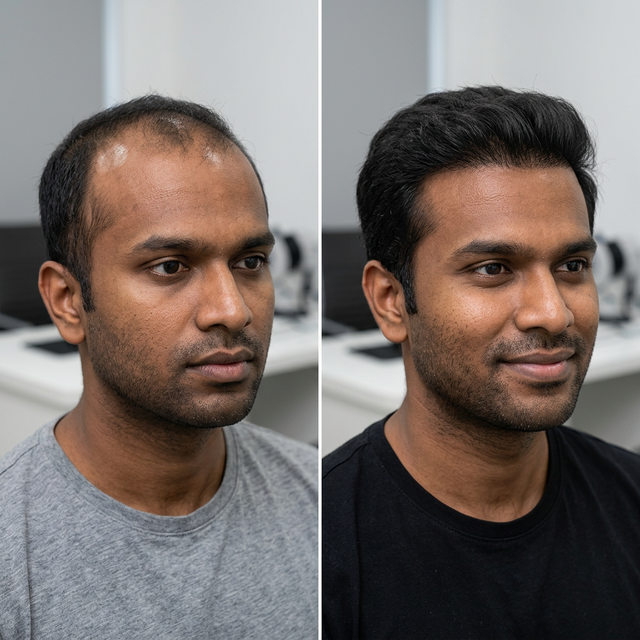
Many patients ask us about Can Prp Regrow Hair during their consultations. "Can PRP actually regrow my hair — naturally, without drugs?" This is the question that drives thousands of Indians to research PRP therapy every month. At DenceSpot Clinic Gurgaon, we provide honest, science-backed answers.
At DenceSpot Clinic, Can Prp Regrow Hair is a very common point of discussion. In an era of chemical treatments and synthetic solutions, PRP stands out as a genuinely natural approach to hair restoration. It uses nothing more than your body's own healing biology — concentrated platelets from your blood — to wake up sleeping follicles and stimulate new growth. But can it really regrow hair? Let us examine the evidence.
The Science Behind PRP Hair Regrowth
PRP works because your platelets are nature's repair kit. When you cut your finger, platelets rush to the wound and release growth factors that trigger healing. PRP therapy harnesses this same mechanism — but directs it to your scalp.
The concentrated platelets in PRP release several key growth factors:
- PDGF (Platelet-Derived Growth Factor): Stimulates cell proliferation in the hair follicle bulge — where stem cells reside. This reactivates dormant follicles.
- VEGF (Vascular Endothelial Growth Factor): Creates new blood vessels around follicles, improving oxygen and nutrient delivery to the hair root.
- TGF-β (Transforming Growth Factor): Regulates the hair cycle, pushing follicles from the resting phase back into the active growth phase.
- EGF (Epidermal Growth Factor): Promotes the growth and differentiation of cells in the hair matrix.
Together, these growth factors create an environment that encourages follicles to produce thicker, healthier hair. This is why PRP is considered one of the most natural treatments in dermatology — it amplifies what your body already does.
What Research Says About PRP Hair Regrowth
2014 Study (Stem Cells Translational Medicine): Italian researchers demonstrated a 45.9% increase in hair density in PRP-treated areas compared to untreated control areas. The results were visible within 3 months.
2017 Systematic Review (International Journal of Molecular Sciences): After analyzing multiple clinical trials, the reviewers concluded that PRP consistently promotes hair regrowth in androgenetic alopecia patients, with minimal side effects.
2019 Randomized Controlled Trial: Patients receiving PRP showed significant improvements in hair count, hair thickness, and hair root strength compared to placebo injections. The improvement was sustained for up to 12 months with maintenance sessions.
How PRP Regrows Hair — Stage by Stage
Stage 1: Follicle Reactivation (Weeks 1-4)
Growth factors stimulate dormant follicle stem cells. Blood supply to the scalp improves. You may not see visible changes yet, but cellular activity is increasing beneath the surface.
Stage 2: Reduced Shedding (Weeks 4-8)
Hair fall decreases noticeably. Follicles transition from the telogen (resting) phase to the anagen (growth) phase. Your pillow and shower drain show fewer fallen hairs. This is the first encouraging sign that PRP is working.
Stage 3: New Vellus Hair (Months 3-4)
Fine, light-coloured baby hairs begin to appear in thinning areas. These vellus hairs are newly activated follicles producing their first growth cycle. They will gradually thicken over time.
Stage 4: Visible Regrowth (Months 5-8)
Vellus hairs mature into terminal hairs — thicker, darker, and more visible. Hair density improves, and the scalp becomes less visible through the hair. This is when most patients feel genuinely excited about their progress.
Stage 5: Optimal Density (Months 8-12)
With continued maintenance sessions, hair reaches its maximum regrowth potential. Combined with proper hair care practices and nutrition, results can be sustained long-term.
Who Can Expect PRP to Regrow Hair?
Best Responders
- Men and women with early-stage thinning (within 5 years of onset)
- Diffuse thinning patterns rather than complete baldness
- Patients with good platelet counts and overall health
- Those willing to complete the full treatment protocol
- Post-hair transplant patients seeking accelerated graft growth
Moderate Responders
- Advanced thinning (Norwood 4-5) — PRP can slow progression and thicken remaining hair
- Long-standing hair loss (5-10 years) — some follicles may have permanently miniaturized
- Patients with nutritional deficiencies — correcting vitamin deficiencies alongside PRP improves response
Limited Response Expected
- Complete baldness with no miniaturized hair (shiny, smooth scalp)
- Scarring alopecia where follicles have been destroyed
- Alopecia areata in active autoimmune phase
PRP — The Natural Advantage
What makes PRP unique among hair treatments is its natural approach:
- No synthetic chemicals: Unlike minoxidil or finasteride, PRP introduces nothing artificial into your body.
- Zero allergic risk: Since PRP comes from your own blood, there is no risk of allergic reaction or rejection.
- No daily commitment: Unlike topical treatments that require daily application, PRP sessions are spaced weeks to months apart.
- Complementary: PRP pairs well with microneedling and LED therapy for enhanced results.
The DenceSpot PRP Protocol
At DenceSpot Clinic, our PRP protocol is designed for maximum regrowth:
- Trichoscopy Assessment: We examine your scalp under magnification to identify which follicles are viable for regrowth.
- Double-Spin Centrifugation: Our advanced technique concentrates 7-8x more platelets than standard methods.
- Targeted Injection Mapping: We create a customized injection map based on your specific thinning pattern.
- Combination Therapy: When appropriate, we combine PRP with microneedling or LED therapy for synergistic results.
Discover Your Hair Regrowth Potential
Every hair loss pattern is unique. Book a consultation to find out whether PRP can regrow your hair naturally — and how many sessions you may need.
Book PRP ConsultationFrequently Asked Questions
Can PRP regrow hair on a bald head?
PRP can regrow hair in areas where follicles are still alive but dormant or miniaturized. On completely bald areas where follicles have permanently died, PRP alone cannot regrow hair — a hair transplant would be needed.
How naturally does PRP regrow hair?
PRP is one of the most natural hair treatments available. It uses your own blood platelets — no synthetic chemicals, no drugs. The growth factors are 100% your body's own, making it a truly natural regenerative therapy.
Can PRP regrow hair without surgery?
Yes, PRP is a completely non-surgical procedure. It involves simple injections into the scalp — no incisions, no stitches, no scars. Most patients return to normal activities the same day.
How much hair can PRP regrow?
Studies show PRP can increase hair density by 30-45% in responding patients. The exact amount depends on the degree of existing miniaturization, your platelet quality, and how early treatment begins.
Does PRP regrow hair for women?
Yes, PRP is highly effective for women with diffuse hair thinning. Women often respond even better than men to PRP therapy because their hair loss pattern typically involves miniaturization rather than complete follicle death.
Can PRP regrow hair at the temples?
Temple recession responds moderately to PRP. If follicles in the temple area are still partially active, PRP can thicken existing miniaturized hairs. For significant temple baldness, combining PRP with a transplant gives the best results.