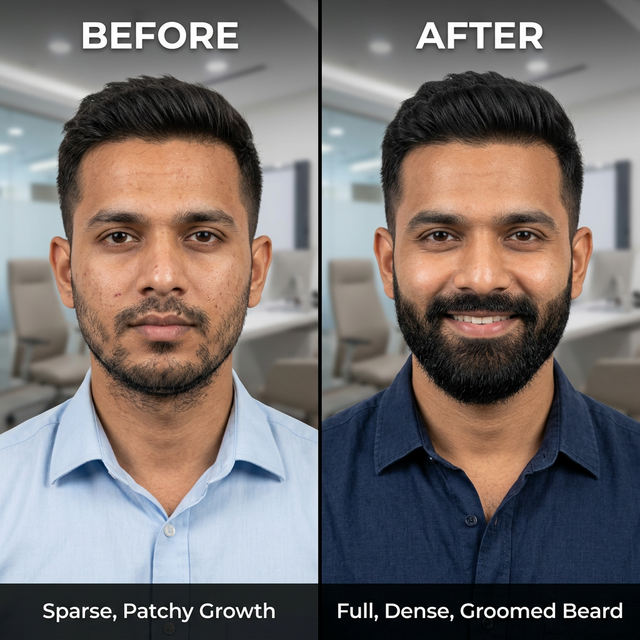
For many men, the patchy, irregular gaps in their beard are not genetic. They are the permanent legacy of severe acne — deep inflammatory breakouts that destroyed the hair follicles beneath the skin, leaving behind scar tissue where a beard should grow. This is a specific, medically understood problem. And beard transplant for acne scars is a highly effective, permanent solution.
At DenceSpot Clinic, the leading destination for beard transplant in Gurgaon, Dr. Nyra has extensive clinical experience performing facial scar hair restoration for patients whose scarring ranges from isolated spot acne to widespread, diffuse cystic acne damage covering both cheeks. This guide explains the biology of why acne destroys beard follicles permanently, exactly how the transplant process works in scar tissue, what to expect from the results, and why the right surgical technique makes all the difference.
How Acne Scars Permanently Destroy Beard Follicles
Understanding the problem begins with understanding what happens beneath the skin during severe acne. When a deep inflammatory papule, pustule, or cyst forms in the skin, it creates intense localised pressure and bacterial activity in the dermis — the deeper layer of skin where hair follicles are anchored.
During the inflammatory process, the body's immune response sends white blood cells to destroy the bacteria. Unfortunately, this inflammatory attack also damages the surrounding dermal tissue, including the delicate hair follicle matrix. When the immune attack is severe enough, the follicle itself is irreparably damaged and replaced by fibrous scar tissue during healing.
Scar tissue is biologically inert. It has no follicular stem cells, no active microvascular network comparable to normal dermal tissue, and no capacity to spontaneously generate new hair follicles. This is why acne scar beard patches are permanent — no topical serum, no minoxidil, no derma roller can create a follicle where scar tissue now occupies the space. The only solution that physically implants a new, living follicle into that scar tissue is a beard hair transplant scars treatment.
How Beard Transplant Works in Scar Tissue
The fundamental mechanism of a beard transplant for acne scars is identical to a standard beard transplant: healthy, DHT-resistant follicles are harvested from the back of the scalp and implanted into the recipient area on the face. The critical difference is the nature of the recipient tissue.
Normal facial skin is pliable, well-vascularised, and receptive to implantation. Scar tissue is denser, less elastic, and has a reduced native blood supply. This presents two specific technical challenges that require a highly experienced surgeon to navigate:
- Implantation Resistance: Scar tissue is physically more difficult to penetrate cleanly. The micro-tools must be used with greater precision to avoid tearing the tissue, which would widen the implantation channel and reduce follicle stability.
- Reduced Vascular Uptake: Because scar tissue has fewer active blood vessels, the newly implanted follicle has a modestly harder time establishing its initial blood supply connection. This slightly reduces graft survival rates on scar tissue compared to normal skin — typically 75-85% versus 90-97% on healthy dermis.
Why Graft Angle is Critical in Scar Tissue Cases
In standard beard transplantation, the angle of implantation determines how naturally the hair grows against the face. In acne scar cases, the angle is even more critical for an additional reason: scar tissue is rigid and does not flex like normal skin. A follicle implanted at a slightly incorrect angle in scar tissue will grow at that fixed, wrong angle permanently, with no natural tissue flexibility to partially compensate.
This is precisely why Dr. Nyra uses the DHT (Direct Hair Transplant) technique with implanter pens for virtually all acne scar beard transplant cases. The implanter pen allows microscopic, millimetre-level control of the insertion angle, direction, and depth simultaneously — far superior to the slit-and-forceps implantation method used in standard FUE, which introduces more angular variability. The result is follicles that grow flat against the face at the exact angle native beard hairs would have grown, producing a completely natural appearance even in heavily scarred tissue.
Success Rates and Before/After Expectations
Based on clinical outcomes at DenceSpot Clinic Gurgaon, patients undergoing beard transplant for acne scars Gurgaon can expect the following realistic outcomes:
- Isolated Scar Spots (1-3 discrete patches): Excellent results. Survival rates of 80-90% with DHT technique. The scarred areas are thoroughly covered with natural-looking growth by month 9-12, and the patches become visually indistinguishable from surrounding beard hair.
- Moderate Diffuse Scarring (both cheeks, partial): Good to excellent results. Two-session approach may be recommended for the most comprehensive coverage. The beard is dramatically denser and more uniform, though very dense, deep ice-pick scarring may require PRP adjunctive therapy for optimal vascular support of the grafts.
- Severe Widespread Cystic Acne Scarring: Good results achievable. Realistic expectation setting is essential — Dr. Nyra will be honest about what can be achieved in one versus two sessions. Results are nonetheless transformative and profoundly confidence-restoring.
The Role of PRP in Acne Scar Beard Restoration
At DenceSpot Clinic, every beard transplant package includes a complimentary first PRP (Platelet-Rich Plasma) session. For acne scar cases specifically, PRP is not merely a standard add-on — it is a clinically meaningful adjunctive treatment. PRP contains highly concentrated growth factors including VEGF (Vascular Endothelial Growth Factor), PDGF (Platelet-Derived Growth Factor), and IGF-1, all of which directly stimulate new blood vessel formation in the treated tissue.
When injected into the scar tissue surrounding newly implanted follicles, PRP accelerates the development of the microvascular network that the new follicles depend on for survival and growth. Clinical data shows that PRP adjunctive therapy in scar tissue cases improves graft survival by 8-15% compared to transplant alone. This is why Dr. Nyra schedules the complimentary PRP session at 4-6 weeks post-surgery — the optimal biological window for maximum growth factor impact on settling follicles.
Dr. Nyra's Expertise in Facial Scar Hair Restoration
Not every hair transplant surgeon offers beard hair transplant scars treatment for complex acne scar cases. It requires specialised knowledge of scar tissue biology, advanced DHT implantation technique, and the surgical artistry to design a natural-looking beard layout that integrates seamlessly with the existing scarring pattern. Dr. Nyra at DenceSpot Clinic Gurgaon has performed this procedure for patients with mild spot scarring through to extensive cystic acne damage, with consistently strong clinical outcomes and high patient satisfaction scores.
Every scar case is individually assessed. A careful pre-surgical examination evaluates the depth, density, and distribution of the scarring, the quality of the patient's donor zone, the patient's skin type and healing response history, and the desired aesthetic outcome. This thorough assessment drives a precise, personalised surgical plan — not a generic one-size approach.
Reclaim the Beard Your Acne Took from You
Acne scar beard patches are permanent without surgical intervention. But with the right surgical technique and an experienced surgeon, they can be comprehensively and permanently restored. Book a free consultation with Dr. Nyra at DenceSpot Clinic Gurgaon and discover what is possible for your specific scar pattern.
Book a Free ConsultationFrequently Asked Questions
Can a beard transplant work on acne-scarred skin?
Yes, beard transplant for acne scars is a well-established procedure at DenceSpot Gurgaon. Scar tissue is denser than normal skin and requires a more precise implantation technique, but permanent follicles can successfully be placed into and around scarred areas. Survival rates on scar tissue are slightly lower than on normal skin (75-85% vs 90-97%), which is why Dr. Nyra typically recommends slightly higher graft density to compensate.
Does acne scar tissue prevent hair from growing after a transplant?
Scar tissue does not have an active blood supply as rich as normal skin, which is why native follicles do not grow in scarred areas. However, a transplanted follicle physically brings its own biological structure into the tissue. With correct implantation depth and angle, the follicle establishes a new microvascular connection and grows successfully. The key is a surgeon experienced specifically in scar tissue implantation — not all surgeons have this capability.
How many grafts are needed to cover acne scars with beard hair?
The graft count for acne scar coverage depends entirely on the size and distribution of the scarred areas. Isolated spot scars may require only 100-300 grafts per scar cluster. Widespread, diffuse acne scarring across both cheeks could require 800-1,500 grafts for thorough coverage. Dr. Nyra assesses scar density and distribution in the consultation to provide an accurate count.
Will a beard transplant make my acne scars completely invisible?
A beard transplant fills the scarred areas with hair, which visually conceals the scar tissue when the beard is kept at a normal length. The scars themselves are not removed — the hair provides coverage. For patients whose primary concern is the visible patchiness caused by scar-related follicle loss, the result is typically excellent and dramatically confidence-restoring. The combination of beard transplant and PRP therapy at DenceSpot delivers the most comprehensive improvement.
Is beard transplant for acne scars more expensive than a standard beard transplant?
The per-graft pricing is identical. However, because scar tissue cases sometimes require a slightly higher graft count (to compensate for the modestly lower survival rate on scar tissue), and because the procedure demands additional surgical time and precision, the total cost can be marginally higher than a comparable standard beard transplant. Dr. Nyra provides a full transparent quote during consultation.